


The full Week 21 issue lands this Sunday at thesundaysignal.ai. Subscribe so it arrives in your inbox. This issue is also available as a podcast. Listen on Spotify, Apple Podcasts or YouTube and tell me what you think.
Bottom Line Up Front
The AI economy did two things in public today. It cut the jobs and it strained the grid. The same machine drives both. A bank with roots in the 1850s said the quiet part on the record, and separately, a British company said the energy wall everyone treats as inevitable is already breakable. One of those stories is a warning. The other might be the way out. Both are in Sunday’s issue.
The bank stopped pretending it was about cost
Standard Chartered confirmed today it will cut more than fifteen per cent of its corporate functions roles by 2030. Run the arithmetic the bank invited: fifteen per cent of its roughly 52,000 support staff is around 7,800 jobs, taken from a global workforce near 82,000. The bank wants income per employee up around twenty per cent by 2028.
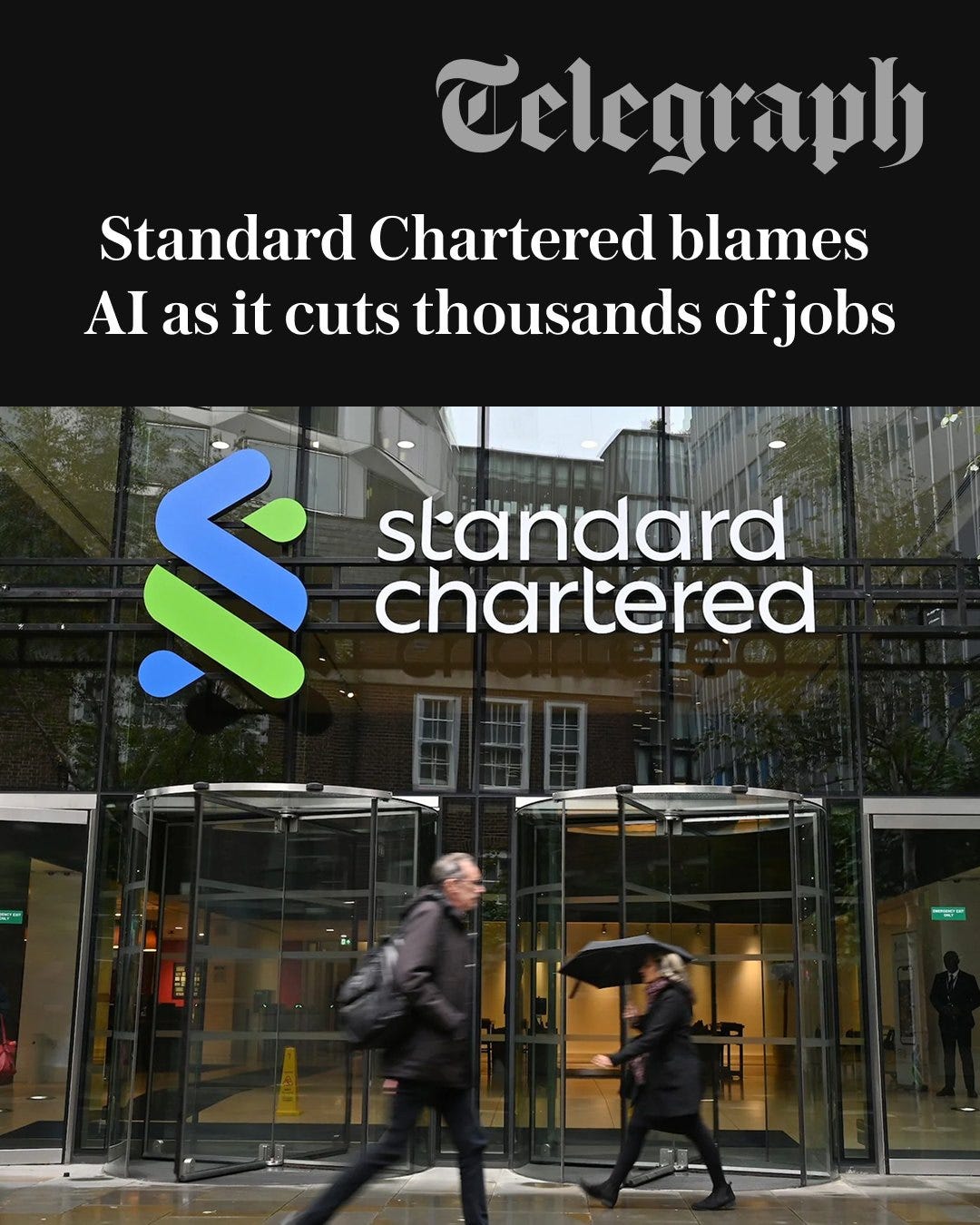
What makes this the defining cut of May is not the headcount. It is the language. Chief executive Bill Winters told reporters this was not cost-cutting but “replacing in some cases lower-value human capital” with the bank’s investment in technology and AI. Read that back slowly. A FTSE 100 chief executive described his own staff as lower-value capital to be swapped for machines, in public, on the record, as the plan.
The offshore arbitrage is over
For two decades Western banks cut costs by moving back-office work to operational hubs in Asia and Eastern Europe. On current reporting, the centres most exposed are offshore: Chennai, Bengaluru, Kuala Lumpur, Warsaw. Treat the specific list as indicative until the bank confirms it.
The pattern matters more than the postcodes. The offshore centre was the last answer to the cost question. In 2026 the answer is an agent. When the inexpensive analyst in Bengaluru is no longer inexpensive enough against software, the outsourcing engine that quietly runs global banking moves into the line of fire. This is a different phase from tech firms trimming engineers. It reaches the people hired precisely because they were cheap.
Week 21 tracker, early look
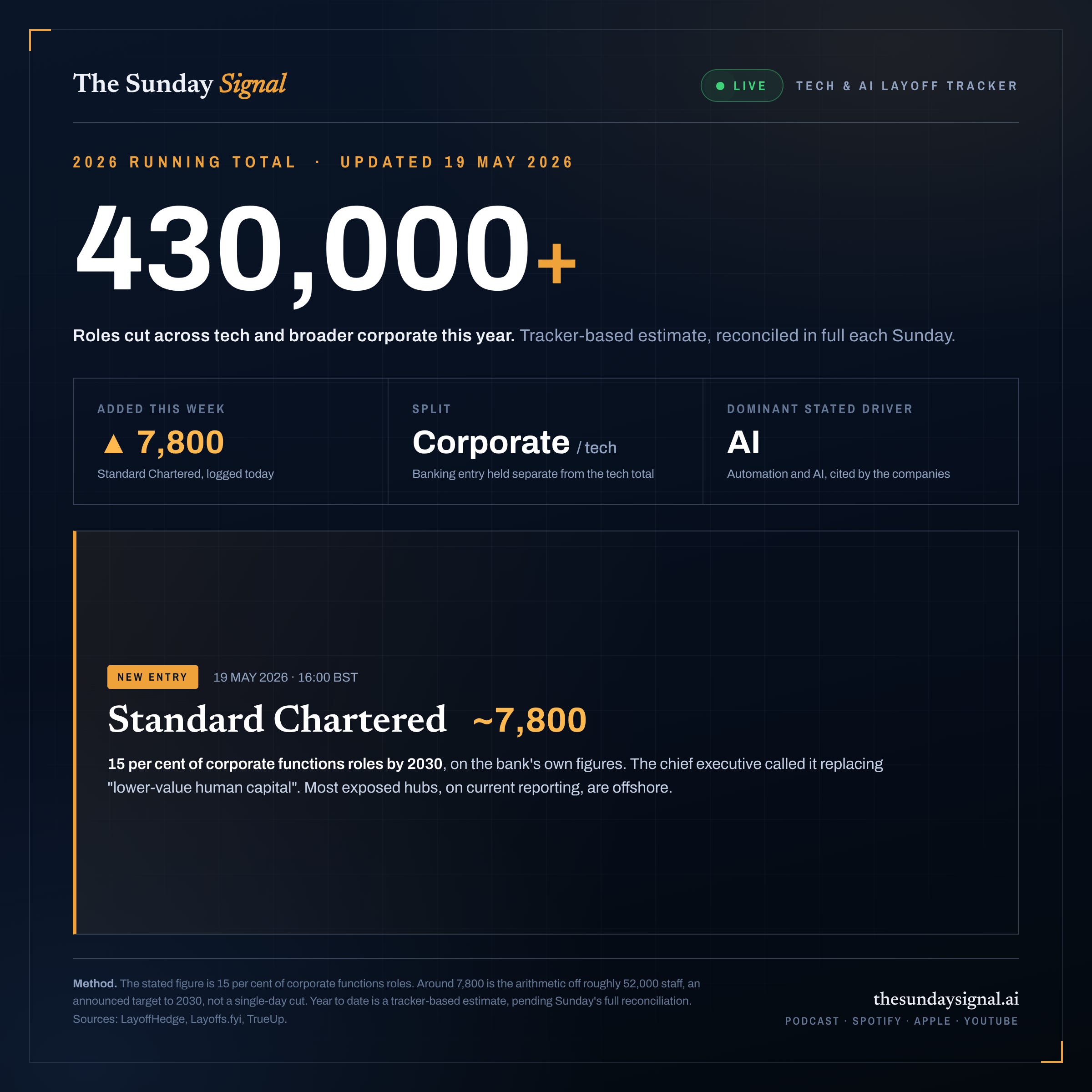
The year-to-date number is a tracker-based estimate and will be reconciled in Sunday’s full issue.
And the other half of the story
Every argument about AI’s future now ends at the same wall. The power. The standard line is that demand doubles by 2030, the grid cannot carry it, and there is nothing to do but build more of everything and burn more to run it.
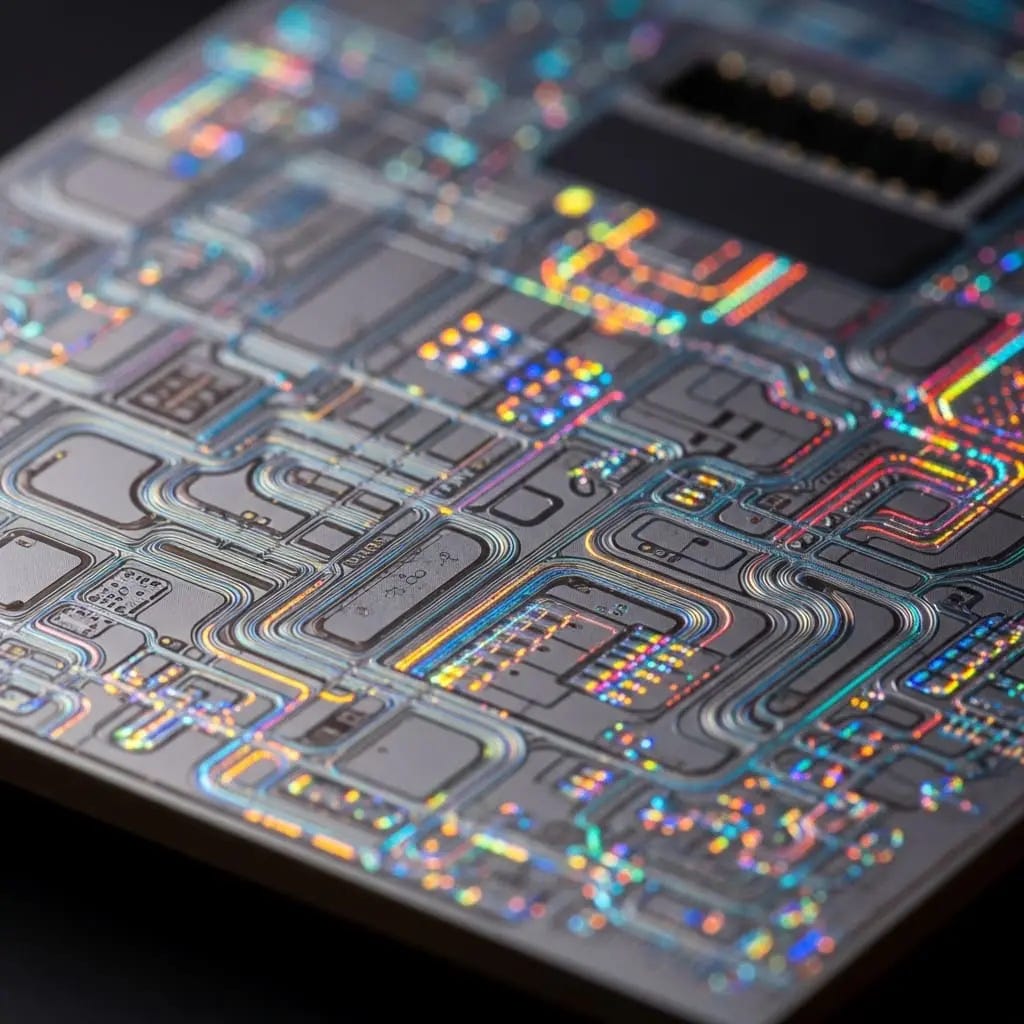
There is a company that says that wall is already breakable, and the reason is physics, not money. A chip computes by pushing electrons through silicon, and electrons throw off heat with every step. This company does the heavy mathematics of AI with light instead. Photons do not resist the way electrons do. The claim, on its own figures, is up to ninety per cent less energy than the hardware the entire industry currently depends on. It is not American. It is British, and it came out of a UK university.
I spoke with the person running it. The obvious questions are the hard ones. Are the numbers real or projected? Who is actually testing it? And the one that should bother every reader of this newsletter: Britain keeps inventing this, and America keeps owning it, so does this one stay here?
The name, the numbers and the verdict are in Sunday’s Signal.
Coming Sunday
Two stories that are really one. The bank that called its people lower-value capital, and the British company that thinks it can take the power problem off the table before America buys the answer.
More on Sunday.
The Sunday Signal. Weekly, every Sunday. Subscribe at thesundaysignal.ai.
Listen to the podcast on Spotify, Apple Podcasts or YouTube.
Until Sunday, David.
Using photon lights for AI chips is very powerful and should be applauded but what of other free energy sources that can significantly lower power requirements/consumption such as enhanced geothermal (deep drilling in Cornwall (Geoscience et al) and c40% more efficient than solar alongside mimetic solar captured from leaves on trees eg Cambridge University research for algae CO2 to O2 conversion on the River Cam. Synthetic Fuels and other scientific breakthroughs on carbon capture and even desalination plants may mean very good news for GB as we also have P2P energy blockchain coming along too. Rgds Noel