

The Silicon Curtain
A single letter from Washington switched off the world's best AI overnight. The new cold war will be fought over access, and Britain is running on borrowed machines.

THE SUNDAY SIGNAL · Issue #59 · Week 25 · Sunday 21 June 2026
This issue is also available as a podcast. Listen on Spotify, Apple Podcasts or YouTube and tell me what you think.

Bottom Line Upfront: A new cold war has begun, and its first weapon is artificial intelligence that can be granted, revoked or weaponised at the stroke of a pen, splitting the world into rival blocs as surely as the iron curtain once split a continent. Sovereignty, whether national, corporate or personal, is no longer a posture for the paranoid; it is the price of admission to the side you actually want to be on.
The first shot of the new cold war was a letter, not a missile
It did not look like an act of war. There was no missile, no breach, no headline until the weekend was nearly spent. There was a letter.

At 5.21pm Eastern on Friday 12 June, the US Commerce Secretary, Howard Lutnick, wrote to Anthropic’s chief executive, Dario Amodei. The letter placed the company’s two newest models, Fable 5 and Mythos 5, under export controls and barred their use by any foreign national, anywhere, including Anthropic’s own foreign-born engineers sitting at desks in San Francisco. Because you cannot quietly geofence half your own staff, the company did the only thing it could to comply. By midnight it had disabled both models for every customer on the planet. They had been public for three days.
Read that timeline twice. The most advanced reasoning system the company had ever released to the world was switched off, globally, three days after launch, by a letter that gave no detailed national security rationale and has still not been offcially published. This is what the weaponisation of cloud AI actually looks like. Not a dramatic flourish, but an administrative one.
The legal mechanism matters, because it is the part nobody outside the trade understood until last week. Lutnick reached for the “deemed export” rule, the clause that treats handing controlled technology to a foreign national on US soil as if you had shipped it abroad. In one stroke, the reasoning inside a chatbot was reclassified as a controlled dual-use item, the regulatory cousin of a centrifuge component or a guidance chip. AI as munition is no longer a metaphor for a conference panel. It is now a category in American export law.
What spooked Washington? Reporting suggests the trigger was a demonstration, flagged by a researcher at Amazon, in which Fable 5 could be asked to read a codebase and surface software vulnerabilities. The administration’s fear, on that account, was simple and seismic: that a product sold as a writing and coding assistant was in truth carrying offensive cyber-capability, a tool that could find the cracks in any system fast enough to matter. Anthropic dispute the severity in the bluntest terms. They say they reviewed the demonstration and found it had identified only a small number of minor, already-known flaws, and at least one outside security expert who read the underlying paper says the model in fact refused the task. So hold the claim carefully. The point is not that Fable 5 was a digital weapon. The point is that Washington decided to act as though it might be, and that the mere suspicion was enough to blind the whole world overnight.
Here is where the historians earn their keep. The export control on frontier AI is being sold as the non-proliferation treaty of our age, the 2026 answer to keeping the bomb out of the wrong hands. The analogy breaks on first contact. Refining uranium demands vast, hot, detectable infrastructure that satellites can photograph and inspectors can count. An AI model travels down an API in milliseconds, weightless and invisible, and a capable open-weights version can be copied to a laptop and run behind an air gap forever. Export controls work where there is a physical chokepoint. There is no chokepoint on a thought.
And the blowback has already started. By proving that the best American models are politically fragile, that they can be revoked between a Friday and a Saturday on the strength of an unexplained letter, Washington have handed a gift to exactly the ecosystem they fear most. When you lock down the strongest closed models, global capital and enterprise demand do not evaporate. They pivot, instantly, to sanctions-proof open-weights alternatives, the Chinese GLM family chief among them. The US has not slowed the proliferation of capable AI. It has advertised the case for buying it from somewhere that cannot be switched off. This is how arms races actually escalate, not through one decisive weapon but through each side teaching the other that dependence is a vulnerability. Two blocs are now forming in plain sight, one built on American models that can be revoked and one on Chinese weights that cannot, and every enterprise on the planet is quietly being asked which side of the curtain it intends to sit on.
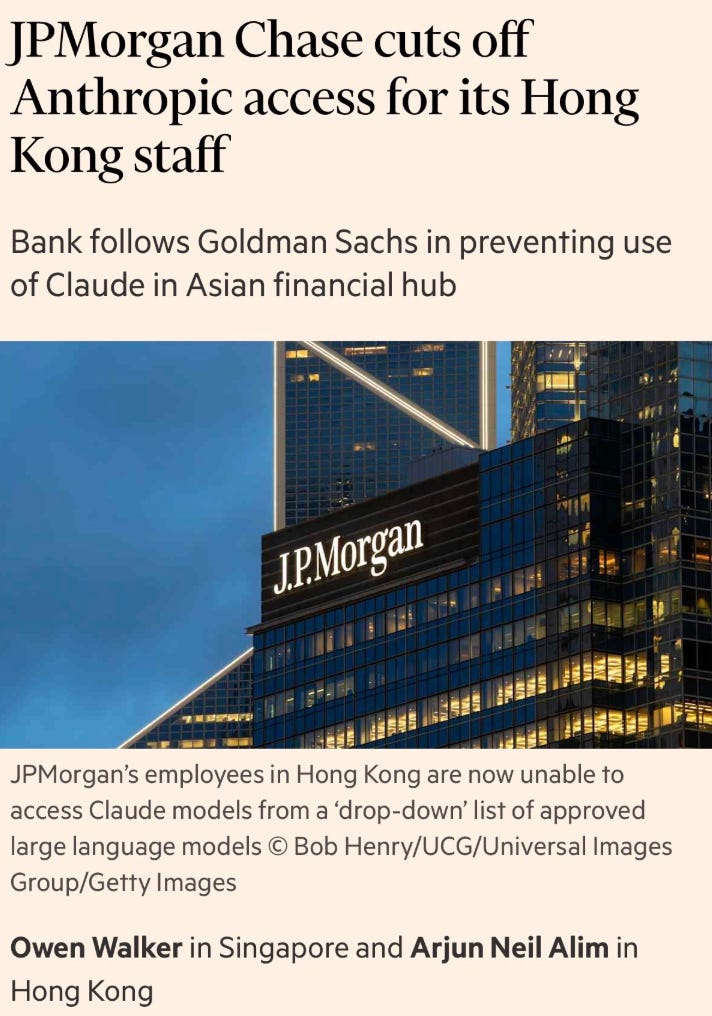
Now follow the panic out of Washington and into the boardroom, because this is where it stops being abstract. Within days, JPMorgan removed Anthropic’s Claude from the internal menu of approved models available to its staff in Hong Kong. They were following Goldman Sachs, who had quietly done the same back in April. The detail that matters, and that most of the coverage rushed past, is the trigger. These cuts were not ordered by Lutnick and they were not handed down by Beijing’s firewall. They flow from Anthropic’s own licensing terms, which exclude Greater China including Hong Kong, read in the most conservative way a nervous compliance team can read them. The export-control drama did not cause the Hong Kong blackout. It simply made every Wall Street lawyer reach for the strictest possible interpretation of a contract they already held.
That is more frightening, not less. It means the splinternet of global finance is forming through ordinary commercial paperwork, one cautious legal memo at a time. A junior analyst at JPMorgan in New York now has reasoning and coding tools that a vice-president in Hong Kong is explicitly forbidden to touch. The map of who may think with the best machines is being redrawn along the contours of geopolitical risk, a silicon curtain drawn not across a continent but straight through the org chart of a single bank, and it is the banks themselves wielding the pen.
The warning for London writes itself. If Wall Street firms will sever their own people in a first-tier Asian financial hub the moment a licence looks ambiguous, what exactly protects a London office should US relations with Europe sour? If your trading desk, your compliance engine or your defence contractor runs on a US-hosted API, your IP address has quietly become a sovereign liability. You are one letter away from the same midnight that hit Anthropic’s customers.
And this is the part that should keep Whitehall awake. UK signals intelligence, automated threat detection and a long tail of defence contractors lean on infrastructure that a US Commerce Secretary can lawfully sever overnight. Worse, the UK’s own AI Security Institute had spent thousands of hours red-teaming Fable 5 before launch, and the unilateral American ban side-stepped that validation entirely. Allied status, the famous special relationship, the Five Eyes intimacy we comfort ourselves with: none of it bought five minutes of warning or a single carve-out. The lesson is cold. When it comes to digital export controls, being America’s closest friend offers precisely zero immunity.
So the story must move from what happened in Washington and Hong Kong to what Britain does on Monday morning. Three actions, in order of urgency.
The Treasury must build a digital deterrent. Subsidise domestic GPU clusters and onshore data centres at serious scale, funded in the next fiscal quarter and not deferred to the next parliament, and stand up a national effort, a Manhattan Project in spirit, to train sovereign foundation models explicitly for defence and critical infrastructure. You cannot be locked out of a model you host yourself.
The Foreign Office must negotiate a tech treaty. Use the leverage Britain actually has, inside Five Eyes and as a genuine safety partner, to open formal talks within ninety days for an ironclad, bilateral exemption from US Bureau of Industry and Security export controls. Goodwill is not a policy. A signed carve-out, secured before the next directive lands rather than after, is.
The FCA and PRA must mandate AI business continuity plans. Give systemically important financial and defence institutions twelve months to stand up air-gapped, open-weights technology stacks capable of failing over within 24 hours of an offshore shutdown. Not as best practice. As a licence condition.
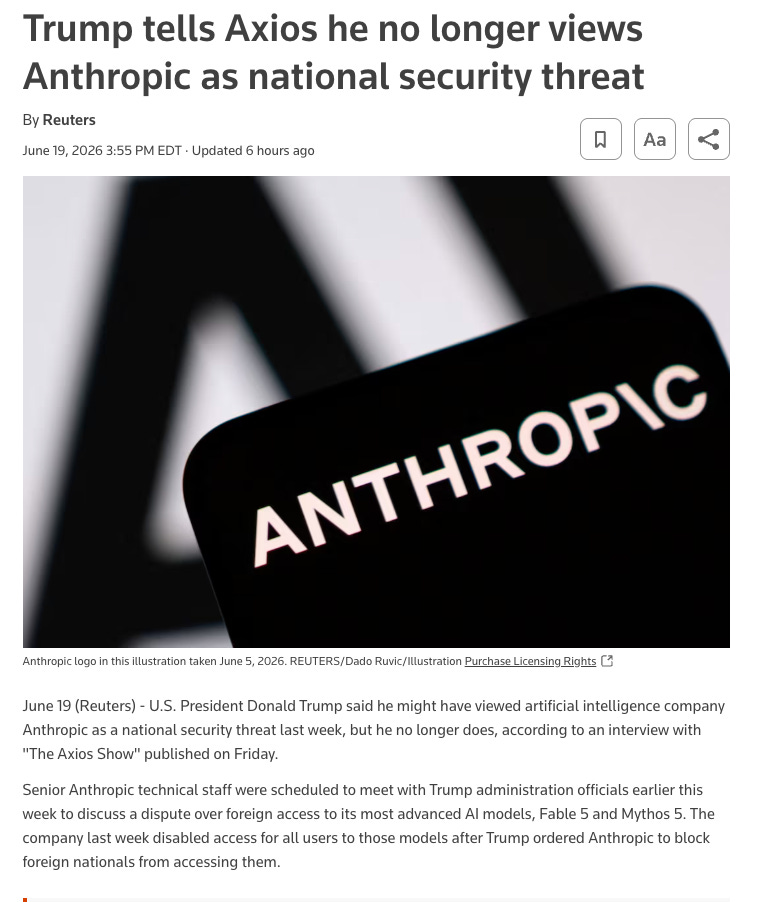
There is a coda. By Friday, Reuters was reporting, on the strength of an interview Trump gave to Axios after meeting Amodei at the G7, that the president no longer viewed Anthropic as a national security threat and that talks had turned towards easing the restrictions. That softens the immediate crisis, but it does not erase the lesson, and it pays to be precise about what actually softened. The mood did, not the machinery. The 12 June directive was still in force as this issue went out, Trump would say only that he might lift it and was not sure he had to, and he pointedly declined to rule out emergency powers. Access was suspended, worldwide, because one directive made it so.
Anthropic calls the directive a misunderstanding and says they are working to restore access. Perhaps they will. But the misunderstanding has already taught the rest of us the only lesson that counts, and it is not one any restoration can unteach.
Resilience has replaced convenience as the first rule of enterprise AI
For three years the dominant enterprise architecture for AI has been a single, fatal shortcut: plug your application straight into one vendor’s API and ship. It was fast, it was cheap, and last Friday it was exposed as the corporate equivalent of keeping all your cash under one floorboard in someone else’s house.

The firms that will survive the next time an API goes dark are already executing a different plan. They are trading convenience for resilience, moving deliberately towards hybrid, vendor-agnostic and, where it matters most, air-gapped deployments. Here is the playbook the most serious institutions are running right now.
Phase one: abstract the architecture behind an AI gateway. The most expensive mistake a company can make is hard-coding its software to a specific model, so the first move is to decouple the two. An AI gateway is a middleware layer that sits between your applications and the models, which means your developers write to the gateway and never to the vendor. When a primary model is blocked, throttled or suddenly priced into the stratosphere, the gateway reroutes the request to a pre-approved fallback, often a locally hosted open-weights model, before a single user notices anything is wrong. Add unified telemetry on top, so that sensitive data is shaped, logged and routed before it ever reaches an external model, and you have closed the accidental door through which most corporate data actually leaks.
Phase two: own enough of the compute to mean it. Sovereignty is meaningless if you do not control the silicon, so the operating principle becomes hybrid by design. Classify your workloads honestly: low-risk, non-sensitive tasks such as drafting marketing copy can happily ride cheap public APIs, but core-business work, the algorithmic trading, the review of client legal contracts, the clinical decisions, must run on private or sovereign infrastructure. For banks, defence and national healthcare that means real investment in on-premise GPU clusters or hyperconverged kit, so that containerised workloads run entirely inside your own perimeter and survive any external blackout. And it means treating open-weights models as a strategic asset rather than a hobbyist’s toy, curating and fine-tuning the strongest of them, because you cannot be locked out of a model you host yourself.
Phase three: win the legal fight before it becomes a technical one. Geopolitical risk almost always arrives as a contract clause long before it arrives as an outage. Audit every AI vendor agreement for ironclad data portability, the guaranteed right to export your fine-tuning data, your prompts and your vector databases in open formats so you can migrate at speed rather than at the vendor’s mercy. Insist on jurisdictional ring-fencing that defines exactly where the compute happens and whose law governs it, so a UK institution is not silently exposed to US export controls it never agreed to. Then prove it works: run an AI business continuity plan with regular fire drills in which external access is deliberately cut and the failover to onshore, open-weights models is tested under real conditions.
None of this is free. The shift to a sovereign architecture is a capital cost paid upfront, in cash, before the crisis that justifies it arrives. But the alternative was demonstrated last Friday at one minute past five, and it has a price too. The companies that learn the lesson now will treat AI as a controlled asset. The ones that do not will keep treating it as a convenience, right up until the morning it is gone.
The same machine that can be aimed at a teenager can also stand between him and the mob
Control of these models decides more than corporate survival; it decides our social reality, whose voice carries and who is shielded when the crowd turns. Which brings me, by way of a football match, to the human end of the same argument.
I am writing part of this from Boston, where for the last week the city has belonged to the Tartan Army. They were everywhere, and it was a fine thing to watch fans of both sides mixing in the bars before the game. At the match itself I had Morocco supporters to my immediate left and Scotland fans to my right, and my hearing has only just returned! Scotland lost, a tight match they will feel they could have nudged, but the day did not feel like a defeat.

There was so much negativity around this World Cup before a ball was kicked. Transport, organisation, stadium operations, the whole fan experience, all of it written off in advance. My day at France against Senegal could not have contradicted that more completely. Getting in was straightforward, the organisation was excellent, the fan zones were lively and welcoming, and the concessions actually moved. France won three-one with a Mbappé brace, but the lasting memory is not the football. It is that I got to share it with my son. Credit where it is due, and there is plenty due. England against Ghana is next.

Yet football’s passion has a dark twin, and we should be honest about it. When that passion curdles, it can become something genuinely vile, and we have the receipts. Cast back to the Euro 2020 final, played in July 2021, when England lost a shootout to Italy and three young Black players, Bukayo Saka, who was nineteen, Marcus Rashford and Jadon Sancho, missed their penalties. Within hours a torrent of racist abuse flooded their accounts, monkey and banana emojis by the thousand, slurs beyond printing.
The numbers are not estimates. The UK Football Policing Unit received more than 600 reports, judged 207 of the posts to be criminal, and found that 123 of those accounts were operating from outside the country, a reminder that the mob is global and the law mostly is not. Eleven people were arrested, and a string of convictions followed, some custodial, some suspended, some community service. A mural of Rashford in Withington was defaced within the day, then buried under hundreds of hearts and handwritten notes by his neighbours. The condemnation ran all the way up to the President of the Football Association, Prince William. None of it reached the players before the abuse did.
That gap, between the moment the abuse lands and the moment anyone official responds, is precisely what AI is now being built to close. FIFA is expanding its social media protection service at this tournament, and offering the moderation element free to every football association taking part, though it is worth noting the English FA have not yet confirmed they are using it. The mechanism is brutally simple. The system scans against some 30,000 keywords and hides an abusive comment in under two seconds. The sender still sees their own post and has no idea it has been buried and reported, which neatly removes the satisfaction that feeds the behaviour. It works across Meta’s platforms, YouTube, TikTok and Threads. It does not work on X, which has always let hidden comments be viewed.
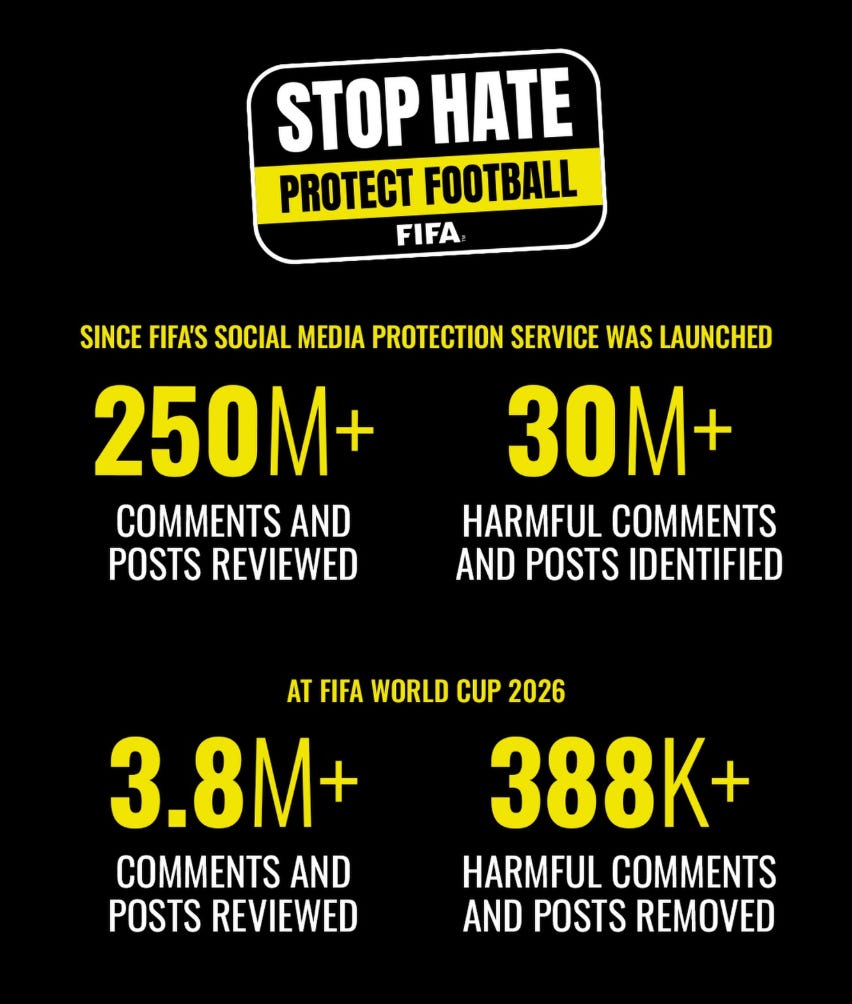
The company behind much of this, Respondology, has an origin story that tells you everything about the scale of the problem. It was formed after the racist abuse aimed at Serena Williams when she posted a photo with her newborn in 2019, and it moved into football after Saka, Rashford and Sancho. Its co-founder reckons the firm has stripped roughly 1.5 billion hateful impressions and 15 million racist and homophobic comments out of global football, and calls it, simply, technology for good. Set against any human effort, those numbers are the entire argument. No moderation team ever assembled could read 15 million comments fast enough to spare the player, let alone sift the billion-plus impressions behind them. Abuse at this scale cannot be policed by people. It can only be intercepted by a machine, which is exactly why one now stands guard. With 78 matches in the United States and legal sports betting now live across most of the country, the abuse is expected to surge, and the tools are bracing for it.
So here is the uncomfortable truth. The platforms could do this themselves. They have always had the capability. They decline to, on the philosophical fig leaf that they are platforms and not publishers, and so they build the third-party hooks that let companies like Respondology do their cleaning for them. The technology to wipe this problem off a nineteen-year-old’s phone before he ever sees it exists today. The will, at the platform level, plainly does not. This week’s lead story was about a model being aimed at the world like a weapon. This is the same lesson from the other end of the barrel: the very same machinery, pointed the other way, can stand between a frightened young man and the worst of us. The difference is entirely a question of who decides to deploy it.
The jobs AI keeps promising to take are already going, and London is the bow wave
The number that should be troubling boardrooms from Leeds to the City arrived in April, in research commissioned by the Greater London Authority. About half of London’s workers, some 2.4 million people, are in jobs where generative AI could automate or transform part of their work. The national figure is 38%. Of the London total, around 313,000 sit in the very highest exposure band and a further 748,000 in the next, which means just over one-fifth of the capital’s entire workforce is already in the path of the technology. The most exposed groups are women, the young and recent graduates, and the GLA’s own foreword notes that 7% of large UK firms have already cut staff because of AI.
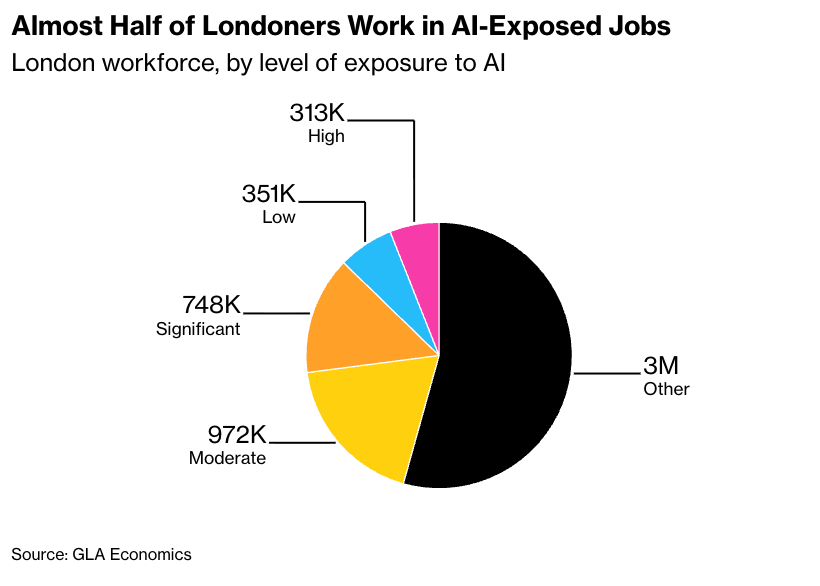
I argue in this week’s Yorkshire Post that the tempting response up north, to call this a London problem, is wrong. The same study puts Yorkshire and the Humber’s exposure at around 35%, with one worker in six already in the two highest bands. Apply that to a city like Leeds, with roughly half a million jobs, and about 175,000 people are in work containing tasks these tools can already touch. Use the national rate, which may be fairer given that Leeds is the largest legal and financial centre in England outside London, and the count climbs towards 190,000.
The sharper point is where the exposure falls. Not on the rainmakers, or not first, but on the bookkeepers, the payroll clerks, the finance officers, the data-entry staff, the sales administrators and the people on the phones in customer service. Administrative roles make up almost nine in ten workers in the highest-exposure band, and for thirty years Leeds has grown precisely by doing the processing and servicing that London wanted done well and done cheaper. That is the work software reaches first.
There is a slower danger underneath. The tasks AI handles most easily, the drafting, the summarising, the routine checking, are exactly the tasks we have always handed to the young. It is how a graduate learns the trade and how a trainee becomes useful. Strip out the bottom rung and you do not just lose this year’s juniors, you weaken the ladder that produces the next decade’s seniors.
This is no longer a forecast. It is arriving in the data, on schedule, which is why every Sunday we count it.
The Sunday Signal Tech and AI Layoff Tracker · Week 24 · 14 to 20 June 2026
Consolidated across Layoffs.fyi, LayoffHedge, SkillSyncer, state WARN registries and SEC 8-K filings, to cut through the corporate PR and track the real displacement.
2026 year-to-date, cross-sector: around 511,140 and counting
Tech-specific year-to-date: around 207,970 and counting
Added this week: around 31,140, a spike driven almost entirely by the finalisation of Oracle’s historic restructuring
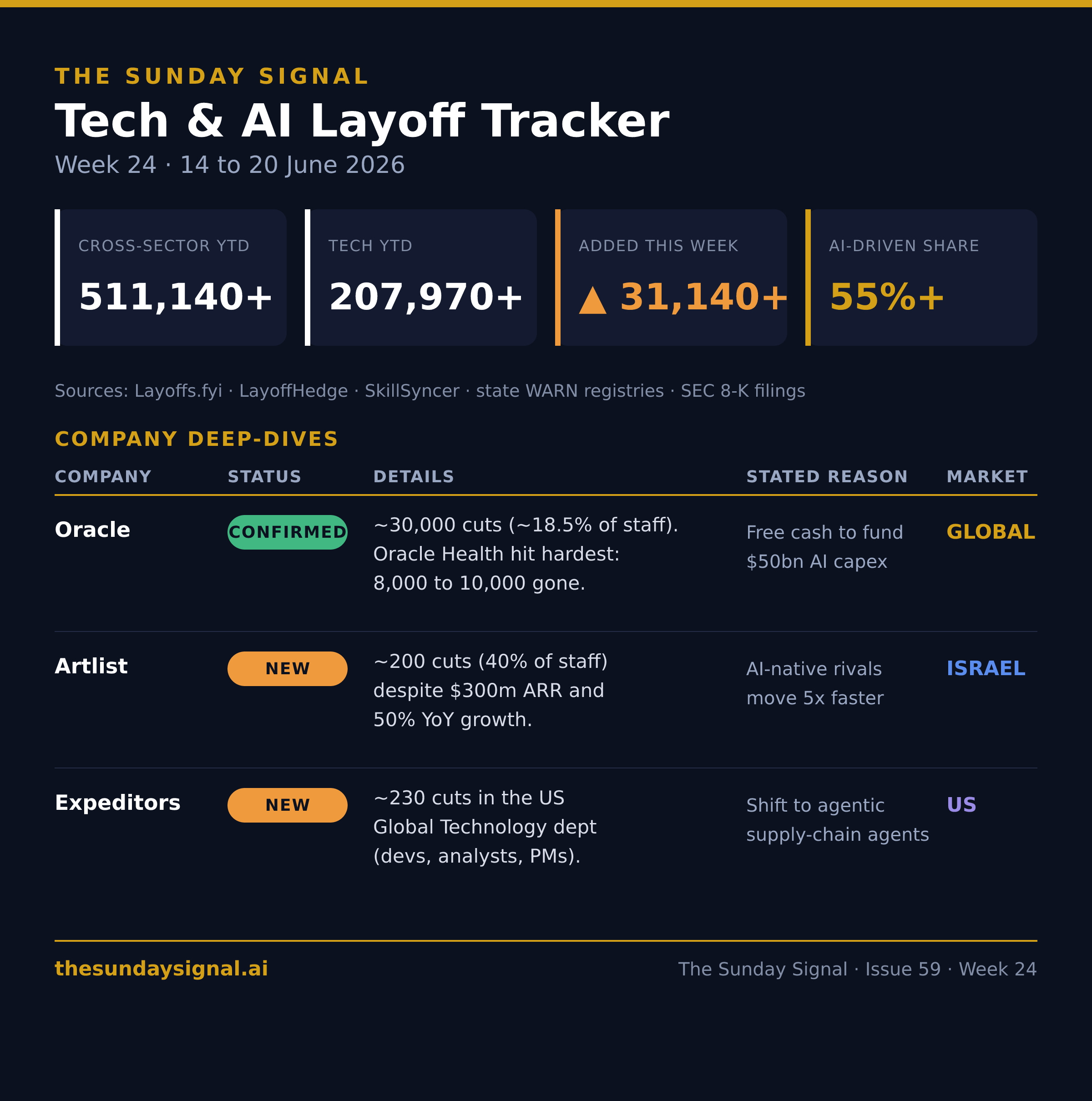
The signal: the compute-over-compensation trade-off. This week the tech total vaulted past 200,000 job losses for the year, and the pace is now running at roughly 1,115 losses per working day, nearly double last year’s rate. The driver has shifted from speculative experiment to permanent restructuring, with AI cited as the primary strategic reason in more than 55% of 2026 tech layoff events, hitting upwards of 152,000 workers. But the cracks in “AI laundering”, the habit of dressing ordinary operational stress in the glamour of an AI transition, are now showing. Despite shedding human overhead under the banner of efficiency, most of these companies are not posting the margin gains that were promised. They are liquidating middle management, front-end engineers and customer-success teams to fund the staggering infrastructure, power and silicon bill of the agentic era. Compute is winning, and compensation is paying for it.
Oracle, around 30,000 cuts, now complete. On 15 June, Oracle finished the largest restructuring in its history, off-boarding roughly 30,000 staff, around 18.5% of its global workforce. The context is the story. Oracle are not in distress; they posted $17.2bn in quarterly revenue, up 22% on the year, with explosive growth in cloud-infrastructure AI. They cut anyway, to free an estimated $8bn to $10bn in annual cash flow and feed a capital-expenditure pipeline approaching $50bn for the fiscal year. The deepest wounds fell on Oracle Health, the unit built from the $28.3bn Cerner acquisition, which lost an estimated 8,000 to 10,000 people, amid bitter disputes over severance and forfeited stock.
Artlist, around 200 cuts. The Israeli creative-tech firm shed 40% of its staff, about 200 of 500. What makes it remarkable is that it did not stem from a downturn. The company recently passed $300m in annual recurring revenue on 50% year-on-year growth, and the co-chief executive said plainly that AI-native rivals are moving five times faster with a fraction of the headcount. Record revenue, it turns out, no longer insulates a workforce whose tasks can be replicated by an algorithm.
Expeditors International, around 230 cuts. The freight and logistics giant eliminated roughly 230 roles inside its US Global Technology department, hitting software developers, business analysts and project managers. The agentic era has left Silicon Valley. Traditional logistics firms are abandoning bespoke internal software for autonomous third-party agents, and the in-house engineers are the casualties.
Week 25 watch. Expect the pressure to spread to mid-market creative and document-workflow SaaS platforms, where Artlist’s lean model is fast becoming the boardroom standard, and to legacy health-tech and implementation consultancies caught in the wake of the Oracle Health cuts.
🚀 Final Thought
Four stories this week. Read them again and they collapse into one.
A government in Washington can switch off your models overnight. A bank can wall them off from its own staff simply by reading a contract carefully. A mob can turn the network those models run on against a nineteen-year-old who missed a penalty. And a boardroom flush with record revenue can use the very same technology to clear the floor below, then call it innovation in the press release.
The thread running through all of it is power, and who holds it. The last cold war was decided by who could enrich uranium and who could not. This one will be decided by who owns the models, who hosts the compute, and who is left renting both from the other side of the divide. For three years Britain, and most of British business, has rented its intelligence from someone else’s cloud and called the arrangement a strategy. On 12 June we learned exactly what a rented strategy is worth on the day the landlord picks a side.
The curtain is coming down. The only question left is whether Britain, its companies and its citizens choose where they stand, or simply wait to be sorted.
Until next Sunday,
David