


THE SUNDAY SIGNAL · Issue #68 · Week 34 · Sunday 23 August 2026
This issue is also available as a podcast. Listen on Spotify, Apple Podcasts or YouTube and tell me what you think.
BOTTOM LINE UPFRONT: The scarce thing has changed, and almost everyone is still counting the old one. Amazon plans roughly $220bn of cash capital expenditure this year and still says it cannot meet all the demand in front of it in 2026. Most of the capacity being added for 2027 is already reserved, with substantial reservations extending into 2028. Britain has the same constraint one layer down. Data centres now account for at least 80GW of proposed demand in the grid connection queue, while connected data-centre capacity today is roughly 2.4GW. China has built energy infrastructure at extraordinary speed but is selectively reopening access to American chips, a sign that domestic silicon still cannot carry every advanced workload. The conclusion is not that every company should buy a GPU server. It is that access to compute, power and the grid has become a balance-sheet risk. Firms must decide which workloads are predictable enough to own, which need reserved capacity, and which still belong on frontier APIs. Own the predictable. Rent the exceptional.

Amazon Web Services cannot build fast enough, and the reason matters more than the fact
Picture a letter from your electricity supplier. The meter still works, it says, but there is not enough power to sell you everything you have asked for this year. Nor next year. The list for 2028 is filling. You would not call that a growth story. You would call it a shortage. Amazon Web Services described exactly that on 30 July, and the market called it a triumph.
Andy Jassy told shareholders that AWS cannot build enough capacity to meet all the demand in front of it in 2026. He expects the constraint to persist through 2027, with most of the capacity being added for that year already reserved, and said substantial reservations extend into 2028, describing that advance demand in a single word: “striking”.
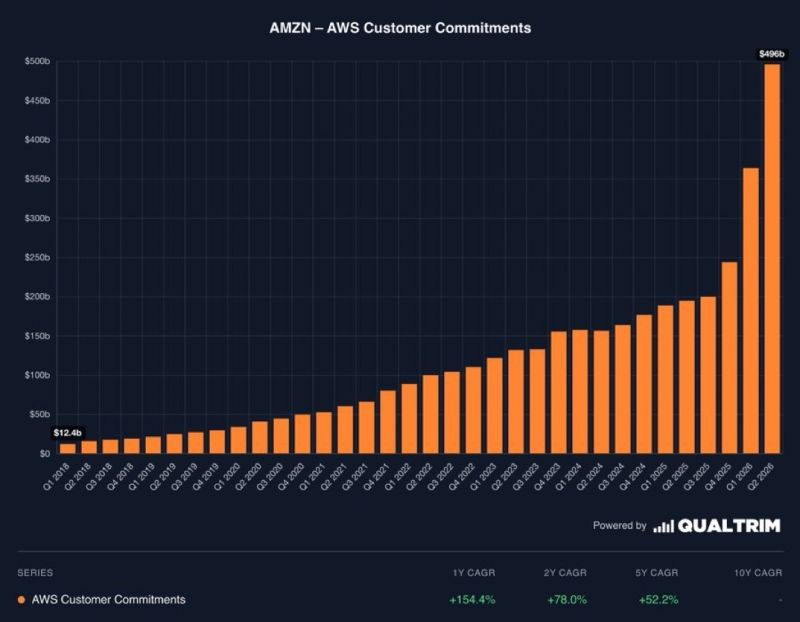
A note on whose numbers these are, because the coverage has blurred them and the distinction changes the argument. Amazon the group reported revenue of $200.6bn for the quarter, up 20%, with operating income of $27.5bn, up 43%. AWS is one segment inside that: revenue of $42.2bn, up 36.7%, and operating income of $16.6bn. So the cloud division supplies roughly a fifth of Amazon’s revenue and about three-fifths of its operating profit. That ratio explains why AWS sits at the centre of Amazon’s capital allocation. The shortage is the division’s. The chequebook is the group’s.
The segment numbers are strong on their own terms. That 36.7% is the fifth consecutive quarter of acceleration and the fastest rate in eighteen quarters, back when AWS was less than half its present size. The backlog stands at $496bn, growing at triple digits. The chips business and the AI business have each passed $25bn in annual run rate.
Three things in the popular telling need correcting.
The first is the capital figure. The rise from about $200bn to about $220bn is being read purely as a demand signal. It is partly a price signal. Jassy attributed the increase to higher memory costs. At least part of that increase reflects component inflation rather than additional capacity. Some of the extra money simply pays the higher price of memory, and that same squeeze is about to reach your own hardware quotes.
The second is the shape of the demand. The two named multi-year, multi-gigawatt commitments to AWS’s Trainium chips come from Anthropic and OpenAI. Anthropic is simultaneously one of Amazon’s most important AI customers and the source of most of the investment gain behind the group’s quarterly net income of $62.6bn, which included $53.4bn of non-operating pre-tax income primarily from those investments. That does not invalidate the demand, which is real and contracted. But it means the customer commitment, the cloud revenue and the investment return should not be treated as three wholly independent signals.
The third is the on-premises statistic being passed around as neutral evidence. Jassy says 85% of global IT spending remains on premises, and his conclusion is that cloud migration has another ten to twenty years to run. That is the view of a company that sells cloud migration. It is worth knowing and worth discounting accordingly.
What matters more than the backlog is the margin. That $16.6bn of segment operating income on $42.2bn of revenue is a margin near 39%, up 650 basis points year-on-year, or 520 stripping out an accounting gain on energy contracts. AWS accelerated growth and expanded margins while the group committed roughly $220bn to cash capital expenditure this year. Booking demand is easier than serving it profitably while building the factory.
Britain queued, China built, and both are short at a different layer
Bring it home, because this is where the story stops being about American capital allocation.
The scale of Britain’s problem has moved faster than the reporting. In February, the connection queue held around 140 data-centre projects seeking roughly 50GW. Ofgem’s July consultation said contracted demand offers had increased from 41GW in November 2024 to 125GW by June 2025, largely driven by data centres, which now account for at least 80GW. Within the transmission queue, Ofgem identified 315 data-centre projects requesting around 73GW. Great Britain’s peak electricity demand, recorded on 11 February this year, was 45GW. Connected data-centre capacity stands at roughly 2.4GW.
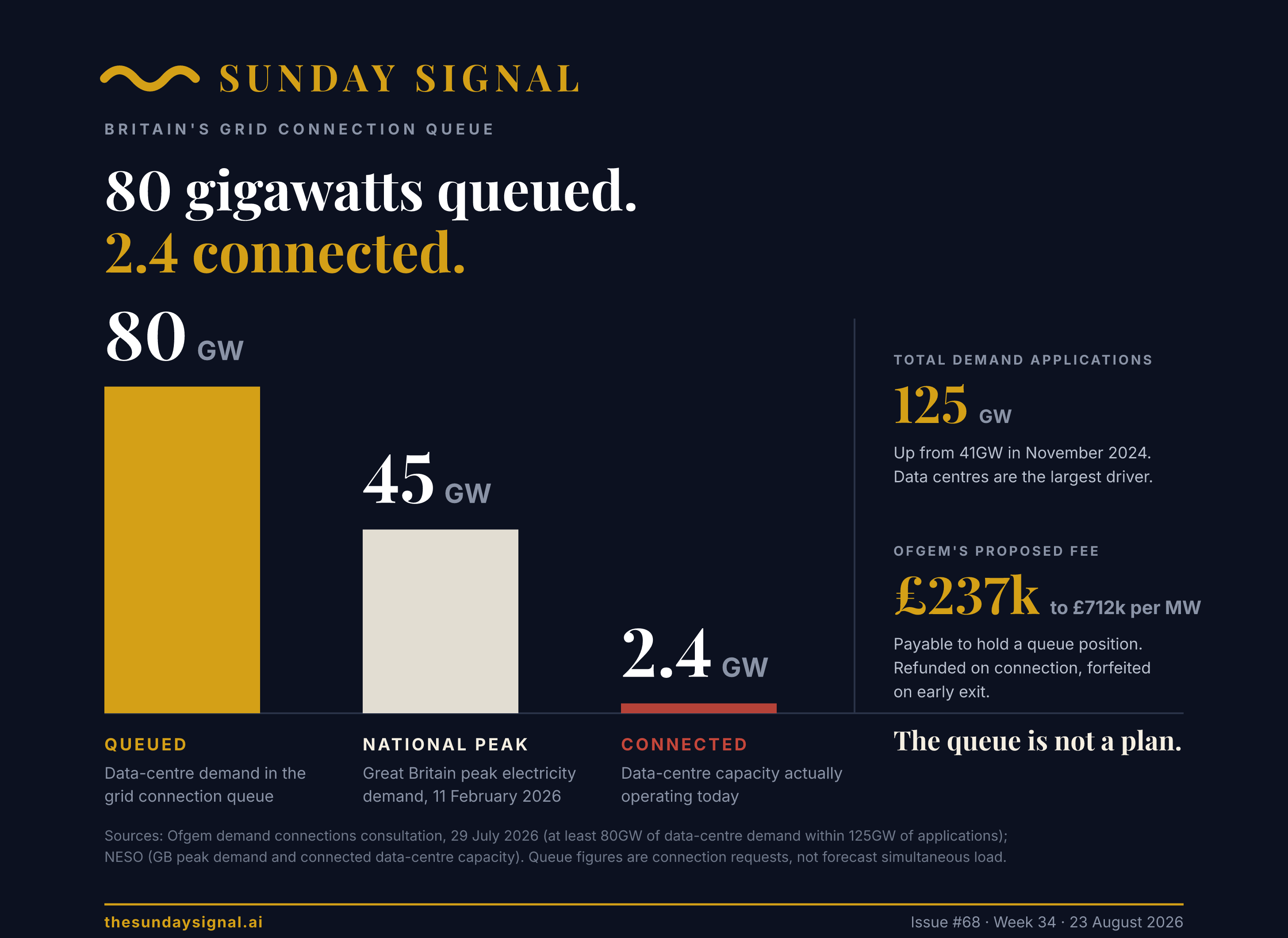
Those are not directly comparable figures, and I am not going to pretend otherwise. Requested future load and operational installed capacity measure different things on different timescales. But the direction is unmistakable. The contracted demand queue more than tripled between November 2024 and June 2025, and the connection requests from one industry now exceed everything the country draws at its winter peak.
The system cannot tell quickly enough which of those projects is real. Of the earlier cohort, 71 projects representing about 20GW had reported a final investment decision. The remainder had not, which does not mean they lack financing, land or intent, but does leave the operator unable to separate viable developments from projects preserving an option they may never exercise.
Ofgem is not sitting still, and the fair version of this criticism has to say so. The regulator is consulting on a Data Centre Commitment Fee of £237,500 to £712,500 per megawatt, equivalent to roughly 2.5% to 7.5% of average project costs, refunded on energisation and forfeited on early exit, alongside milestones requiring evidence of financial capability and commercial progress. Earlier reforms on the generation side brought forward 7.8GW of connections by an average of six years. This is not administrative inactivity. But it remains telling that Britain is reforming the allocation of scarcity faster than it is building supply.
The market has noticed. In April, OpenAI paused Stargate UK, announced during the Trump state visit with Nvidia and Nscale for sites including Cobalt Park in the North East AI Growth Zone, citing energy costs and the regulatory environment. Large-scale Norwegian capacity continued under a different commercial structure. Hydroelectric power was not the only difference between the two, but it was an important one. Britain entered this race with the highest industrial electricity prices among the twenty-four IEA countries reporting in 2023, four times those of the United States and Canada.
Nor are we placed to lecture anyone on building. Hinkley Point C was approved in 2016 at an estimated cost of about £18bn, with generation expected from 2025. The current estimate is around £35bn in 2015 prices, nearly £49bn in current money, with first power targeted for June 2030. Nuclear-safety concrete was first poured in 2017. If 2030 holds, first power arrives roughly thirteen years after construction began.
Set that beside China. It added more than 430GW of wind and solar last year, taking cumulative wind and solar capacity to 1.84TW, or 47.3% of installed capacity, though those sources delivered 22% of actual generation. It operates 60 reactors and has 36 more under construction, representing more than 49% of nuclear construction worldwide. Between 2012 and 2021, Chinese reactors took an average of six years to build, against about nine globally.
The picture is less one-sided than the capacity figures suggest. Nuclear still supplies less than 5% of Chinese electricity. An analysis published by ASPI’s The Strategist argues that the Eastern Data, Western Computing programme has produced inter-governmental competition, speculative overbuilding and fragmented infrastructure. Beijing reportedly subsidised electricity costs by up to half for some data centres using domestic chips, which suggests the state was having to manufacture demand or offset weaker economics, though it does not by itself prove those centres were idle.
Then this month. After months of restricting foreign chips and pressing its technology companies towards domestic alternatives, Beijing has selectively reopened access to limited quantities of H200s. The Financial Times reports that ByteDance and Tencent have each received around ten thousand, a claim Reuters has relayed without independently verifying. Blackwell remains restricted.
So the map is not the one usually drawn. Western markets have the leading chips but are increasingly constrained by power and construction. China has built energy infrastructure at extraordinary speed but has not removed its dependence on advanced foreign silicon. Both have abundance in one part of the stack and scarcity in another.
When renting stops being automatic, the ownership maths changes
For fifteen years the logic of enterprise computing ran one way. Do not own the machine. Rent it, because somebody with more capital and better economies of scale will always own it more cheaply than you can. That argument was correct, and it built the largest businesses in the world.
It has not become wrong. It has stopped being automatic. Renting still makes sense for most workloads most of the time, and the realistic answer for almost every business is a mix of frontier APIs, reserved cloud capacity, private cloud, colocation and, for some workloads, owned hardware. What has changed is that the decision now has to be made rather than assumed, against a supplier who has said plainly that capacity is constrained.
We are testing this at Yorkshire AI Labs and sharing the modelling across our portfolio, because the companies we back are reaching the same question at the same moment. The numbers are now close enough to justify modelling ownership seriously. They are not close enough to justify announcing a conclusion before the model is built.
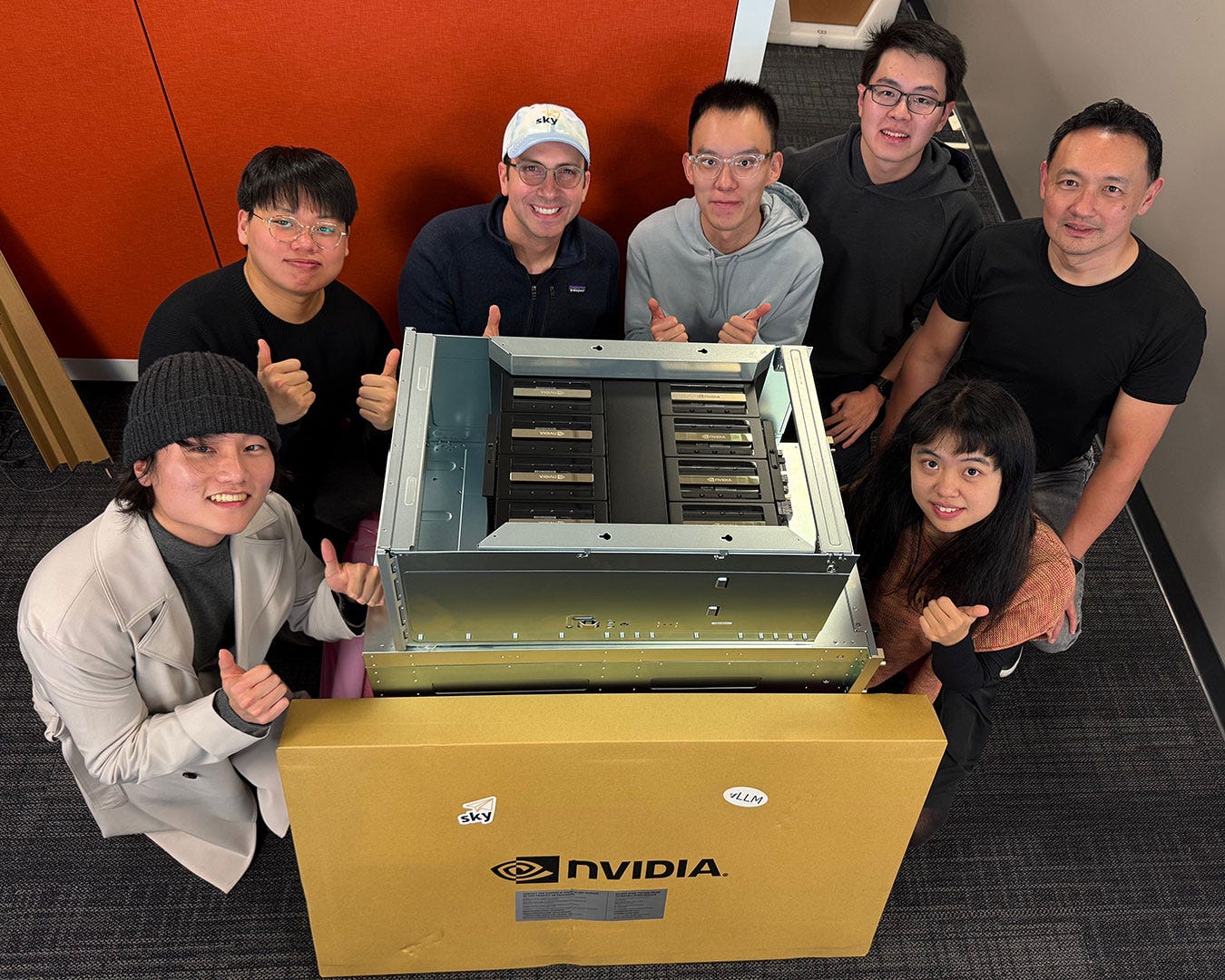
Start with the hardware, and its most striking feature is how opaque the pricing is. Public market estimates place Nvidia’s DGX B200, an integrated eight-GPU Blackwell system, between roughly $280,000 and $515,000. Comparable estimates put the DGX B300 at about $300,000 to $350,000, and the DGX Station between about $80,000 and $125,000. None of those are official list prices. DGX Spark, a compact Grace Blackwell development machine with 128GB of unified memory, launched at $3,999 last October and reached $4,699 by February, a rise Nvidia attributed to global memory prices. That is the same squeeze that pushed Amazon’s capital guidance up by twenty billion dollars, arriving at the other end of the market as a 17.5% increase on a desktop.
Those quotations vary enormously, partly because configuration, support, storage, networking, territory, tax and delivery terms differ, and partly because delivery itself now carries a premium. The same applies to rental: B200 capacity is advertised between roughly $3.35 and $16.11 per GPU-hour, although the commitment, service, location and availability differ materially between providers. Price discovery is poor enough that no board should approve a purchase from a headline system price alone.
The software is a separate line, and it is the one most business cases miss. Nvidia AI Enterprise lists at $4,500 per GPU for one year, $13,500 for three, or $22,500 per GPU for a perpetual licence with five years of support. On an eight-GPU system that is $36,000 a year at list. Nvidia states that AI Enterprise licences must be purchased separately for Blackwell DGX systems, so while a reseller may fold them into a commercial package, the quotation has to say so explicitly. Do not confuse that licence with the hardware support entitlement, which Nvidia lists as three years of Enterprise Business Standard support on the DGX B200.
One line in that price list matters to anyone backing startups. Qualifying members of Nvidia’s Inception programme, and eligible education and research institutions, pay $1,125 per GPU per year rather than $4,500, a 75% reduction, subject to a cap on how many discounted subscriptions can be bought in a twelve-month period. Every eligible portfolio company should check its status before buying anything.
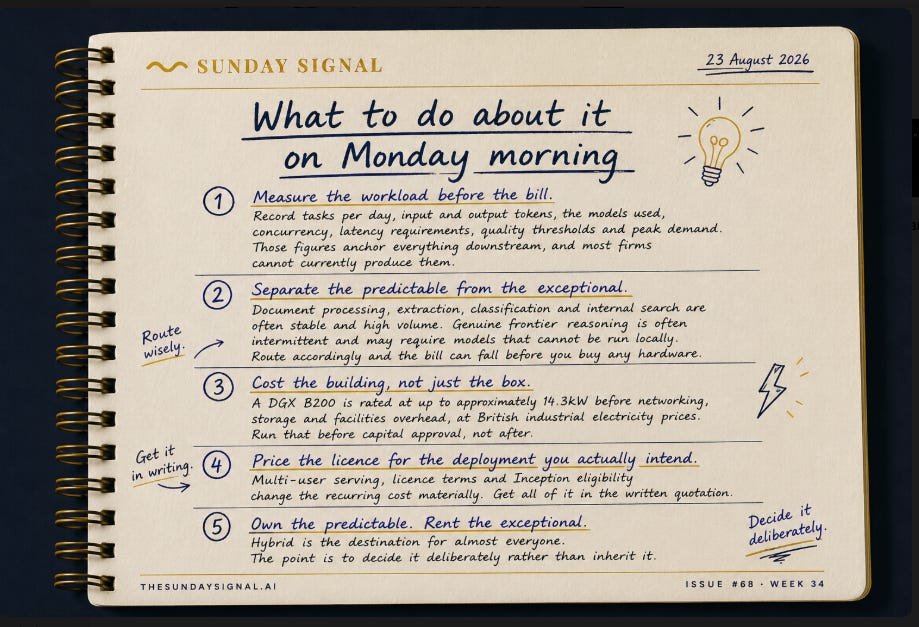
Then the building. A complete eight-GPU DGX B200 is rated at approximately 14.3kW maximum. It is air-cooled, which is not the same as being office equipment. It requires serious electrical provision, heat removal, networking and resilience, paid for at British industrial electricity prices. Owning your compute does not exempt you from the power problem. It relocates it to your building, where you control more of the operating timetable.
On the economics, resist anyone offering you a single crossover number, including me. Owned infrastructure can become cheaper once a stable workload keeps it sufficiently busy, but there is no universal token count at which that happens. The answer depends on the model, the quality threshold you will accept, the balance of input and output tokens, batching, idle time, latency, redundancy, facilities, staffing, financing and residual value. Deloitte’s modelling found potential savings above 50% over three years in some scenarios, while also finding that roughly half the owned cost can sit outside the GPUs. And the metric is not really cost per million tokens. It is cost per successfully completed task at the quality, latency and reliability the business requires, which is harder to produce and the only figure worth having.
The direction of travel is clearer than the arithmetic. Broadcom’s vendor-sponsored survey of 1,800 senior IT decision-makers at organisations with at least a thousand employees suggests production inference is shifting towards private cloud: 56% were running or planning such workloads there, while reported public cloud use for the same category fell from 56% to 41%. Private cloud can be hosted or managed by somebody else, so this is a change in direction rather than a completed migration onto owned racks.
Two operational cautions before anybody signs.
DGX Spark is a compact development system, not resilient production infrastructure. Buy it for local development and evaluation, not as the sole machine serving customers. There is also a software boundary worth reading first: some Nvidia inference microservices are free on qualifying workstation systems but fall outside those free terms when used to serve multiple users. That restriction does not cover every local inference stack, so the precise software architecture matters, and the intended deployment should be checked directly with Nvidia or the reseller rather than assumed.
The second is the part I think is most underexplored, and it is the reason we are looking at this at portfolio level rather than company by company. Utilisation is one of the variables most likely to decide the answer, and pooling can change it substantially. One machine serving eight companies is a different financial object from eight companies each renting badly. A portfolio, a university partnership or a cluster of firms on one industrial estate can reach a level of use that none of them reaches alone.
It also creates an operating company in miniature. Somebody has to provide tenant isolation, scheduling, security, data governance, software licensing, maintenance, chargeback and service levels. That is a real business with real staff and real liability. Any group considering this should cost the operation, not just the box.
What to do about it on Monday morning
The way out of a power shortage is needing less of it
Everything above is a supply-side answer. Build more. Buy your own. Reserve earlier. All of it is slow and capital-hungry.
There is a second answer, and it is British.

In May I wrote about Lumai, spun out of the University of Oxford in 2021, after meeting the team at a Royal Academy of Engineering Enterprise Hub demo day. Lumai uses an optical tensor engine to perform some of the core matrix operations in AI with photons rather than conventional electronic computation. Lumai says its optical engine works in three-dimensional volume, allowing many operations to happen simultaneously rather than moving through the two-dimensional layout of a conventional chip.
In April the company launched Iris Nova, which it describes as the first optical computing system to run billion-parameter language models in real time. Lumai says it runs Llama 8B and 70B through a hybrid design, conventional digital processing for control and software alongside the optical engine for the mathematics, and that it is designed to integrate with conventional data-centre infrastructure rather than requiring a facility to be rebuilt around it. It is available for evaluation, and ARIA has partnered with the company.
The headline claim is up to 90% lower energy consumption than conventional GPU architecture. That is a company claim, not an independent benchmark, and it should be read as such. But hold its shape against everything above. Amazon plans roughly $220bn of cash capital expenditure and AWS still cannot meet all the demand in front of it. Britain has at least 80GW of proposed data-centre demand waiting in the connections queue. A DGX B200 is rated at approximately 14.3kW maximum. If the same arithmetic could be done for a fraction of the power, several constraints in this issue loosen at once, without pouring a cubic metre of concrete.
Two honest caveats. The first is the Jevons paradox: efficiency gains often stimulate enough additional demand to consume much of the saving. Optical compute is unlikely to end the power problem. It would change who can afford to be in the game, which is different and still valuable.
The second is closer to the bone. Britain has form for inventing the future and watching it leave. Our best deep-tech companies reach the point of needing serious capital and find that the serious capital speaks with an American accent. Lumai is exactly the kind of asset that cannot be spoken into existence, which is precisely why it could become an acquisition target before Britain has captured the full value.
Where AI will actually live, and what that does to your balance sheet
My Yorkshire Post column this week asks where artificial intelligence will eventually reside. The answer is everywhere, because it will become the layer through which we use every machine. The operating system stops being a toolbox and becomes a toolmaker.

To see what that does to economics, consider the handsaw. For two centuries a good saw was a serious purchase, and Sheffield made many of the finest. When the teeth dulled, the saw went to a sharpener, or in the works the saw doctor, who jointed them, reset them and filed each one back to an edge. The trade existed for one reason. Maintaining the tool cost less than replacing it. Then came the hardpoint saw, its teeth hardened by induction so they held an edge far longer and no ordinary file would bite. Once a new saw cost less than the skilled hour needed to restore an old one, routine sharpening lost its market.
Software is approaching the same line. Every application you own is a sharpenable saw, kept alive by people replacing obsolete libraries and making yesterday’s code work on tomorrow’s platform. Coding agents are dismantling that bargain, because the cost of producing bespoke software is falling towards the cost of describing it. Plenty survives: banks, games, social networks, anything welded to proprietary data, machinery or hard-won distribution. But a company whose only defence is that its code was hard to write has little defence once the code can be generated.
Set that beside everything above, because it is the same argument. Value is draining out of whatever can be produced on demand and pooling in whatever cannot. Nobody speaks a gigawatt, a grid connection, a proprietary data set or eight Blackwell chips in a rack into existence. The durable assets are physical, contractual and slow, which is exactly the category Britain has spent forty years treating as somebody else’s problem.
Cheap saws did not stop anyone cutting wood. AI will not kill software. It will kill the assumption that all software must be packaged and maintained as a product. And the question for every business is what it controls that could not be spoken into existence before lunch.
The Signal Tech & AI Layoff Tracker
Coverage window: 15 to 21 August 2026. Figures as at Friday 21 August. Sources: Layoffs.fyi, SEC filings, state WARN registries.
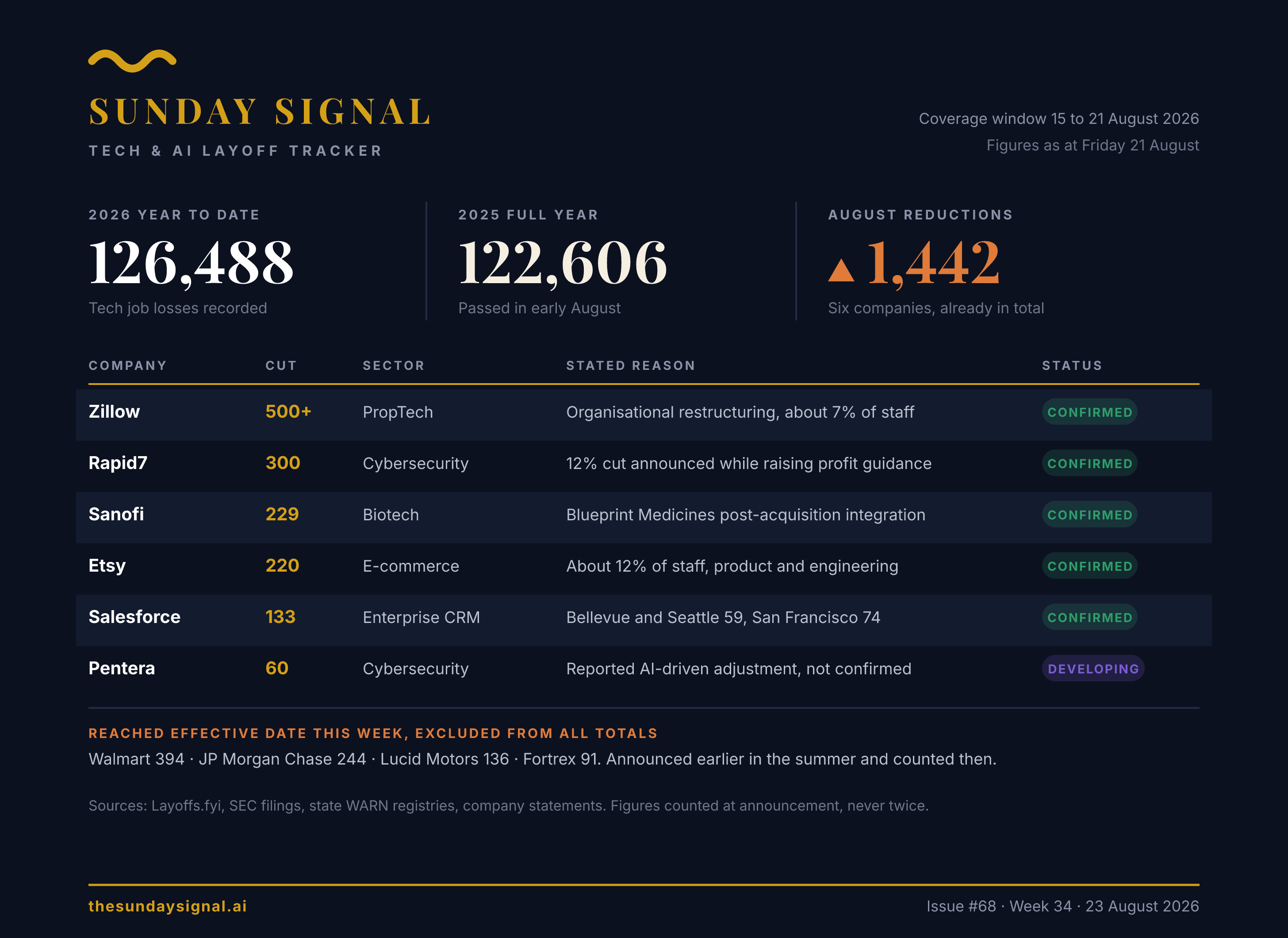
A separate group reached its legal effective date this week: 394 e-commerce and technology roles at Walmart in California, 244 finance roles at JP Morgan Chase in Texas, 136 at Lucid Motors in California, and 91 at Fortrex. Those workers came off payroll this week, but the cuts were announced earlier in the summer and counted then. They are listed here and excluded from every total, because counting a job when it is announced and again when it ends is how trackers inflate.
The trade nobody is naming honestly
The pattern is not the one the headlines describe. These are not failing companies. Etsy cut about 12% of its workforce in the same quarter its income from continuing operations rose to $114.3m from $45.6m, and the cuts landed on the product and engineering teams that had just delivered the result. Rapid7 cut 12% while raising its profit outlook. Cisco eliminated close to 4,000 roles in a quarter of record revenue. Cloudflare cut around 1,100 people, roughly a fifth of its staff, in the same week it reported 34% annual revenue growth.
Microsoft is the cleanest illustration, and it belongs in the analysis rather than the weekly table, because the cut was announced on 6 July. It eliminated 4,800 roles, 2.1% of its workforce, with the Xbox division hardest hit at 1,600 immediately and around 3,200 across the financial year. In the same period it projected roughly $190bn of infrastructure and data centre spending for 2026, against Big Tech AI outlays reported as likely to top $700bn this year.
Then follow the money one step further than anyone else has. A surge in memory prices, driven by data centre demand, forced Microsoft to raise Xbox console prices by $100 to $150 worldwide. That is the same squeeze that pushed Amazon’s capital guidance up by twenty billion dollars and put 17.5% on the price of a desktop development machine. Hyperscaler capital expenditure, an enterprise hardware quote and a games console on a shop shelf, all moved by one component shortage in one quarter. If you want a single fact that explains why compute has stopped behaving like a utility, it is that one.
Two chief executives have now declined the automation excuse, and the difference between their refusals matters. Etsy’s Kruti Patel Goyal told staff the decisions “weren’t driven by AI” at all, attributing them to an organisational design the company already knew needed changing. Microsoft’s chief people officer Amy Coleman was narrower, writing that the eliminated roles are not being replaced by AI while accepting that AI is changing how work gets done. Etsy rejected the cause. Microsoft rejected the mechanism and accepted the cause. That is not one pattern yet. It is a formula being drafted in public, and it is worth watching which version becomes standard, because the honest answer in most of these cases is neither. The money is moving from payroll to concrete.
Set that beside the top of this issue. Amazon plans to spend roughly $220bn this year on capacity it cannot build fast enough. The companies queuing to rent that capacity are, in the same quarter, cutting staff from profitable businesses. Record capital is going into compute while the headcount that compute was meant to augment comes out. Whatever that is, it is not yet a productivity story. It is a substitution story wearing a productivity story’s clothes.
Final Thought 🚀
For fifteen years we were told to stop owning things. Do not own the servers, do not own the software, do not own the building. Rent it all from somebody with better economies of scale and put the capital into growth instead. It was good advice and it made fortunes.
That advice has not been repealed. It has been qualified, and Amazon read out the qualification on 30 July. When the landlord cannot house every tenant who wants a room, tenancy stops being a decision you can leave unmade.
Britain’s answer is a queue. China’s is to selectively reopen access to the American chips it spent months restricting. Amazon’s is to commit roughly two hundred and twenty billion dollars of cash capital expenditure, much of it to the infrastructure beneath AI and cloud.
The firms selling the rented future are spending record sums to own what sits beneath it.
So here is the question I would put to any board in this country. When compute is constrained, what does your business control that a supplier cannot ration away? A machine in your own building. Guaranteed capacity. A proprietary data set. A grid connection with your name on it. A customer relationship no competitor can rent.
If the honest answer is nothing, your strategy depends on somebody else’s queue.
Until next Sunday, David