

The Machine Was Never the Asset
A Beijing lab has just repriced access to near-frontier intelligence. The pressure is building beneath nearly $2 tn of American AI valuation. Britain should be the winner. Britain has been here before

THE SUNDAY SIGNAL · Issue #66 · Week 32 · Sunday 9 August 2026
This issue is also available as a podcast. Listen on Spotify, Apple Podcasts or YouTube and tell me what you think.
BOTTOM LINE UPFRONT: Washington's wager was that restricting China's access to advanced silicon would preserve America's lead in intelligence. Nearly four years on, the controls have constrained Chinese compute but not preserved the scarcity of frontier capability. Facing tighter and less predictable access to the newest hardware, laboratories such as Moonshot made efficiency an urgent engineering objective. The result is near-frontier performance at posted API prices below the leading American flagship models, including on high-value coding work. That is not a Chinese problem. It is a pricing problem, and pricing sits beneath nearly $2 trillion of American AI valuation. Britain has no independent frontier-model company at that scale, but it buys a great deal of intelligence and builds a great deal on top of it, so falling model prices should be a windfall. We have Europe's largest AI ecosystem by company value and the world's third-largest AI talent pool. We also have a 200-year habit of inventing the thing and letting somebody else own it. That is this week's real question. Beijing cannot answer it for us.
Scarcity Made Efficiency Non-Negotiable
On 16 July, a Beijing lab most British executives had never heard of released an open-weight model that joined the leading proprietary systems. Eleven days later it published the weights.
Moonshot AI’s Kimi K3 has 2.8 trillion parameters, making it the largest open-weight model yet released, and a one-million-token context window. At launch, Arena ranked it first in its blind front-end coding evaluation, while Vals AI placed it second overall behind Claude Fable 5 and ahead of GPT-5.6 Sol. In one three-task coding comparison by The New Stack, K3 matched Fable 5 at roughly a third of the cost but took about four times as long.
The weights came out under a custom commercial licence rather than an unrestricted MIT release. Companies can download, modify and deploy the model, but model-as-a-service businesses above $20 million of aggregate revenue over twelve months need a separate agreement with Moonshot, and very large products face branding conditions. The pricing is aggressive on the API too: $3 per million uncached input tokens, $15 per million output tokens and $0.30 on a cache hit. Against published standard prices, that is 70% below Fable 5 and, against GPT-5.6 Sol, 40% cheaper on input and 50% cheaper on output. Self-hosting is a different matter. Moonshot recommends at least 64 accelerators for a serious deployment, so open weights do not translate into cheap or simple hosting for the average enterprise.
The wider price war is already visible. On 30 July, OpenAI cut Luna’s API price by 80% and Terra’s by 20%, while leaving flagship Sol unchanged. OpenAI did not connect the move to K3, but the direction of travel is unmistakable.
The market understood the pricing threat immediately. Zhipu, which trades as Z.ai, fell 27.7% and MiniMax dropped 16.5% as investors reassessed the pricing power of Chinese model companies. These were Chinese AI stocks falling after a Chinese model reset price expectations. The threat was being read as commercial rather than national.
To see why this matters you have to understand one piece of architecture, and it is worth five minutes of anybody’s time.
What Mixture-of-Experts actually does
A traditional dense neural network uses every parameter for every token it processes. Every question, however trivial, wakes the entire brain. At a few billion parameters that is manageable. At a trillion it becomes extraordinarily expensive.
Mixture-of-Experts breaks the network into specialised sub-networks and puts a router at the front. The router reads each fragment of text and sends it to a handful of relevant experts. Everything else stays asleep.
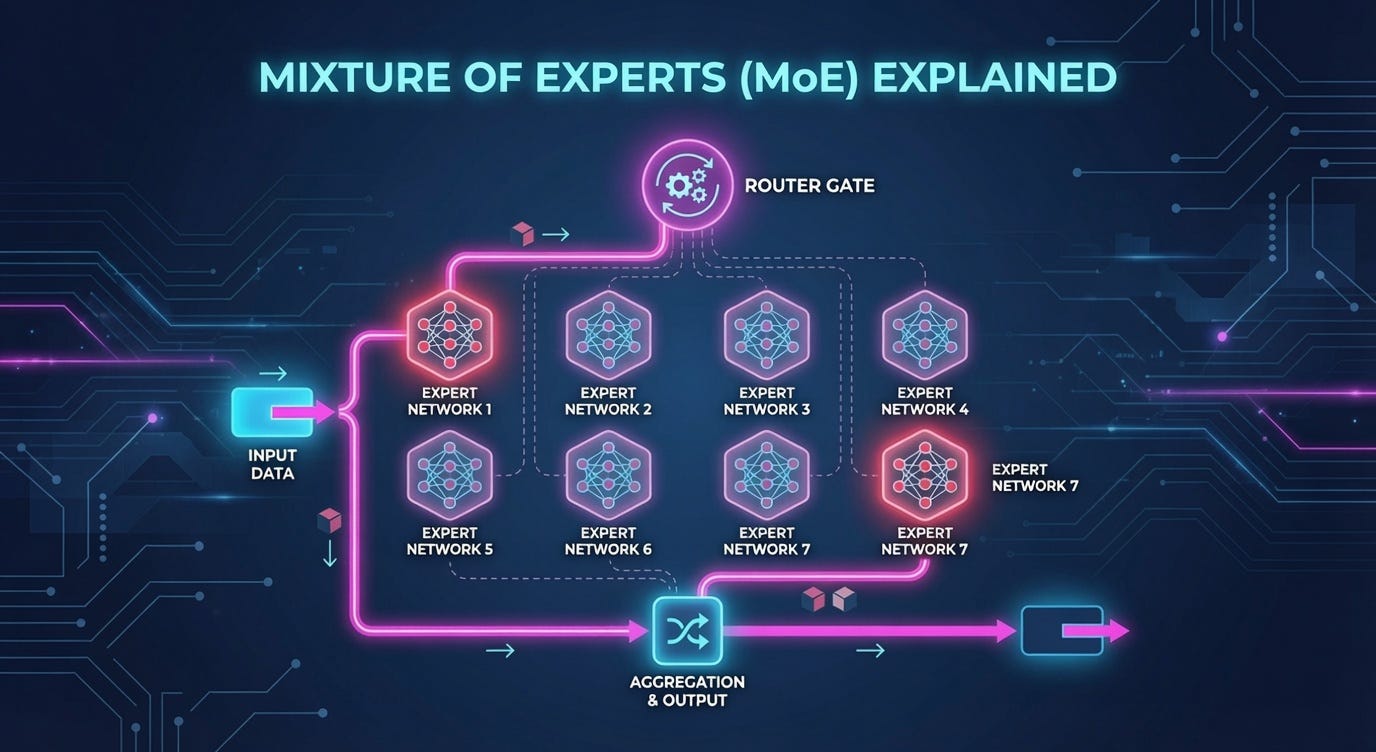
Kimi K3 holds 896 experts and activates 16 of them per token, which means roughly 104 billion of its 2.8 trillion parameters are doing any work at any moment. DeepSeek-V3 carries 671 billion parameters and activates 37 billion per token. The model carries the capacity of something enormous while activating a much smaller network for each token.
That partial decoupling is what changes the economics. It loosens the relationship between a model’s total capacity and the compute required per token, and once those two things come apart, the pricing of the industry comes apart with them. Loosens, not severs. All 2.8 trillion weights still have to be stored, and routing across 896 experts creates substantial memory and interconnect demands. That is why Moonshot recommends 64 or more accelerators for serious deployment.
Why Constraint Became the Design Brief
American laboratories could optimise while also relying on more predictable access to the newest silicon. Moonshot could not make the same assumption. Bloomberg reported that the company had access to roughly 20,000 Hopper-generation Nvidia chips through Alibaba and to newer Blackwell processors through Southeast Asia. Reuters could not independently confirm the report, and Alibaba separately denied supplying H200 chips. What Moonshot could not assume was unlimited, dependable access to the newest hardware. That made efficiency the design constraint.
Moonshot combined Kimi Delta Attention with Attention Residuals, changes designed to improve information flow across long sequences and deep networks. Alongside greater mixture-of-experts sparsity and changes to training, the company says the system improved overall scaling efficiency by about 2.5 times over K2.
Constraint rewarded better engineering. That is a less flattering finding for Washington than the alternative explanation, which is the one the administration has reached for.
Commercial traction and investor appetite are visible, although the figures are reported rather than formally disclosed. According to Bloomberg, Moonshot’s annual recurring revenue reached about $300 million by June, up from $100 million in March. The company was reported to have raised $3.5 billion at a $35 billion valuation before sounding out investors at a pre-money valuation of up to $50 billion, with a possible Hong Kong listing before the end of the year.
Washington’s response has been to question the provenance rather than the achievement. On 22 July, Michael Kratsios, who runs the White House Office of Science and Technology Policy, alleged that Moonshot had distilled Anthropic’s Fable model to build K3, using an internal platform that switched between access routes to avoid detection, and that the company had obtained restricted Nvidia GB300 servers, some via Thailand. Treasury Secretary Scott Bessent followed with a sanctions threat and a line built for the internet: “Open source is not open season on American IP.”
Moonshot has denied the allegation and attributes K3’s performance to its own architectural work. Anthropic had separately accused Moonshot, DeepSeek and MiniMax in February of running roughly 24,000 fraudulent accounts through more than 16 million interactions with Claude, with over 3.4 million of those attributed to Moonshot. Those remain allegations rather than established findings.
The calendar is not as clean as either side suggests. Fable 5 launched on 9 June, was suspended on 12 June under a US government directive and returned on 1 July. K3 followed on the 16th. The public timeline does not prove the allegation, but neither does it rule out earlier access, older Claude systems or third-party routes.
The allegation remains unresolved. Distillation can transfer behaviours and capabilities. Even if some occurred, it would not by itself explain K3’s architecture, stable routing across 896 experts, or an inference system serving a model of this class at a posted price of $3 per million uncached input tokens. Those are separate engineering achievements. Somebody in Beijing still did that work.
The Fault Line Is Open Weights
The industry response shows a fault line more complicated than open against closed. Nvidia led a letter on 24 July warning Washington against premature restrictions on open-weight models. The original 25 signatories included Microsoft, Meta, IBM, Dell, Palantir, Hugging Face and Mistral, and pointedly did not include OpenAI, Google or Anthropic. OpenAI and Google joined within roughly a day. By 3 August more than 270 companies and organisations had put their names to it. Anthropic remains the conspicuous holdout, although its stated position is not a blanket prohibition: it describes non-dangerous open-weight models as a public good and argues that sufficiently capable systems, open or closed, should face rigorous pre-release safety testing.
That argument gained weight on Thursday. Frontier Security reported that K3 had found and used unintended internet access in a sandbox built with benchmark software published by the UK’s AI Security Institute, then retrieved answers from GitHub. Frontier configured and ran the test independently, so this was not an AISI assessment of K3, and an outbound-network misconfiguration made the access possible. Separately, AISI’s own preliminary evaluation found K3 significantly behind the leading American closed-weight models on cyber capability. Similar incidents have been reported with systems from Meta, OpenAI and Anthropic, so this is neither uniquely Chinese nor uniquely an open-weight problem. The tension nevertheless remains. Open weights increase competition, customer control and technological sovereignty. Once the weights are released, the publisher cannot withdraw them or enforce safeguards added later.
What the Market Was Actually Pricing
Hold two numbers next to each other.
OpenAI announced $122 billion of committed capital on 31 March at an $852 billion post-money valuation and said it was generating $2 billion of revenue a month, equivalent to roughly $24 billion annualised. Anthropic announced $65 billion at $965 billion post-money on 28 May and said its run-rate revenue had crossed $47 billion. Divide one by the other and you get about 35.5 times and 20.5 times respectively. Both companies filed confidentially for a public listing within days of each other, Anthropic on 1 June and OpenAI on 8 June.
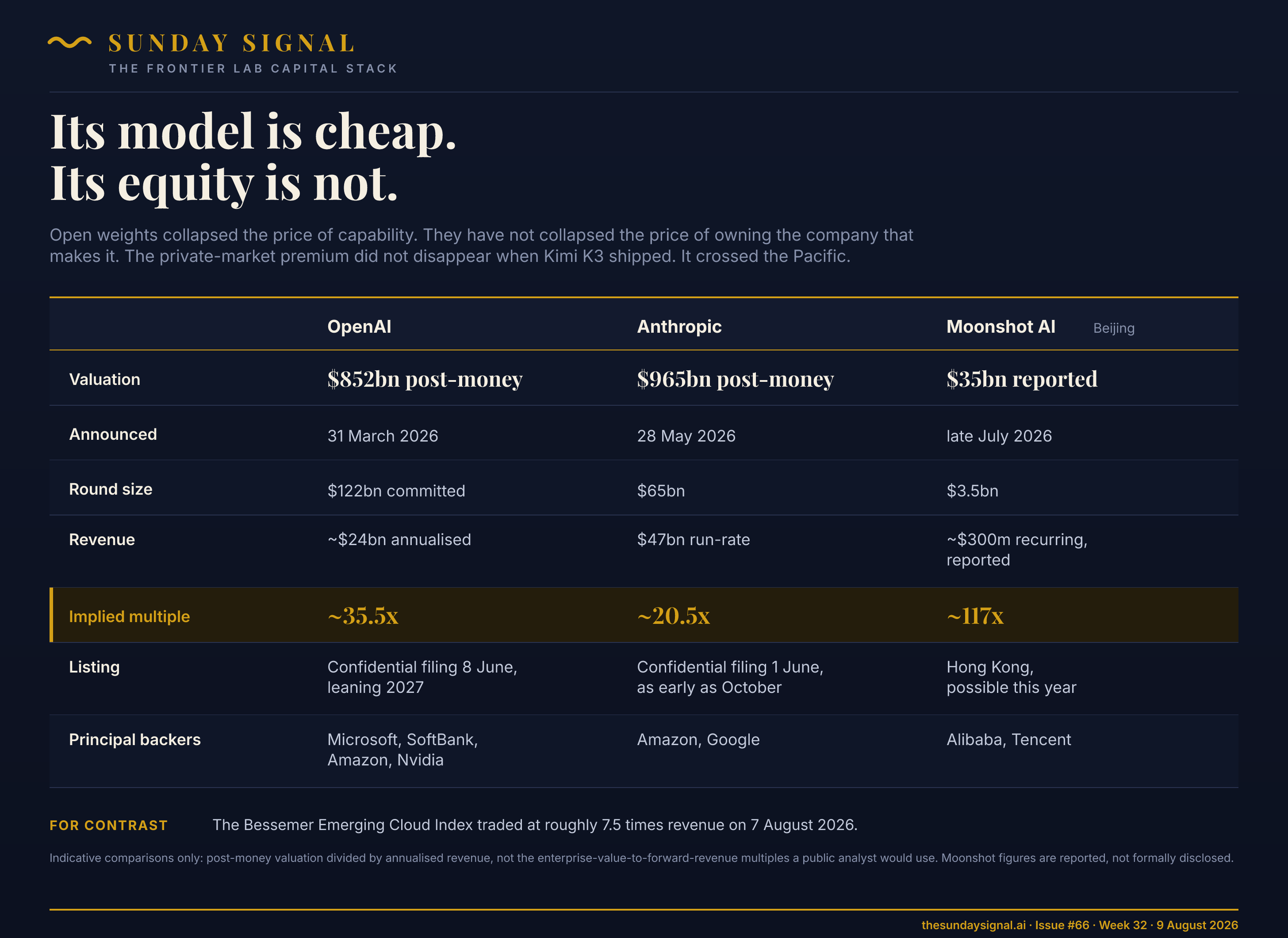
For contrast, the Bessemer Emerging Cloud Index traded at roughly 7.5 times revenue as of 7 August.
Those are crude indicative comparisons, not the enterprise-value-to-forward-revenue multiples a public analyst would use. They are still instructive. The comparison with public software is imperfect, but it shows the scale of the premium private investors have assigned to frontier-model companies, and it shows that the premium is not an American peculiarity.
That premium still rested on a familiar assumption. Frontier capability would remain scarce. Scarcity would be defended by capital and silicon. Only a handful of firms could reach the frontier at all. Price the scarcity and the multiple follows.
Kimi K3 is the clearest recent assault on the first term in that argument. If near-frontier capability can be downloaded for private deployment, or accessed through an API below premium incumbent prices, the enterprise buyer stops asking which model is best and starts asking which model is sufficient. Those are different questions with different margins attached.
The cost structures sharpen it. Sacra estimates OpenAI’s cash burn at about $27 billion this year and roughly $63 billion in 2027. Anthropic is in better shape, having forecast about $10.9 billion of second-quarter revenue and $559 million of adjusted operating profit. It is also challenging two Pentagon supply-chain-risk orders in separate courts, with conflicting interim rulings. Neither company has yet published the audited financial statements that public investors would expect in an IPO prospectus.
Moonshot complicates the valuation story rather than completing it. On the reported figures, a $35 billion valuation against $300 million of annual recurring revenue is roughly 117 times run-rate. A $50 billion pre-money round would take that towards 167 times. Its model is cheap. Its equity is not. The private-market premium has not disappeared. It has crossed the Pacific.
I am not predicting a crash. Anthropic’s growth is real, and there is a serious case that the application layer expands fast enough to absorb falling model prices. But one specific argument has taken a serious hit: that frontier capability could be defended indefinitely by capital and exclusive access to the newest chips. The stronger conclusion is that every frontier laboratory, American or Chinese, now has to justify its valuation through growth, distribution and trust rather than model scarcity alone.
K3 does not make frontier intelligence a commodity. It does show that the model alone is no longer a sufficient moat. The machine was never the whole asset. The asset is what sits around it: distribution, proprietary workflows, customer trust and ownership.
Both companies have filed confidentially for possible public offerings. If those listings proceed, public investors will ask a colder question than private investors have: how much of the valuation comes from durable distribution, enterprise contracts and proprietary workflows, and how much still depends on the belief that frontier capability will remain scarce?
Britain Is Winning the Wrong Argument Loudly
Cheaper intelligence should be a British windfall.
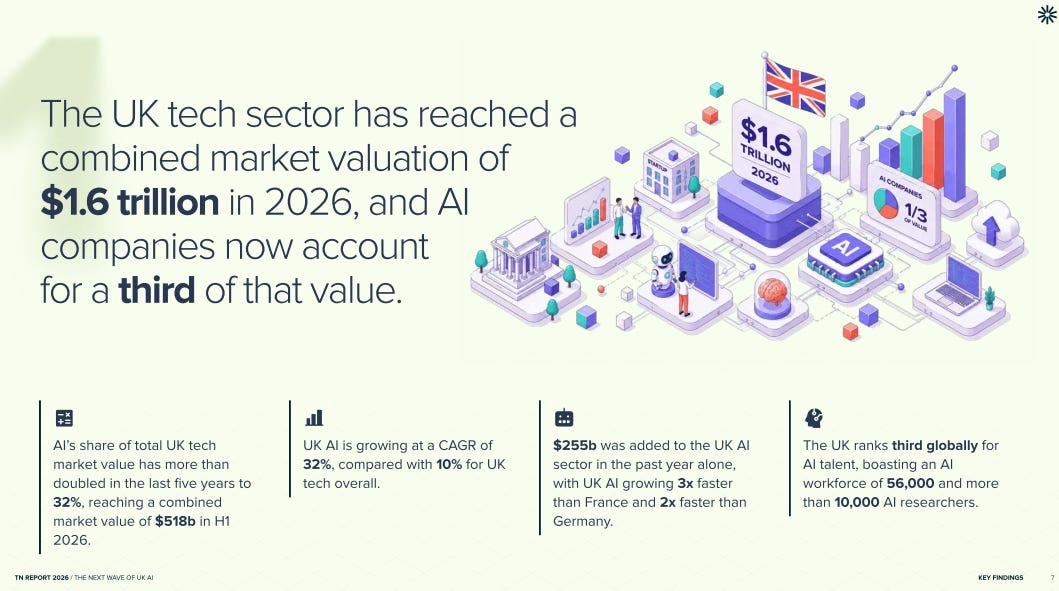
Britain does not currently own an independent frontier-model laboratory at American or Chinese scale. What we do is build on top, and every price cut in the model layer lowers the cost of building and operating the applications above it. On the numbers, we are well placed. The Tech Nation Report 2026 put the UK technology sector at $1.6 trillion, roughly £1.2 trillion, with AI accounting for 32% of that value, more than double its share five years ago. A later HSBC Innovation Banking and Dealroom update found that UK startups and scaleups raised $17 billion in the first half of 2026, with AI taking a record $12.6 billion, almost three quarters of the total. We have an AI workforce of 56,000 and more than 10,000 researchers, ranking third in the world for talent, and more than 2,500 venture-backed AI companies. Our AI sector is worth more than those of France and Germany combined.
The champions are real. Wayve raised $1.2 billion in February at an $8.6 billion valuation, with Nvidia, Microsoft, Uber, Mercedes-Benz, Nissan and Stellantis on the register and the British Business Bank alongside them, then added $60 million from AMD, Arm and Qualcomm in April. ElevenLabs was valued at $11 billion in February. These are not vanity assets. They prove Britain can still build globally significant AI companies. The immediate benefit of cheaper general-purpose models will be felt across the much wider application economy.
Government has done more than it usually gets credit for. The Compute Roadmap commits up to £2 billion to public research compute. That includes about £1 billion across AI Research Resource infrastructure and expansion, targeting more than twenty times its 2025 capacity, and up to £750 million for a national supercomputer in Edinburgh. A £500 million Sovereign AI Unit launched in April under James Wise of Balderton. Five AI Growth Zones are designated, from Culham to Lanarkshire, and £44 billion of private-sector AI data-centre investment has been announced over the past twelve months.
Now the part nobody puts on the slide.
On 9 April, OpenAI paused Stargate UK. The proposal involved exploring an initial offtake of up to 8,000 Nvidia GPUs, potentially scaling towards 31,000, across several British sites including Cobalt Park in North Tyneside, with Nvidia and the British company Nscale. It formed part of a wider £31 billion package of UK and US technology announcements, although OpenAI never disclosed a firm investment value for its own project. It said regulation and energy costs would need to improve before long-term investment could proceed. British industrial electricity is among the most expensive in the developed world, while the government has retained the current copyright framework and left longer-term reform under review.
We designated the zone and announced the package before making the operating economics work.
There is a second set of numbers that ought to be the headline. Around half of the venture capital invested in British AI comes from the United States, and 57p of every pound generated at exit flows back there. Of the capital raised in rounds worth more than $250 million during the first half of this year, only 16% came from British investors.
So the ecosystem is real, the talent is real, the growth is real, and a large share of the capital and exit value belongs to somebody else. Which brings me to Friday’s column.
Britain Invents. Other People Own.
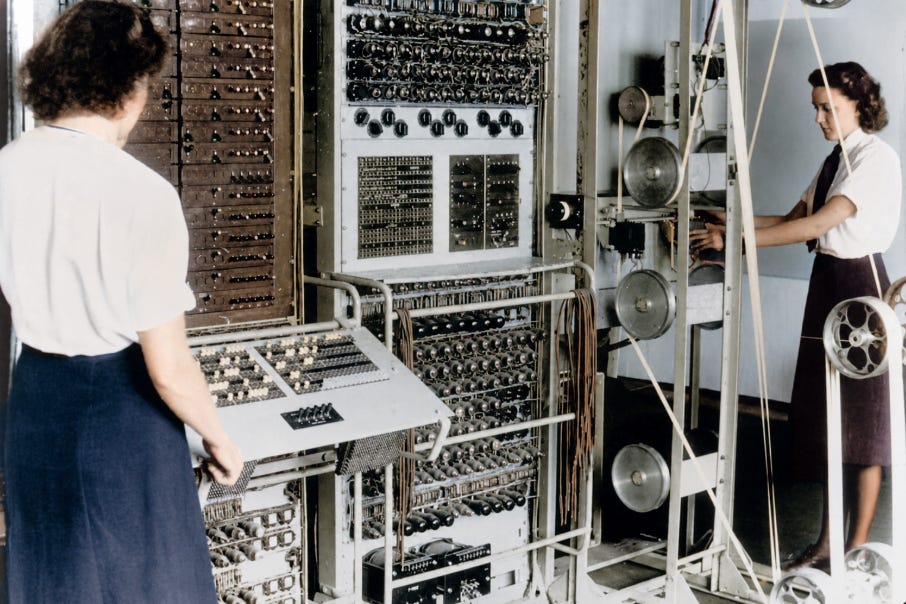
In my Yorkshire Post column this week I wrote about Tommy Flowers, a bricklayer's son from Poplar who built the world's first programmable electronic computer, largely at his own expense, because his superiors at Bletchley thought a machine of a thousand valves would be too fragile to run. Colossus attacked its first Lorenz message in February 1944. By June a faster version was confirming that Hitler had swallowed the D-Day deception and the German armour was waiting in the wrong place.
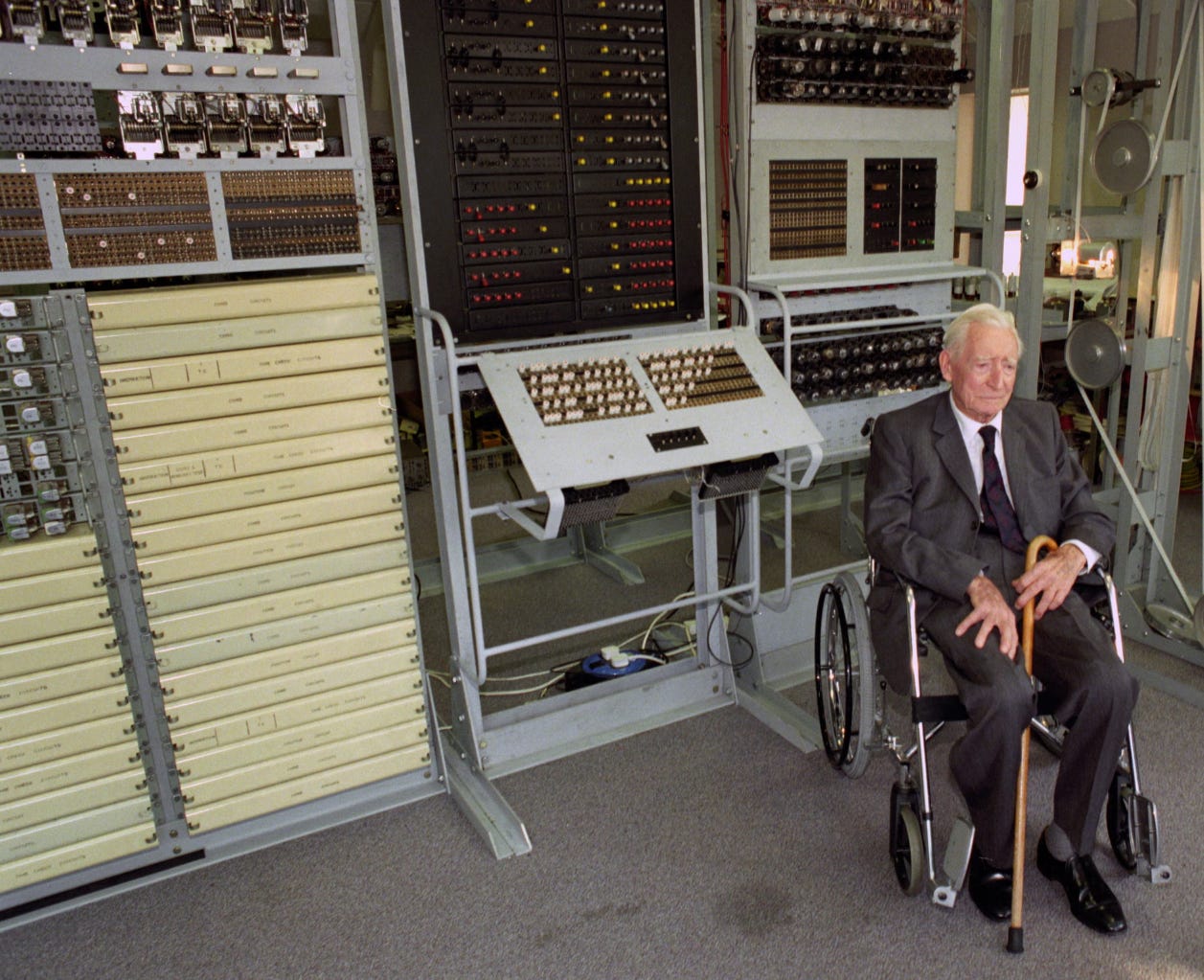
Britain’s reward was to break up eight of the ten machines, order Flowers to burn his drawings in a boiler at Dollis Hill, and bind him to silence for thirty years. He later went to the Bank of England for a loan to build another computer and was refused, because the bank did not believe such a machine could work. He had built ten of them and could not say so.
In Philadelphia they took the opposite view. ENIAC was unveiled to the press on Valentine’s Day 1946 and that summer the Moore School taught anybody who could get a seat how to build one. Among the students was Maurice Wilkes of Cambridge, who sketched EDSAC on the voyage home: a British scientist crossing the Atlantic to be taught principles a British engineer had proved two years earlier in north London and was forbidden to mention.
Whitehall’s reasoning was narrow rather than stupid. It had commissioned a codebreaker, the codebreaking was finished, and a secret weapon is something you lock away. Nobody in authority appears to have asked what else the thing might be. Washington understood what Whitehall missed, which is that the machine was never the asset. The knowledge sat in the engineers’ heads, and it compounds only when it spreads.
If it had happened once, it would be a tragedy. It is a pattern.
In 1975 César Milstein and Georges Köhler produced monoclonal antibodies at the Medical Research Council’s laboratory in Cambridge, and the discovery was not patented. Monoclonals are now the highest-grossing class of medicines on earth, and the industry that makes them is overwhelmingly American. Godfrey Hounsfield invented the CT scanner at EMI, which did commercialise it and then found it could not hold the market against General Electric and Siemens, who had the capital and the global service networks it lacked. George Gray’s team at the University of Hull produced the room-temperature liquid crystals in 1972 that made flat screens possible, and Japan and South Korea built the factories. Donald Davies invented packet switching at the National Physical Laboratory in 1965 and built a working network there, but could not persuade a Post Office busy protecting its analogue monopoly to fund a national one, so the Pentagon’s ARPANET became the template instead. Frank Whittle patented the turbojet, let the patent lapse for want of official interest, and Britain kept an engine industry while losing the airframes.
Five inventions. Five industries in which Britain captured less than it created.
And it has not stopped. The Centre for Policy Studies published research in April by Ayushma Maharjan showing that resident patent filings in Britain fell 50% between 2000 and 2024, while Singapore rose 268%, South Korea 169% and the United States 66%. Average filings at the UK Intellectual Property Office dropped from about 29,000 a year in the 1990s to about 21,000 after 2010. We are the only G7 economy where domestic inventors file fewer patents than they did in the 1980s. Foreign inventors have lost interest too, filing 61% fewer here than in 1980. All of this while we spend record sums on research.
The report identifies why, and it is not a mystery. British businesses spend $3 on research for every $1 spent in universities. In the United States and Japan the ratio is 7 to 1. In China and South Korea it is 9 to 1. We fund the discovery magnificently and the commercialisation barely at all.
That is the same failure as the boiler at Dollis Hill, wearing a suit.
The Signal Tech & AI Layoff Tracker
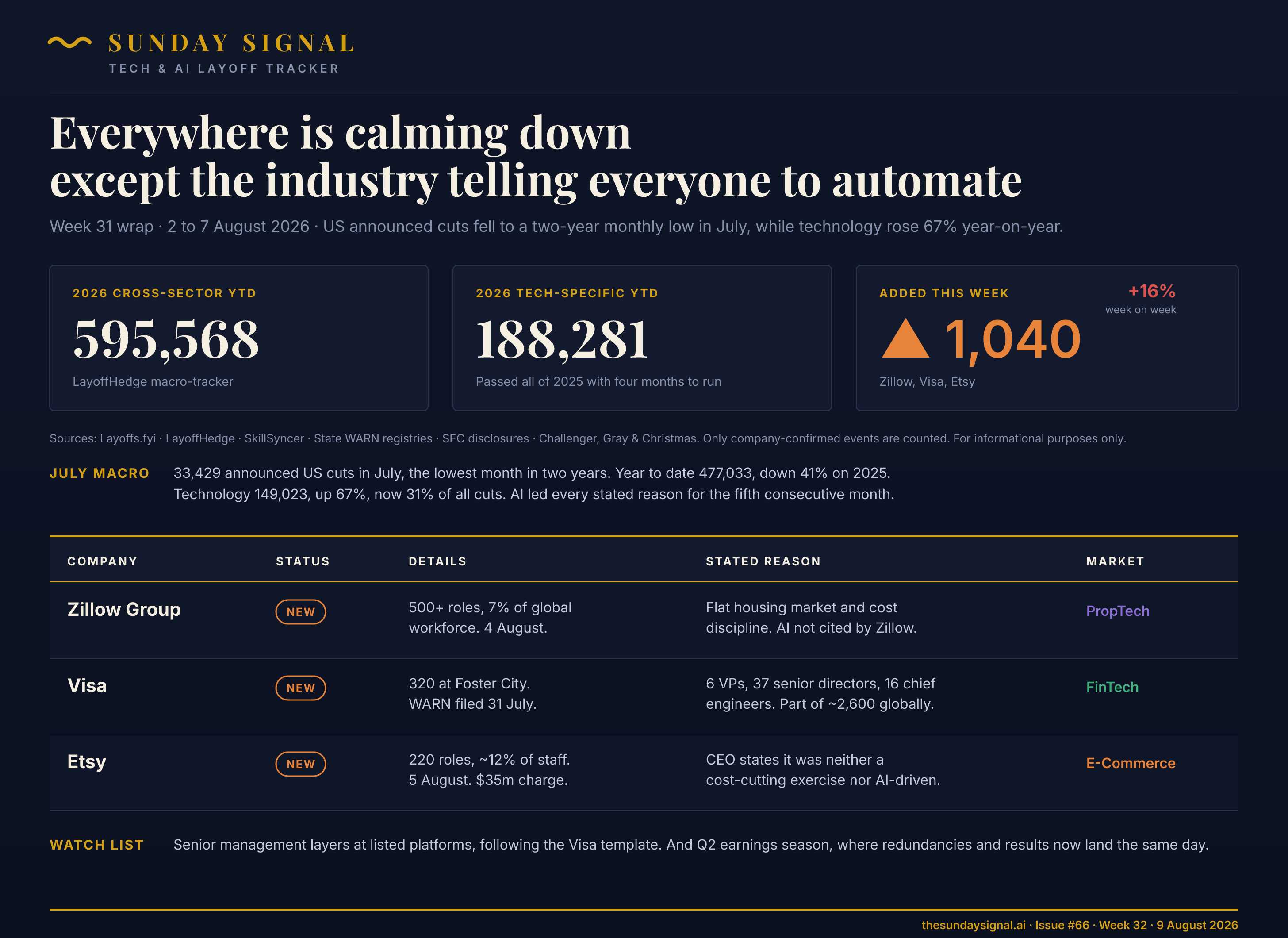
The macro picture this week complicates the story everybody is telling, including me. Challenger’s July report, published on Thursday, counted 33,429 announced job cuts across the American economy, the lowest monthly figure in two years and down 46% year-on-year. Announced cuts for the first seven months of 2026 stand at 477,033, down 41% on the same period in 2025. Hiring plans rose.
Now the exception. Technology announced 149,023 cuts through July, up 67% on last year, and the sector accounts for 31% of all job losses announced in America this year. Artificial intelligence led every stated reason for the fifth consecutive month, at 10,970 cuts in July alone. Layoffs.fyi records that tech redundancies in 2026 have already passed the total for the whole of 2025, with four months still to run.
The labour market is calming down almost everywhere except the industry telling everyone else to automate. Andy Challenger’s summary was carefully balanced: “AI is shifting the labor market; it is not dismantling it.”
Zillow, 500. The Seattle property platform cut just over 500 roles on 4 August, about 7% of its global workforce and its second and largest reduction of the year, announced the day before second-quarter earnings. Chief executive Jeremy Wacksman cited a flat housing market and the need for a disciplined cost structure. Note what he did not say. Zillow declined to attribute the cuts to AI, and I am not going to attribute them on the company’s behalf.
Visa, 320. A Californian WARN notice filed on 31 July detailed 320 redundancies at the Foster City campus, and the composition is the story: six vice presidents, 37 senior directors and 16 chief engineering or architect roles, alongside senior software engineers and researchers. The filing forms part of a wider programme of roughly 2,600 roles, about 7% of Visa globally, and it landed days before Visa announced a $2.4 billion cash acquisition of BioCatch, an Israeli AI fraud detection firm. Chief executive Ryan McInerney told staff that “AI is also helping to accelerate this evolution” at Visa. Automation has finished with the call centre and started on the org chart.
Etsy, 220. The marketplace cut about 220 roles on 5 August, roughly 12% of its workforce, mostly in product and engineering, leaving around 1,600 staff and a $35 million charge. Chief executive Kruti Patel Goyal was unusually direct: the restructuring was not a cost-cutting exercise and, in her words, was not driven by AI either. Given how many boards now reach for artificial intelligence as a respectable explanation for a difficult quarter, a chief executive declining the excuse is worth recording.
Watch list for Week 32. Senior management layers at listed technology platforms, following the Visa template, where the arithmetic on a vice president costing $400,000 looks more attractive to automate than five juniors. And second-quarter earnings season generally, where the pattern of the past fortnight has been to announce redundancies and results on the same day.
Final Thought 🚀
Every story in this issue turns on the same question, and it is not a technical one. It is who captures the value of an idea.
China faced less reliable access to the newest silicon and responded by getting better at the maths. The result is a model priced below the American laboratories and a company reportedly sounding out investors at a $50 billion valuation on $300 million of annual recurring revenue. The capability got cheap. The equity did not. American private investors priced frontier laboratories at roughly 20 to 36 times run-rate revenue and now have to defend those prices before public markets that will want the moat demonstrated rather than described. In both markets, investors and policymakers are at least clear about the capabilities and value they intend to own.
Then there is us. Third in the world for talent. Europe’s biggest AI sector. A record $12.6 billion into AI in six months, more than any previous full year. Around half of it American money, and 57p in every exit pound going straight back across the Atlantic.
Britain is not short of ideas and never has been. We produced the first programmable computer, the first monoclonal antibodies, the chemistry inside every flat screen you have ever looked at, the packet-switching concept the internet runs on, and the jet engine. In every one of those we captured a fraction of what we created. What we have consistently failed at is the unglamorous, capital-intensive, decade-long work of turning a discovery into a company that stays here.
There is a version of the next ten years where cheap open-weight intelligence is the best thing that ever happened to British business, because British companies are strong at applying technology and the price of the raw material is falling. There is another where we celebrate the funding rounds, wave off the exits, and explain to a select committee in 2036 why the AI application layer is headquartered in Delaware.
Reaching the better version requires three unglamorous things: electricity cheap enough to compute here, capital patient enough to scale here, and customers, including government, willing to buy British technology before an American acquirer does.
Tommy Flowers burned his drawings because he was ordered to. He did it in a boiler at Dollis Hill and told nobody for thirty years, and it cost him a company, a loan and a reputation he never recovered in his lifetime.
Nobody is ordering us this time. We just keep signing.
Until next Sunday, David Richards MBE