
The Floor Is Moving
Coding showed the pattern first. The back office, the ledger and the brief are next. And the people deciding your future are reading a map that went out of date this week.

Issue #55 · Week 22 · Sunday 31 May 2026
This issue is also available as a podcast. Listen on Spotify, Apple Podcasts or YouTube and tell me what you think.

Bottom Line Up Front
Whatever you believe about artificial intelligence, check the date on it. Most of what passes for informed opinion, in boardrooms, in Whitehall, in the better newspapers, was true a few months ago and is wrong now. That used to be a forgivable lag. In this field it is a disqualifying one. The technology no longer moves at the speed of quarterly reviews. It moves at the speed of the weekend, and the gap between what the machines can do and what the average decision-maker thinks they can do widens every Friday.
Here is the part that should concentrate the mind. The line that everyone assumed was years away, the one where the machine writes software better than the people paid to write it, was crossed late last year. Coding is the first knowledge profession where the substitution pattern became impossible to ignore. It will not be the last. Once the pattern is proven in one trade, every other trade that runs on rules and documents is simply waiting its turn. This week the proof arrived, the bill arrived, and the redundancy notices arrived. They arrived together. That is not a coincidence.
Your mental model of AI expired while you were forming it
The clearest account of why this moment is different came not from a lab but from a venture capitalist. On 20 April, Sequoia Capital held the fourth edition of its AI Ascent in San Francisco, an invitation-only gathering of more than 150 of the people actually building this technology. Demis Hassabis was in the room. So were Andrej Karpathy, Greg Brockman and Anthropic’s Boris Cherny. The partner keynote that opened the day carried a title chosen to provoke, “This is AGI”, and it was Pat Grady, a partner at the firm, who set out the frame. He did it without the usual hyperbole, which is precisely what made it land.
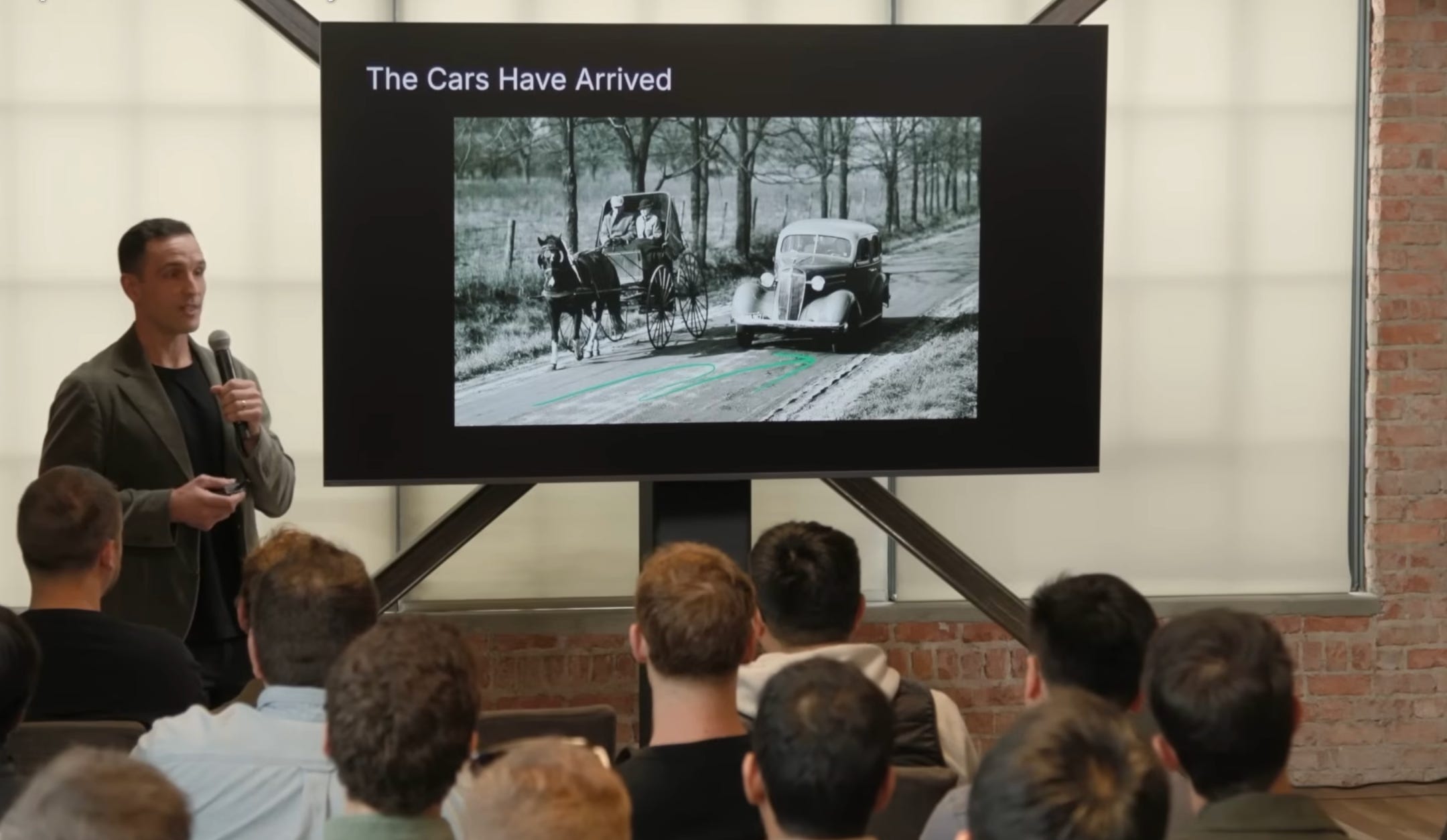
His image for the shift was cars replacing horses. The last few years, he argued, gave us faster horses: applications that made you 10 or 40 per cent more productive without changing how you worked. Now the cars have arrived, tools that make you 10 or 40 times more productive and change the nature of the work itself. His framing of why is worth holding onto. Grady draws a line between two kinds of revolution. There are revolutions in communication, which change how information is distributed. The internet was one. Mobile was another. So was the cloud. Almost everyone alive has only ever lived through revolutions of that kind. AI, he argues, is something else. It is a revolution in computation, a change in how information is processed rather than moved, and that is a fundamentally different shape of wave.
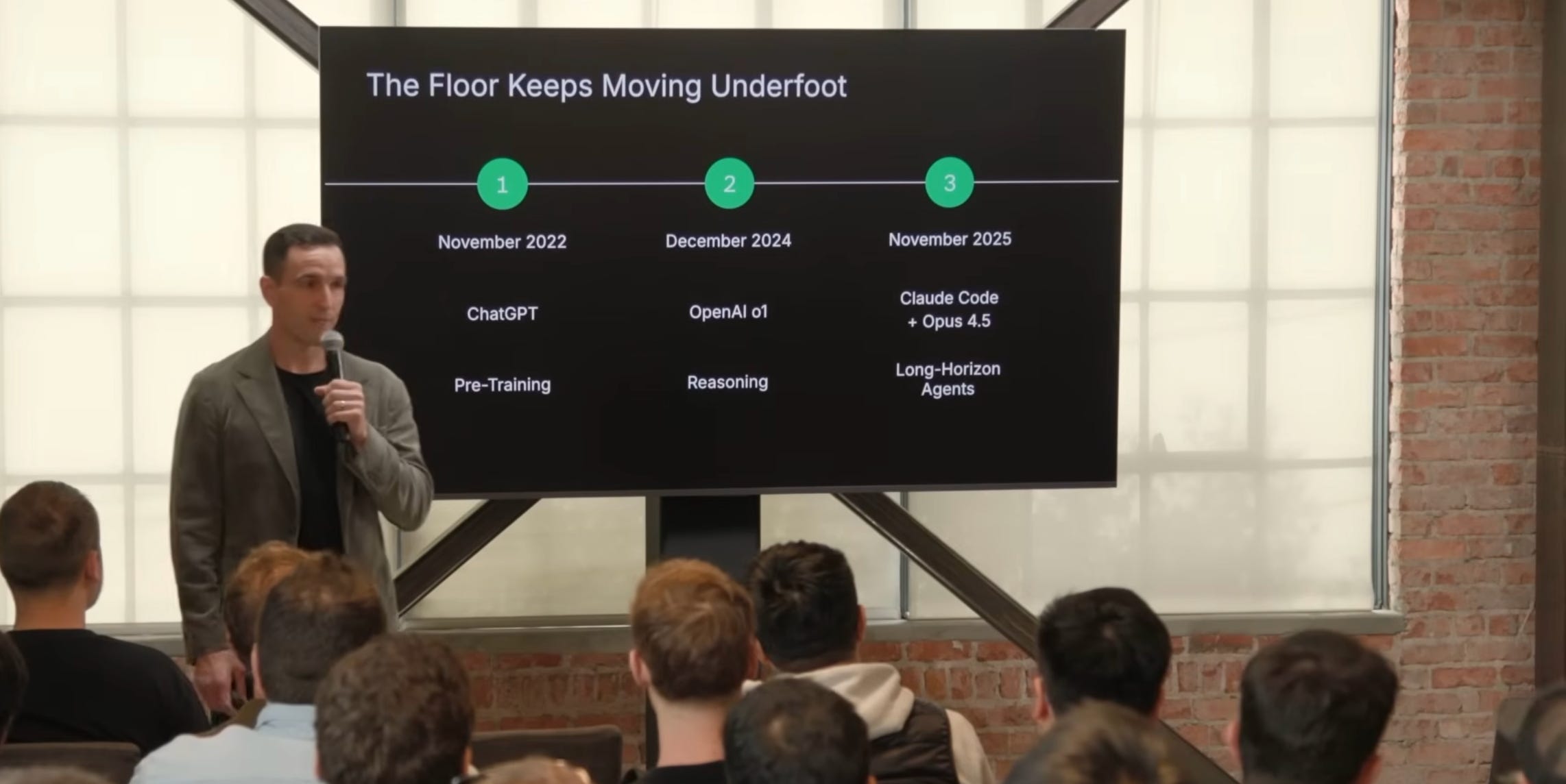
He marks three discontinuities. The first was November 2022, when ChatGPT showed a mainstream audience the power of pre-training. The second came roughly two years later with o1, when a second scaling law appeared around inference-time compute and reasoning models started to think before they answered. The third is happening now, with Claude Code and the current Opus generation, which have demonstrated what long-horizon agents can do when you set them a job and leave them to it. Grady’s point is that these are not three even steps on a ramp. The jump from the second to the third is a hard break, a discontinuity, and most people have not registered that it occurred.
The phrase that lands hardest is his. The technology foundation, he says, is one where “the floor keeps moving underfoot.” Build something on Monday and the capability that made it clever can be commodity by Friday. For anyone whose mental model of AI was assembled even a season ago, the floor has already moved. You are standing somewhere that no longer exists.
And the consequence he draws is blunt: “no lead is safe.” In a downpour of new capability, the incumbent advantage that felt permanent becomes a puddle. That is true of companies. It is also true of professions, and of the assumptions policymakers are using to regulate them. We are writing rules for a technology whose shape will have changed twice before the consultation closes.
Full keynote here:
One builder can now ship like a team of twenty
Start with coding, because coding is the canary, and the canary has stopped singing.
Think of a software engineer as the conductor of an orchestra. To conduct, you must be able to do two things at once: read the music, and play the instruments. Lose either and the performance collapses. For most of the history of the trade, the conductor also had to write out every note by hand. That is the part that has gone.
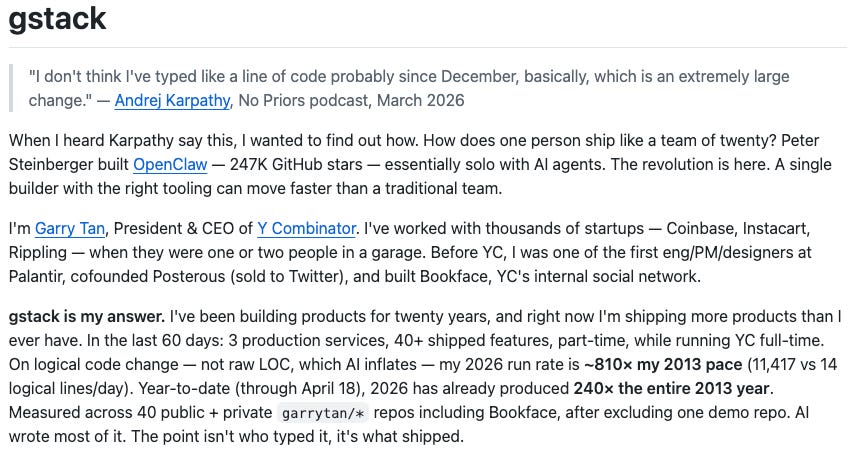
The most vivid proof point this week is Garry Tan, president and chief executive of Y Combinator, who has spent twenty years building products and is, on his own account, shipping more now than at any point in his career. In the README for his open-source toolkit, gstack, he lays out the numbers. In sixty days, working part-time while running YC, he shipped three production services and more than forty features. Measured by logical code change rather than raw lines (which AI inflates, as he is the first to admit), his 2026 run rate is around 810 times his 2013 pace. By mid-April his year had already produced 240 times the output of his entire 2013.
The number is arresting. The method is the lesson. Tan does not use AI as a faster pencil. He uses it as a company. gstack hands Claude a set of defined roles, twenty-three skills in all: a chief executive that challenges the premise of what is being built, an engineering manager that locks the architecture, a quality lead that opens a real browser, clicks through the staging app, finds the bugs and writes the regression tests. He opens the whole thing with a line from the researcher Andrej Karpathy, who said he had not typed a line of code since December. Tan’s own verdict on the productivity debate is the cleanest summary of the new reality you will read: “The point isn’t who typed it, it’s what shipped.”
Now the necessary cold water, because the 810x figure does not generalise and pretending it does would be dishonest. Tan is a senior builder working on greenfield code with no legacy to fight. That is the best case, not the average. Throw the same agents at a tangled enterprise codebase and they frequently slow people down, because someone now has to read, check and unpick what the machine produced. The industry has a name for it: the review tax. Across real organisations the honest multiple is closer to low single figures than to three. Gartner finds that roughly four in five firms piloting or deploying autonomous business capabilities have cut jobs, and that the financial returns are not yet showing up. The machine is not making everyone 800 times faster. It is letting one capable person orchestrate the work of a team, and it is removing the rungs of the ladder those teams used to be built from.
That distinction matters, because the same arithmetic is now being run in finance, in accounting and in law. The junior associate reading a data room. The analyst rebuilding a risk model. The bookkeeper reconciling a ledger at month end. None of them types in a different language from the engineer. They take data from one place, apply a set of rules, and put it somewhere else, and that is precisely the shape of work an agent does without complaint. The conductor’s job survives. The copying-out does not.
If your job is a task, your job is the target
The honest test is one you can run this weekend. Could a competent intern do your role from a three-page brief? If yes, an agent will do it autonomously, and sooner than your employer is telling you. The work does not vanish. It moves up a level, from doing to directing, and the people who make that move first will hold the leverage. Here is the playbook.
The honest test is one you can run this weekend. Could a competent intern do your role from a three-page brief? If yes, an agent will do it autonomously, and sooner than your employer is telling you. The work does not vanish. It moves up a level, from doing to directing, and the people who make that move first will hold the leverage. Here is the playbook.
1. Audit your own week. For five working days, log every task in half-hour blocks, then mark each one against the intern test. The tasks that pass, the structured, repeatable, digital ones, are the targets. The tasks that needed empathy, judgment, negotiation or your signature on the line are your new job description. Find them before the org chart does.
2. Learn the shape of the thing replacing you. The firms moving fastest have stopped buying a single chatbot and started running crews. A supervisor agent takes the goal and breaks it down. Specialist agents do the narrow work: research, risk, drafting, formatting. A final agent cross-checks them and assembles the result. Your move is to stop being a specialist and become the supervisor, the one who designs the workflow, tunes the prompts and directs the digital team.
3. Plant yourself at the review tax. As execution gets cheap, verification becomes the bottleneck, and in regulated work it is the whole game. An agent cannot sign a tax return, file a brief or ship to production. You can. So become the accountable human in the loop, train yourself to spot the slop (the hallucinated precedent, the ghost number in the ledger, the race condition in the code), and own the liability the machine never will. Your licence and your signature are the leverage.
4. Productise what you know before someone else does. Do not wait for procurement to buy the tool that replaces you. Write down the unwritten rules in your head, how you smell a wrong number, how you sense a client going cold, and turn them into prompts and playbooks. Then walk into your manager’s office as a systems architect, not an order-taker: “I have automated sixty per cent of our reporting, and I am now free for the work that actually pays.”
5. Run yourself like a one-person firm. Your value was never the typing. It is the judgment, the foresight and the ability to direct a team of autonomous workers to a result you will put your name to. The task is dead. The workflow is everything.
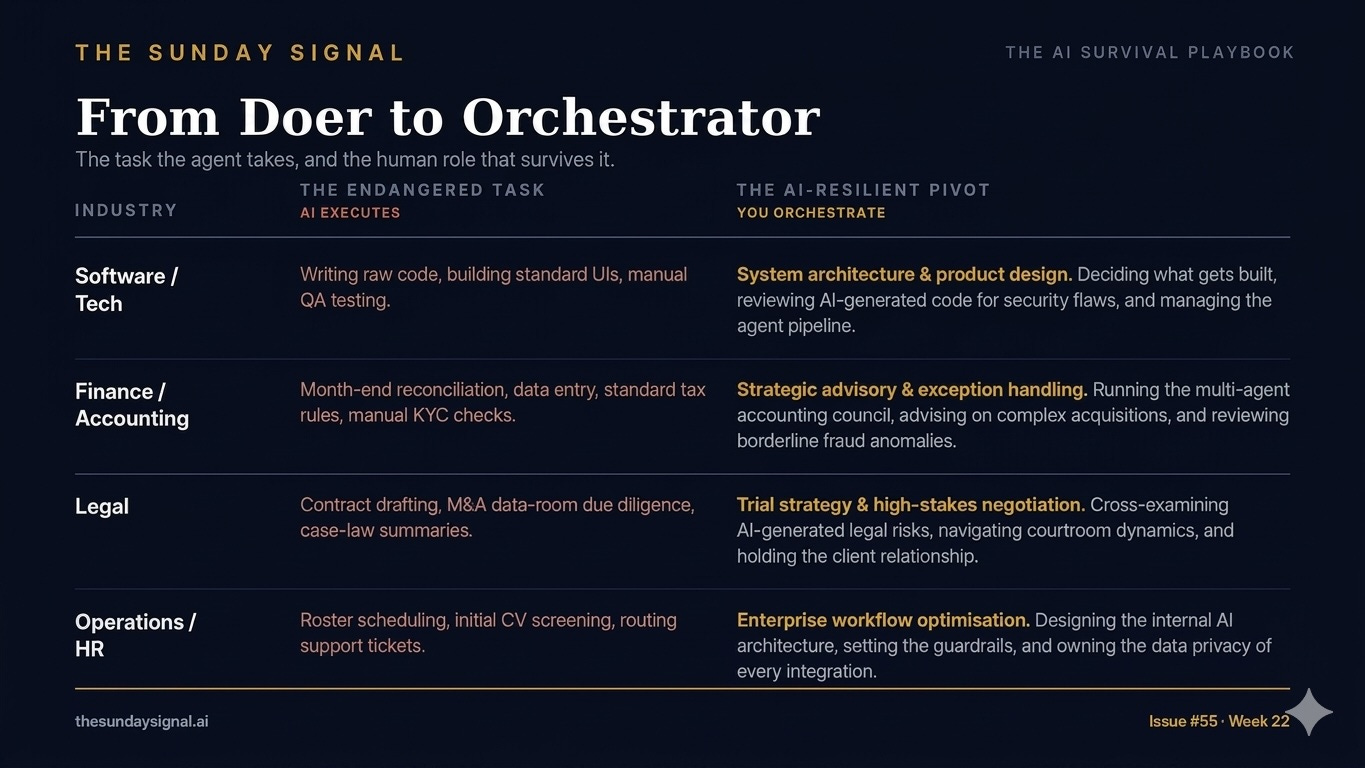
The pivot looks different in every sector. The direction is identical.
The technology is real. The economics are a wager.
Here is where the story turns, because two things can be true at once. The technology is the real thing. The money around it is not yet behaving rationally.
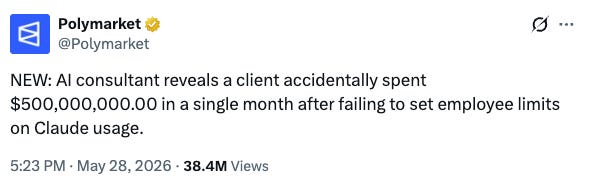
Consider the cautionary tale of the week. An AI consultant told Axios that an unnamed enterprise client reportedly ran up a bill of half a billion dollars on Claude in one month, after giving thousands of staff unrestricted access with no spending caps and no monitoring. Employees left agents looping overnight. People burned premium models on trivia. By the time the invoice landed, the budgetary damage was done. It may be the most expensive AI governance failure yet reported, and it tells you something the marketing does not: this is a consumption utility billed by the token, not a flat-rate subscription, and most of corporate IT has not understood the difference. The same week, Microsoft, the company most committed to embedding AI everywhere, reportedly cancelled most of its internal Claude Code licences on cost grounds. When the believers start flinching at the meter, pay attention.
Now lift your eyes from the invoice to the balance sheet. The four largest hyperscalers are on course to spend around 725 billion dollars on AI infrastructure this year, by the Financial Times’ tally, up roughly 77 per cent on last year and the largest concentrated infrastructure cycle in the history of technology. Amazon’s free cash flow is forecast to turn negative. A depreciation wave is coming as those chips age, with Morgan Stanley putting it north of 680 billion dollars over four years. Markets have started to notice: more than a trillion dollars came off the combined value of the big names in a single week of trading earlier this year. On the most generous reading of the returns, only the cloud-driven players, Amazon and Google, are clearly earning their keep. The rest are spending against a future demand they are betting will arrive.
This is exactly why I keep returning to the dot-com era. The technology was real then too. The internet survived and remade the world. Most of the companies that borrowed against it did not. Incredible engineering does not guarantee sustainable economics, and right now the giants are pouring trillions into the ground in the hope that revenue catches up to capex. That is not certainty. It is a leveraged bet, and the people most exposed when the interest comes due are not the executives who placed it.
Which brings us, with grim logic, to who pays. The chief executive of CloudBees told Axios the quiet part plainly: for many firms, cutting jobs may be the only lever left to offset the AI bill. The machines are sold as the reason for the layoffs. Increasingly they are also the cost that makes the layoffs necessary. Read that twice.
The algorithm in Thatcher’s coat

A version of my Yorkshire Post column this week.
On Tuesday 19 May, in Hong Kong, Bill Winters, chief executive of Standard Chartered, told investors the bank would shed roughly 7,800 corporate and support roles by 2030. In the context of global banking, the figure was not the shock. The framing was. The cuts, Winters explained, were not “cost-cutting” but “replacing in some cases lower-value human capital” with the financial and investment capital the bank was putting in. By Wednesday morning a memo was scrambling to bury the phrase as reflecting “the work, not the value of our people,” and Friday brought a formal apology and talk of mature discussion. Wednesday’s memo was corporate laundering. Tuesday was the boardroom speaking with the microphone left on.
Many of us in the AI industry watched this inflection arrive late last year, and the moment was uncomfortably specific. Claude Code, Anthropic’s coding agent, became plainly better than the median engineer at bounded, testable coding tasks, and was visibly closing on the best. Once that line falls in software, every other knowledge profession sits on a countdown, which is why I started tracking it. The Sunday Signal Layoff Tracker now publishes weekly, monitoring the reallocation of corporate capital from human payroll to AI compute.
What the data shows is sobering. Twenty-two weeks into 2026, the tracker has logged 472,150 corporate job cuts globally, of which roughly 169,430 sit in technology, and if you run that velocity through to December the year lands at 1.1 million, the tech share alone burying the sector’s previous worst year on record (2023, around 263,000). Nor is the curve flattening. Q3 and Q4 historically run hotter than spring as boards rush to right-size ahead of earnings, and roughly 135 billion dollars of fresh AI capex is queued up for the back half, meaning the 2023 record will not merely be broken but pulverised. These are not assembly-line jobs. They are middle-class and salaried: the compliance analyst running KYC, the junior associate annotating contracts, the credit analyst rebuilding risk models, the team lead summarising five reports for the executive one rung up.
Yorkshire of all places ought to recognise the pattern. We have seen what happens when an entire class of work vanishes inside a single decade. The coalfields and the steelworks did not gently retrain into something else. They emptied, and the social damage took three generations to absorb. This time the axe falls not at the pithead or the furnace, but in the financial back office. Financial and insurance services employ about 1.17 million people across the UK, while the wider financial and related professional services industry employs more than 2.4 million, around two-thirds of them outside London. The ONS has just recorded financial and insurance activities as the worst-hit corner of the British economy, shedding 78,000 jobs over the past twelve months alone. This is digital deindustrialisation, and it is the algorithm wearing Thatcher’s coat.
The bitter irony is that the tracker itself is the work of an AI agent. He is called Mac, and he triangulates labour aggregators, SEC 8-K filings, WARN notices and the financial press, cross-referencing headcount against primary disclosures so the PR varnish lifts off. Two years ago, the same brief handed to McKinsey would have arrived as a “Global Labour Optimisation Engagement”: a five-person pod, an offshore researcher in Bengaluru pulling overnight WARN data, and a partner gracing the deck for an hour a week, all invoicing out at half a million pounds a month. Mac does the lot in four seconds, and the analysts who used to build those Excel models are, with painful precision, the demographic the tracker watches disappear.
I have argued before that capital does not protect anyone through this transition. Only those who use AI to create and build will. The honest question facing British boardrooms is no longer whether artificial intelligence will reshape the workforce, but whether you intend to be the executive saying the quiet part out loud, or the one preparing your people for the work that remains.
The Sunday Signal Tech & AI Layoff Tracker
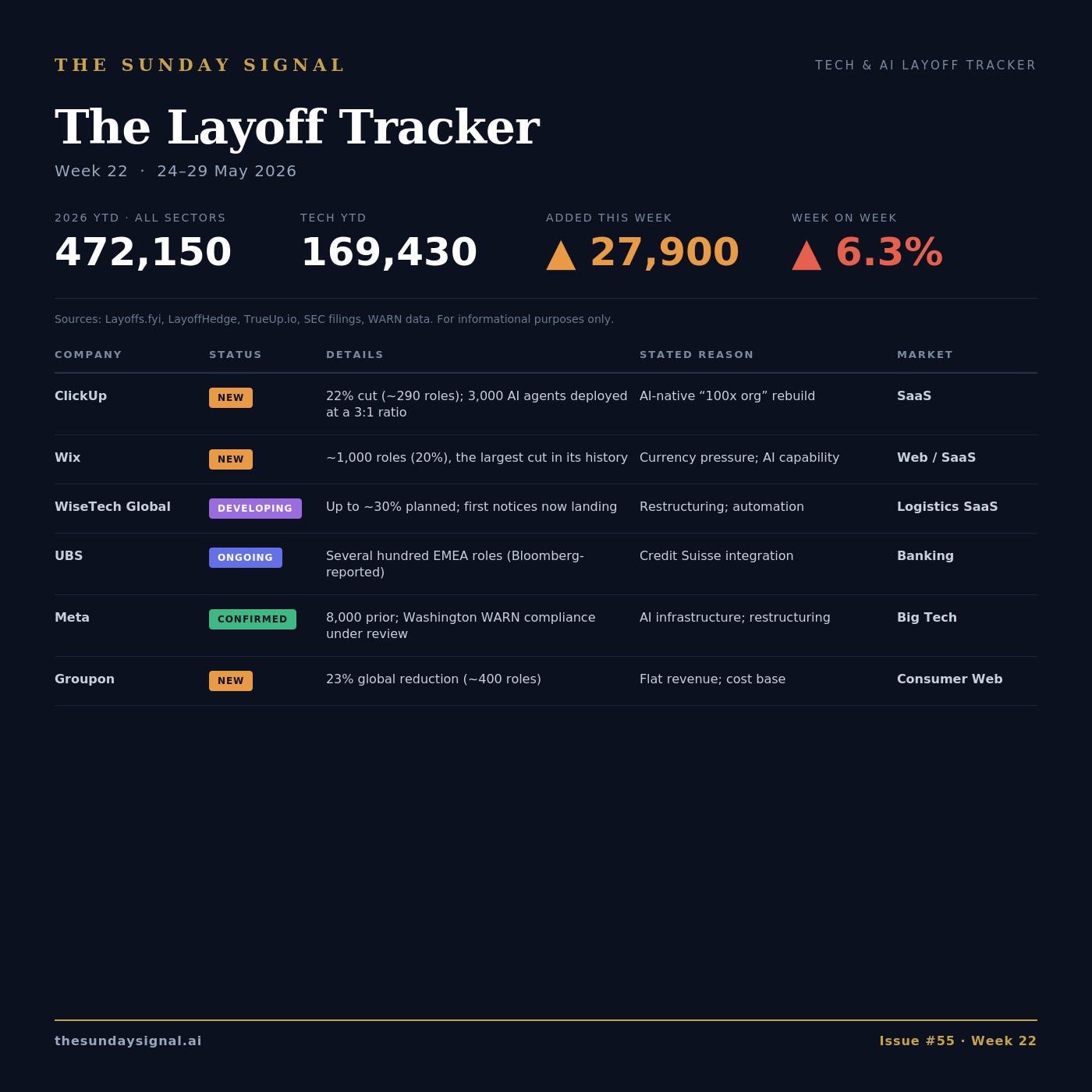
The signal: the rise of the 100x org. Last week’s Standard Chartered cuts were a warning to the back office. This week the strike landed on the builders. The idea that software engineers were safe died between Sunday and Friday, as both mid-cap SaaS and multi-billion-dollar names converged on a single philosophy. They no longer want teams writing raw syntax. They want a handful of system managers commanding fleets of agents.
The clearest statement of it came from ClickUp. The four-billion-dollar productivity firm cut 22 per cent of its staff, roughly 290 of about 1,300 people, and framed it not as a saving but as a rebuild. Chief executive Zeb Evans says the company now runs around 3,000 internal AI agents, a three-to-one ratio of agents to employees, and that his best engineers no longer write code, they direct the agents that write it. The payroll freed by the cuts is being redirected into cash salary bands of up to a million dollars for the ones who can manage the machines. Read that as the new employment contract, stated out loud.
Elsewhere on the wire this week. Website builder Wix announced the largest cut in its history, around 1,000 roles, some 20 per cent of its workforce; management cited currency pressure, though the structural driver, generative tools that build sites from a prompt, is hard to miss. Logistics software group WiseTech Global began a restructuring that could remove roughly 30 per cent of staff, with the first notices now landing, amid internal commentary reportedly weighing the cost of human coding against the cost of compute. UBS entered the European close with a Bloomberg-reported wave of several hundred cuts across EMEA, officially filed under the long-running Credit Suisse integration. A class-action firm in Washington state has opened an investigation into whether Meta‘s latest Washington cuts complied with state WARN notice requirements. And Groupon announced a 23 per cent global reduction, around 400 roles, as the legacy consumer web continues to shed its pandemic-era headcount.
Watch next week. ClickUp has set the benchmark, and the rest of the productivity sector (Asana, Monday.com, Smartsheet) will now be asked by investors why they have not matched its margins. Expect defensive restructurings before the quarter closes. Web design and hosting agencies are the other soft spot, as generative site builders pull the floor out from under standard front-end work.
Final Thought 🚀
The data this week did not describe a transition. It described substitution. The technology is real, the economics are a gamble, and the bill for that gamble is being paid in other people’s jobs while the people who placed it apologise for their choice of words rather than their choice of action. The coalfields were told to retrain too. Three generations later, parts of this county are still waiting. You have been warned, in plain language, by the executives themselves. The only question is whether you were listening, or still reading last month’s map.
Until next Sunday, David
A fascinating insight into the quantum leap that is Alresford shaping the world of work. Not everyone - in fact not most people - can leap the flexion point to safer pastures where work remains available and do-able by humans. And the analysis itself falls short: judgement, negotiation? What do they even mean? Surely AGI can just decide?