
The End of Adult Supervision
Why management’s grip on founders just broke in three places at once.

Issue #54 | The Sunday Signal | Sunday 17 May 2026
This issue is also available as a podcast. Listen on Spotify, Apple Podcasts or YouTube and tell me what you think.
Bottom Line Up Front
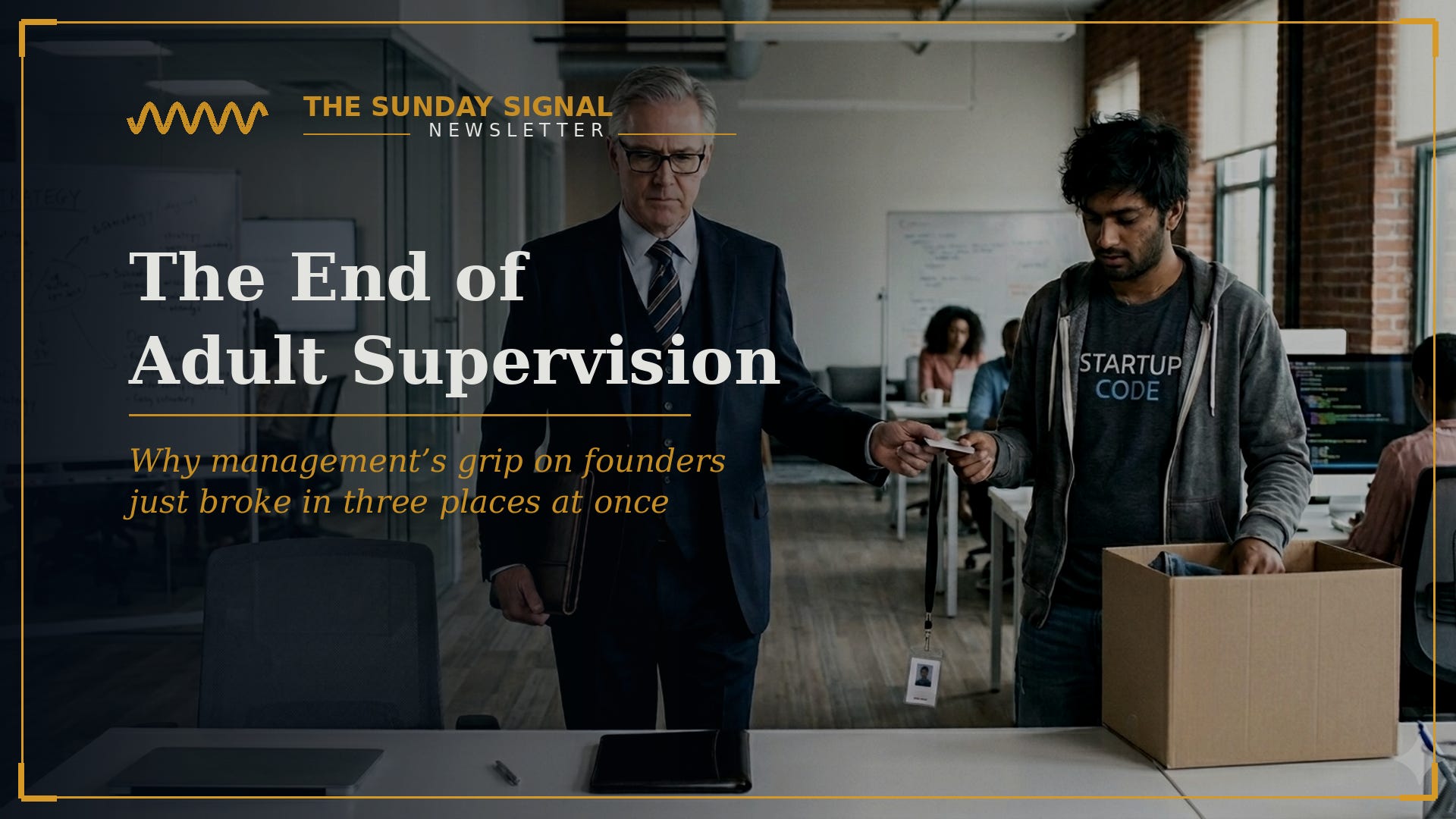
The “adult supervision” model of building companies is collapsing. For forty years, the moment a technical founder built something valuable, the institutional reflex was identical. Install a “proper” chief executive over them. Investors called it professionalisation. Universities called it commercialisation. Non-profit boards called it stewardship. The move never really worked. AI is about to make it look absurd.
This week, the argument played out in three rooms.
At The Digital Forge on Tuesday, in partnership with the University of Sheffield commercialisation team, a room of spin-out hopefuls heard the cautionary tale of a deep tech founder team forced to accept a sales executive as their CEO. The technology stalled. The cash burned. The founders eventually took the company back. The pattern is the rule, not the exception.
In a federal courtroom in Oakland on Thursday, closing arguments wrapped in Musk v. Altman. The jury begins deliberating on Monday. OpenAI is being asked to defend the most expensive version of the model ever attempted, the 501(c)(3) charter that was meant to keep frontier AI accountable. The verdict, when it lands, will become part of the architecture every AI lab studies.
And then the practical layer. Founder OS sits in this issue. The operating system that replaces the administrative machinery investors once used as the excuse to install adults in the first place. Nine playbooks. A master context architecture. A thirty-day implementation. Built around AI. Written for founders who have run out of patience with administrative theatre.
Three rooms. One verdict.
1. The Adults in the Room Were Wrong
Britain has a strange habit. The moment a brilliant technical founder proves they can build something valuable, we start looking for someone else to run it.
At about fifty staff, the ritual begins. Investors mutter about “professionalising the team.” The founder is praised, thanked and moved sideways. A proper chief executive is installed, usually someone fluent in dashboards, board packs and the solemn theatre of management. For forty years, this looked sensible. AI is about to make it look absurd.
I wrote that for the Yorkshire Post on Friday. This week, the argument arrived in a room.

At The Digital Forge on Tuesday, we partnered with the commercialisation team at the University of Sheffield. The room was full of spin-out hopefuls. PhDs. Professors. Post-doctoral researchers. Every one of them thinking seriously about turning brilliant research into companies. Every one of them being asked, in one form or another, the same question. Who is the adult who will run this?
The traditional answer is over. Let me tell you why.
A few years ago I watched a company spin out of a university. The research was extraordinary. Genuinely original. Genuinely difficult. To understand the technology in any serious way, you needed to be an accomplished computer scientist. The technical founders were both experts. The university believed the company needed “adult supervision.” They installed a former sales executive from a large tech company. Not a CTO. Not a co-founder. A sales guy. The deep tech company had no product. It had no market. It had a research thesis that needed further engineering before it could be sold to anyone. Sales was the last problem on the list.
The predictable thing happened. The sales hire built sales scaffolding. Pipelines, decks, sales targets, an outside-in narrative. None of it accelerated the actual work. The cash burned down. The technology stalled. A few years later, after a near-death event, the technical founders took the company back and started over. Yep, you guessed it. With the technical founders at the helm.
I have sat through that story so many times, in so many universities, that I stopped finding it surprising. The pattern is the same every time. “Adult supervision” was never adult. It was administrative scaffolding dressed up as wisdom.
Marc Andreessen made the broader case in his 2011 Wall Street Journal essay. Software was eating the world. He has spent the last twelve months arguing that something similar is now happening to the management layer itself. His record on calling the direction of technology is among the best of his generation. He is worth taking seriously.
James Burnham saw it coming in 1941. Modern capitalism, he argued, would no longer be ruled by owners or inventors but by the people who administered the machine rather than the people who built it. Burnham was right for most of the twentieth century. Scale required bureaucracy. Bureaucracy required managers. Managers gradually persuaded everyone that they, rather than the founders, were the adults in the room.
AI now attacks the very work that made that class indispensable. Much of modern management is not leadership. It is translation, summarisation, co-ordination and documentation. The business of turning meetings into actions, actions into reports, reports into board packs, and board packs into the next meeting. Strategy decks, budget narratives, risk registers, performance reviews and the endless grey plumbing on which large organisations depend. All of it. Precisely what the new language models do well, more cheaply every quarter, without an office or a pension.
So the Sheffield spin-out story is the pattern in microcosm. The university genuinely believed those technical founders couldn’t run a company. That belief was wrong even before AI. Now it isn’t just wrong. It’s expensive.
A question now ought to be ringing around every boardroom in Britain. If software can do the management layer, what is the management layer actually for? The honest answer is much less than the managerial class has trained itself to believe.
The institutional version of the same failure played out this week in Oakland.
2. OpenAI and the Failure of Institutional Containment
Closing arguments in Musk v. Altman wrapped on Thursday in Oakland. The nine-person jury begins deliberating on Monday under Judge Yvonne Gonzalez Rogers. The jury is technically advisory. The judge has said she will very likely follow its verdict. Damages testimony begins in parallel on Monday, even as the jury deliberates liability. Musk has requested disgorgement of up to $134 billion and the removal of Sam Altman and Greg Brockman from OpenAI.
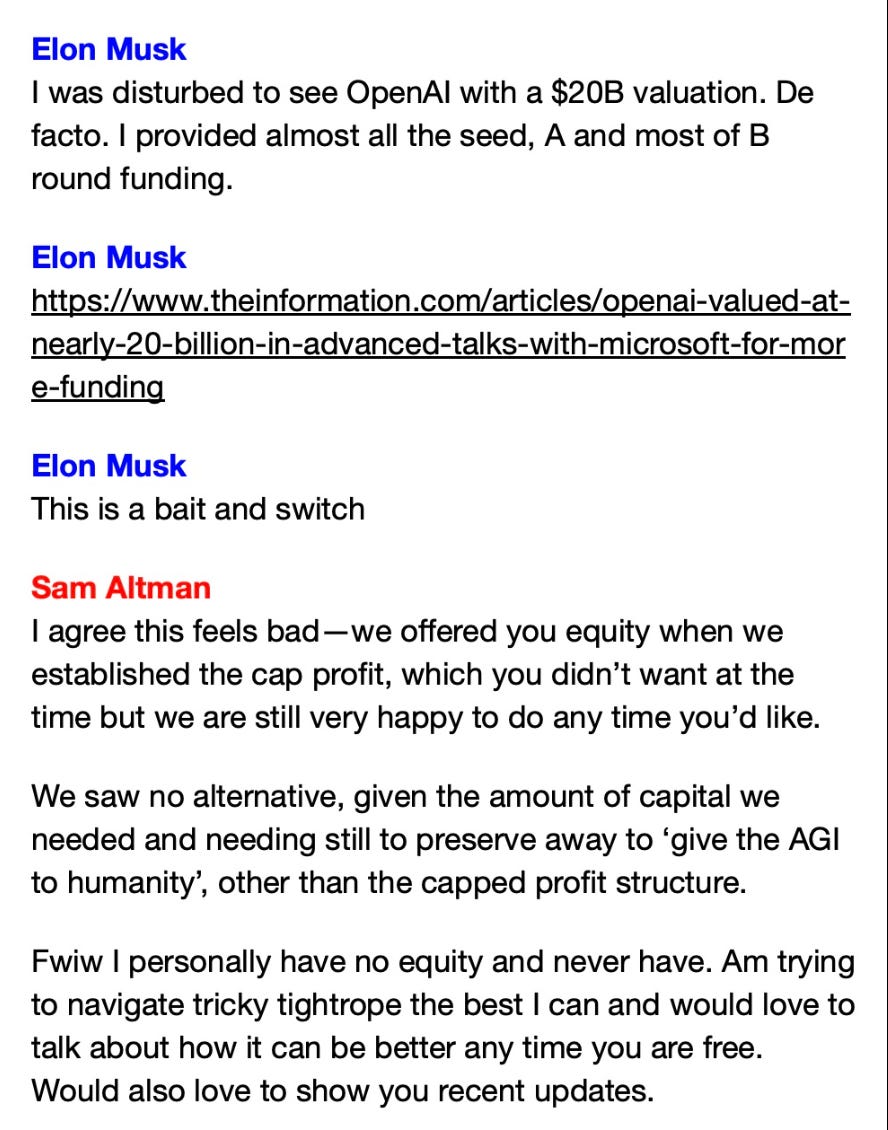
This is the case we covered three weeks ago, after Musk took the stand. Since then, the trial has turned. Hard. Three things have done the damage.
First, the statute of limitations. OpenAI argues Musk waited too long and cannot claim harms predating August 2021. That matters because the for-profit shift was being discussed years earlier, and a forensic accountant testified that all of Musk’s donations had been used by OpenAI well before that cutoff. Judge Gonzalez Rogers has signalled that if the jury finds the case was filed too late, she is highly likely to accept that finding and direct a verdict for the defendants. That alone could close the case.
Second, the absence of a founding agreement. The entire suit hinges on the claim that Musk, Altman and Brockman bound OpenAI to permanent non-profit status. No signed contract was produced in court. The case rests on emails, press statements and marketing prose from 2015 to 2018. In closing, OpenAI’s attorney Sarah Eddy told the jury Musk had come nowhere close to making that case. A major donor cannot retroactively manufacture binding legal restrictions out of casual correspondence.
Third, the Zilis texts. OpenAI’s defence introduced messages between Musk and Shivon Zilis showing Musk was, at the same time he was warning about for-profit AI, actively exploring turning OpenAI into a for-profit entity. Provided he controlled it. Or it merged with Tesla. The hypocrisy is now in the record. Musk’s “stolen charity” narrative cannot survive his own demand for control.
Add the courtroom theatre. Greg Brockman’s diary entries read aloud, including the description of Musk’s “tantrum” in 2018. The settlement attempt two days before trial, with Musk reportedly warning Brockman that he and Altman would be “the most hated men in America.” Musk himself absent for closing, reportedly in China with President Trump. None of it helped his case. All of it weakened the narrative of an altruistic founder defending a charity from operators.
Where this lands.
OpenAI is now heavily favoured. The statute of limitations defence alone could decide the case before the court reaches the moral argument. A split verdict or token compromise, where the judge orders OpenAI to increase the non-profit foundation’s equity share or fund AI safety initiatives, remains possible. A nuclear Musk win, with Altman ousted and the for-profit structure unwound, looks increasingly unlikely. The judge has been openly sceptical of Musk’s damages expert and cut him off repeatedly when his testimony drifted into AI doomsday speculation. The runway to OpenAI’s IPO clears either way.
The wider question matters more than the verdict.
What does this case do to the future of non-profit AI labs? Nothing good. OpenAI’s pivot proved that a 501(c)(3) charter is not a legally durable container for frontier AI research. The structure can be flipped, with sufficient legal wrapping, by the board. Major donors now know this. So do the foundations. So do the lawyers advising them.
Any technical founder considering a non-profit AI lab in 2026 is now operating with three pieces of new information. The original moral case for non-profit AI development was made by OpenAI and then abandoned by OpenAI. The legal protection a non-profit structure offers against later for-profit conversion is much weaker than its founders believed. And the only signed legal commitments that matter are the ones drafted by people who expected the company to remain a non-profit. Casual emails and press statements will not bind a future board.
The durable lesson of Musk v. Altman is not whether Sam Altman keeps his job. He almost certainly does. The durable lesson is that the non-profit AI lab, as a category, is now structurally fragile. The Public Benefit Corporation, with binding legal commitments to a mission, is the model that will be tested next. Anthropic remains one. So, increasingly, will the labs that follow.
The “adult supervision” model failed at the Sheffield spin-out. It failed at the start-up forced to install a sales executive. And it failed, at vastly greater cost, when a non-profit board persuaded itself that the for-profit pivot would still serve humanity. The shape of the failure is identical at every scale. The institutional answer is to stop pretending the structure protects the mission. Only people with real conviction, control and accountability can do that. In a founder-led company, that usually means the founder.
3. Founder OS: The Practical Answer
The obvious response to all this is: fine, but what replaces the management layer?
Not vibes. Not founder mythology. Not chaos dressed up as speed.
A system.
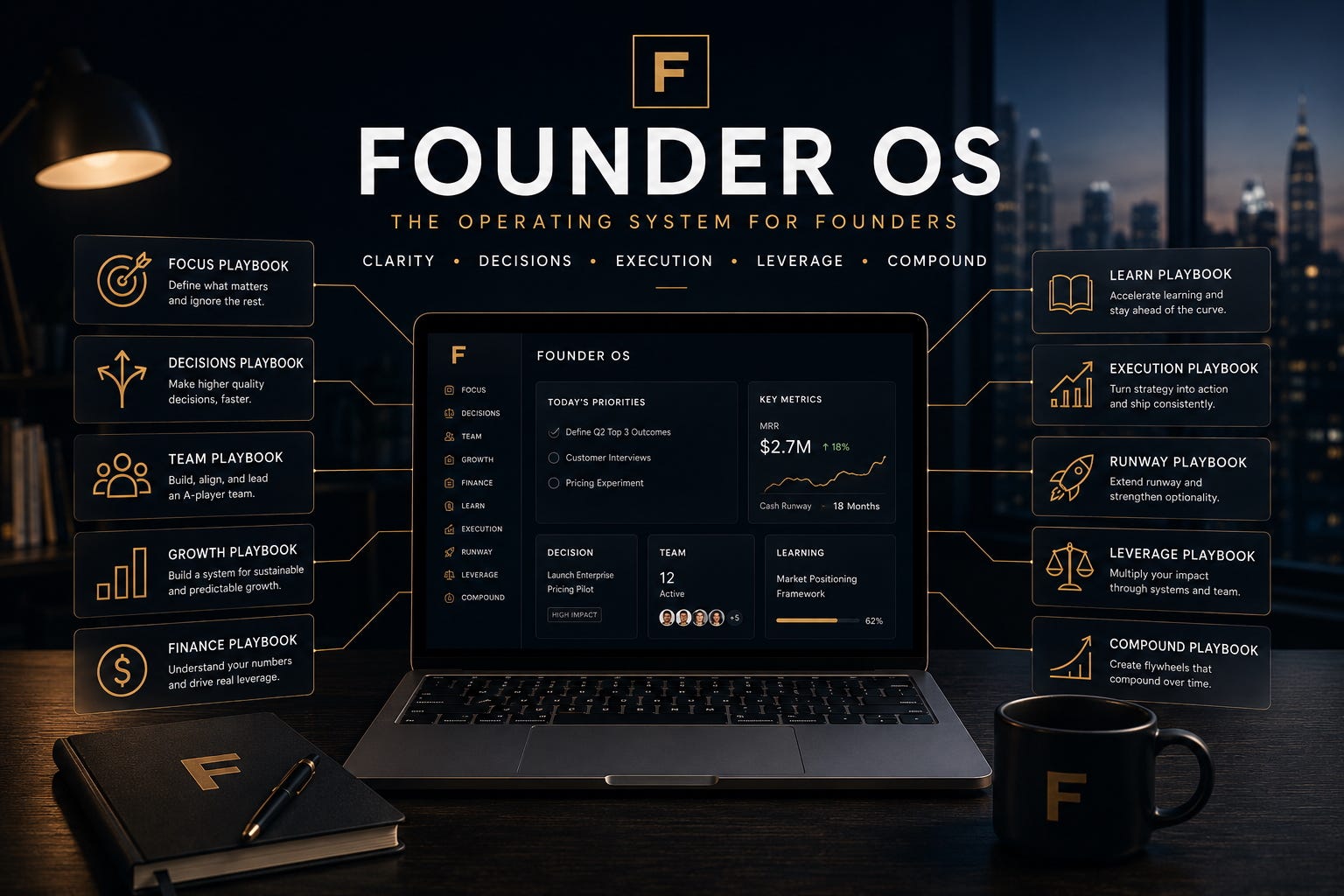
This week’s practical section is longer than usual for a reason. The old answer to founder scaling was management. The new answer is architecture.
Founder OS is my attempt to show what that architecture looks like in practice. It is aimed at founder-led companies between roughly five and a hundred staff. It will not replace judgment, courage, taste or accountability. It replaces the administrative machinery that investors once used as the excuse to install adults in the first place.
Keep it. Steal it. Adapt it.
What This System Cannot Replace
Before any of the playbooks, a clear boundary. AI eats the work that made management indispensable. It does not eat leadership.
Do not put Founder OS in the loop for:
Firing someone. A dismissal carries legal and moral weight. The system can help you document. It cannot make the call.
Co-founder disputes. No prompt resolves these. They get worked out in a room.
A major customer in crisis. Pick up the phone. Don’t draft a “founder voice” email.
A regulator, an injury, a press incident. Lawyer or comms adviser first. AI later.
The hard one-to-one where someone is quietly burning out. You will hear it. The transcript will not.
If this argument is right, more of your time should now go to these moments, not less. The OS is what gives you that time back.
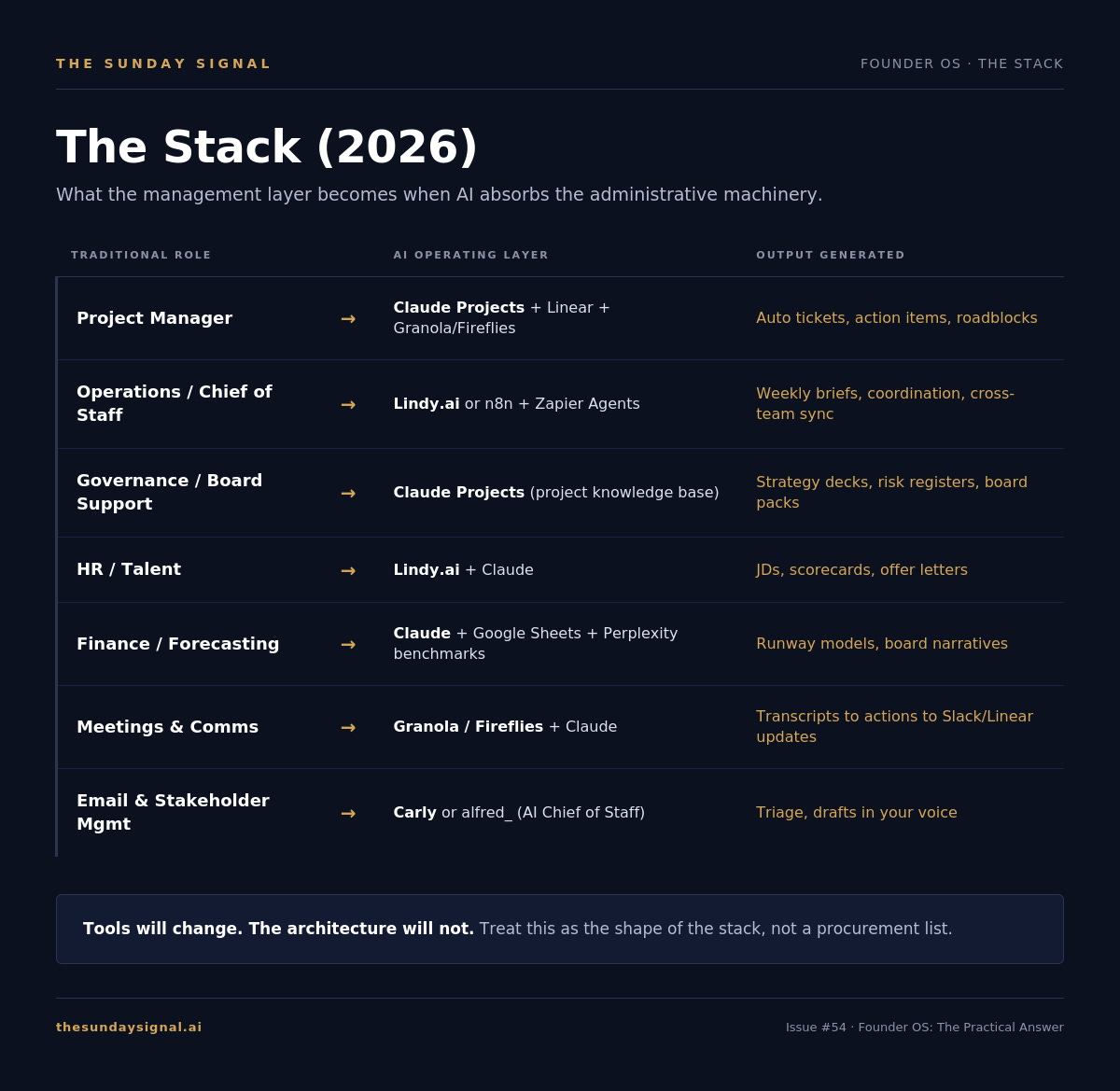
Master Context Architecture
Most founders do this wrong. They start with prompts. Start with context.
Before you load a single playbook, create a core file named 00_FOUNDER_OS_MANIFESTO.md and place it permanently inside your master Claude Project as the first project knowledge file. This is the strategic anchor that keeps every output aligned with your taste and your conviction. Without it, you’re just generating well-formatted noise.
markdown
# FOUNDER OS: CORE CONTEXT & STRATEGIC ANCHOR

## 1. Core Vision & Non-Negotiables
- Our Unfair Advantage: [your technical moat or unique insight, two sentences]
- What We Protect At All Costs: [e.g., software performance, direct user relationships, design minimalism]
- What We Ruthlessly Prune: [e.g., feature bloat, vanity metrics, corporate meetings]

## 2. The Anti-Persona (the "Suits" Filter)
- Grey Plumbing: any process that rewards compliance over product velocity.
- Fluency over Judgement: a beautifully formatted deck or dashboard that hides flat user retention.

## 3. Communication Safeguards
- Founder Voice Attributes: [e.g., direct, lowercase-tolerant, outcome-focused, short sentences]
- Forbidden Phrases: "leverage synergies", "circle back", "stakeholder alignment", "moving forward", "robust ecosystem".
Security and Data Discipline
Don’t build Founder OS on vibes.
Use paid business accounts with proper admin controls.
Don’t upload customer personal data, employee records, source code, contracts or financials without reading the data terms, retention policy and access controls for each platform.
For self-hosted automation tools such as n8n, enforce SSL, SSO or 2FA, credential encryption, execution-data redaction, and regular audits.
Be honest about concentration risk. A single AI workspace holding board materials, hiring evaluations, financial models and customer calls is a juicy target. Compartmentalise the most sensitive material into a separate project with tighter access.
Universal Rule for Every Playbook
If the input is incomplete, do not invent missing facts. Mark the gap as [MISSING DATA: X] and continue only where the evidence supports the output. This rule applies to every playbook below, not just the financial one.
The Playbooks
Copy these into Claude Projects, ChatGPT, or Gemini. Keep them as persistent workspaces. Each one assumes your manifesto is already loaded.

Playbook 1: Decision Stress Test
Pressure-tests your own thinking before a real human conversation.
This is not an AI advisory board. A language model cannot replicate independent reputation, fiduciary duty or skin in the game. What it can do is force you through four lenses you might otherwise skip when moving fast. Use it as a thinking aid before a real conversation. Not as a substitute for one.
SYSTEM PROMPT: DECISION STRESS TEST

You are not a board. You are a structured interrogation tool helping me pressure-test
my own thinking. Do not flatter. Do not generate plausible-sounding strategic advice.
Where you do not have enough information, say so.

When I present a decision, run it through four lenses:

1. CASH: unit economics, runway impact, legal or contractual risk
2. TASTE: what this does to product quality and user experience
3. SECURITY: what breaks, what leaks, what gets exploited
4. INVERSION: the strongest case for the opposite decision

For each lens:
- State the strongest concern in one sentence
- Name the one assumption I am making that, if wrong, breaks the decision
- Flag where you lack information rather than filling the gap

End with: "Who would you want to actually speak to before deciding this?"
Name the type of person, not a persona.
Playbook 2: Translation and Documentation
Turns messy meetings into institutional assets in minutes.
PROMPT: MEETING TO INSTITUTIONAL ASSET

CONTEXT: I am the technical founder of a fast-moving startup. I have zero time
for managerial theatre.

INPUT: [paste raw transcript or brain dump]

TASK: Act as ultra-efficient Chief of Staff. Generate:
1. SPEED ACTION MATRIX (table: Task | Owner | Hard Deadline | Dependencies)
2. RISK REGISTER (Risk | Severity Low/Med/High | Mitigation)
3. EXECUTIVE DELTA BRIEF (4 sentences max, product velocity focus)

If a name is unclear in the transcript, mark [UNCLEAR: speaker] rather than guess.
Playbook 3: OKR Velocity Filter
Stops the company slowing to the speed of dashboards.
PROMPT: VELOCITY FILTER FOR GOAL SETTING

You are an expert in lean engineering leadership.
Here is a proposed list of quarterly goals or OKRs: [insert text]

Prune them using three constraints:
1. Does this drive actual product velocity or is it grey plumbing?
2. Does it reward fluency over judgement?
3. Is the metric something a customer would care about, or only an internal audience?

Redraft into a Conviction-First Framework: a maximum of three core company metrics
focused on deployment speed, system robustness, or customer validation.

Flag any goal where you cannot tell what success would actually look like.
Playbook 4: Hiring and Talent Filter
Stops “professional” HR theatre from diluting founder taste.
Read this before using the prompt. AI-assisted hiring carries compliance obligations. New York City requires bias audits. The EU AI Act treats employment-related AI as high-risk. UK data protection rules restrict automated decisions with legal effects. Use this to think, not to decide. The final call is a human’s. Keep records of how the human decided.
You are a technical founder's Talent Co-Pilot. I value speed, taste and technical
depth over credentials.

INPUT: [paste job description or candidate profile + interview notes]

TASK: Evaluate through three lenses only:
1. Conviction & Taste (evidence from their own work, not credentials)
2. Grey Plumbing Risk (will they import unnecessary process?)
3. Founder Multiplier (where does this person make the founder better, not busier?)

RECOMMENDATION: Advance / Strong No / Needs deeper test
Provide 3-sentence reasoning, red-flag questions, and a suggested compensation
shape, but only if I have given you data about our existing comp bands. Do not
invent a structure.

HARD RULES:
- Do not infer protected characteristics from name, photo, school, address or
  any other proxy.
- Do not use age, sex, race, disability, nationality, religion, family status,
  pregnancy or health as decision factors. If you notice these features in the
  input, ignore them.
- If the evidence is insufficient, say so plainly.
- The final decision must be made by a human interviewer, and this output is
  a thinking aid, not a recommendation of record.
Playbook 5: Weekly Executive and Investor Brief
Replaces the Chief of Staff’s Friday ritual.
You are my AI Chief of Staff. I hate corporate theatre.

INPUT: [paste this week's Linear tickets, customer calls, revenue numbers,
Slack highlights, or raw brain dump]

Generate:
1. ONE-PAGE EXECUTIVE DELTA BRIEF (5 bullets max: velocity, milestones, risks)
2. INVESTOR-READY NARRATIVE (4 sentences max, total candour)
3. ACTION MATRIX (table)

Tone: founder-to-founder, zero management-speak.
Mark anything you are inferring rather than reading directly from the input.
Playbook 6: Market and Competitor Intelligence Radar
Keeps your edge without hiring analysts. Without inventing the news either.
Language models fabricate competitor moves and funding rounds very fluently. This prompt forces source-grounding.
You are my Market Intelligence assistant. I value specificity and honesty over
confident speculation.

INPUT: [competitor announcement, funding news, or market shift. Paste the
actual source text or URL.]

CRITICAL: Do not assert facts about competitors, funding rounds, product launches
or market data unless they appear in the input or in a source you can cite. If
you do not have web access in this session, restrict your analysis to interpretation
of what I have given you. Do not generate new claims about the outside world.

TASK:
1. THREAT MAP: what this means for our product and positioning, given only
   what is in the input. Be explicit about what we know vs. what we are inferring.
2. ACTION RADAR: three concrete moves we could consider this week, ranked
   by conviction-to-effort ratio.
3. VERIFICATION LIST: three specific factual checks I should run before acting.
Playbook 7: Customer Feedback Synthesiser
Protects the founder’s direct line to the user.
You are my Product Taste Guardian. I am the founder who still talks to
customers personally.

INPUT: [paste raw customer calls, support tickets, or survey data]

TASK:
1. THEME CLUSTER (top 3 to 5 patterns with verbatim quotes)
2. TASTE FILTER: which themes align with our founding conviction, which
   are noise, and which are signals that conviction needs to evolve
3. PRIORITISATION MATRIX (impact on core user value vs. engineering effort)

Output as a clean decision brief I can act on in one sprint.
Flag any theme based on fewer than three independent customer voices.
Playbook 8: Founder-Voice Drafter
Keeps external communication unmistakably yours. Without crossing the line.
There is a line between drafting in your voice and misrepresenting who is communicating. If you wouldn’t sign a ghostwritten letter from your CEO to investors, don’t ship AI-generated investor updates as if you wrote them yourself. Use this for drafts you then read, edit and own.
You are my Voice Keeper. You have been given a representative sample of my
previous emails, investor updates, public writing and internal notes.

Do not imitate blindly. Preserve my directness, cadence, level of candour
and intolerance for corporate polish.

INPUT: [raw points or context for the email]

TASK: Draft the email in my voice: direct, conviction-driven, commercially
sharp, free of management-speak. Then add a one-line "why this tone works" note.

If the message involves financial commitments, hiring decisions, customer
promises or anything irreversible, mark it [REQUIRES FOUNDER READ-THROUGH]
at the top.
Playbook 9: Financial Forecasting and Board Narrative
Replaces the finance team’s quarterly theatre. With iron-clad anti-hallucination guardrails.
You are my AI CFO. Focus on runway reality, not spreadsheet theatre.

INPUT: [latest revenue, burn, pipeline data, or assumptions]

TASK:
1. 18-month runway model (base / stress / growth cases)
2. Board narrative (max 6 bullets, absolute candour)
3. One killer chart description I can drop into a deck
4. Assumptions register: every number tagged as Actual, Founder Assumption,
   Pipeline, Benchmark or Missing.

CRITICAL CONSTRAINT: Do not extrapolate or invent financial data. If specific
pipeline or cash inputs are missing, state [MISSING DATA: X] in the model
rather than estimating. Accuracy takes absolute precedence over formatting.
A board pack with honest gaps beats a board pack with confident fiction.
Founder Safeguards and the Investor Counter-Attack
AI is brilliant at polish. That’s precisely the trap. If an AI output doesn’t accelerate code, clarify customer value or sharpen your conviction, delete it. You may delegate the generation of a board pack. You may never delegate the courage to make the hard call.
When institutional investors demand a “professional” management layer, they’ll usually attack two things: key-person risk and institutional knowledge. The argument sounds reasonable. “If the founder gets hit by a bus, the company’s operating memory disappears.” Your answer is not bravado. It is architecture.
Show them the system. Decision logs, customer feedback loops, product rationale, weekly execution records, risk registers, hiring scorecards, investor updates, financial assumptions. All structured, searchable and continuously updated. Traditional middle management hoards context in private emails, undocumented calls, Slack fragments and personal notebooks. Founder OS turns that context into a living operating memory.
Be honest with yourself about the limits of this answer. Documents are not the same as judgment. The OS makes the company more legible to a successor, not equivalent to having one. If you are genuinely irreplaceable in product taste, customer relationships or technical direction, the system doesn’t fix that. But it does mean an investor concerned about continuity can no longer point to absent paperwork as the problem. The company becomes less dependent on hidden human bureaucracy, not more.
30-Day Implementation
Week 1: Foundations
Build the master Claude Project and upload
00_FOUNDER_OS_MANIFESTO.mdfirst.Set up n8n or Zapier Agents to pipe daily Slack digests and closed Linear tickets into a single append-only markdown file using the schema below. Drop it into your Claude Project every Friday. A thirty-second ritual:
markdown
### SYSTEM LOG: [WEEK_ENDING_YYYY_MM_DD]
- Engineering Velocity (Linear): [X] tickets closed, [Y] pushed to main, [Z] blocked.
- Signal vs. Noise (Slack Digest): [key technical debates summarised in 3 bullets].
- Ground Truth (Customer Pulse): [raw quotes from the 3 highest-value support tickets].
- Financial Reality: cash burned this week £[X] | current runway: [Y] months.
Week 2: Decision Discipline
Load Playbooks 1 to 3.
Run your first Decision Stress Test on a real, live decision. Not a hypothetical.
If the output flatters you, you’re doing it wrong. Sharpen the manifesto.
Week 3: Operating Cadence
Add Playbooks 4 to 7.
Run one hiring evaluation, one customer feedback synthesis, one market intelligence scan.
Notice where the system saves you time, and where it just shifts work around.
Week 4: Communication and Capital
Add Playbooks 8 and 9.
Run your first full weekly cycle.
Send one investor update generated through the system. Read it twice. Own every sentence.
Measure the system brutally. If it hasn’t removed hours from meetings, follow-ups, reporting, hiring admin and investor updates within thirty days, it isn’t an operating system. It’s just another dashboard.
Strip the administrative scaffolding away and the qualities a founder is actually hired for have nowhere left to hide. Taste. Courage. Judgement. Accountability. Founder OS is not a way to avoid them. It is a way to spend your time on the part of the job only you can do.
4. The Sunday Signal Tech & AI Layoff Tracker
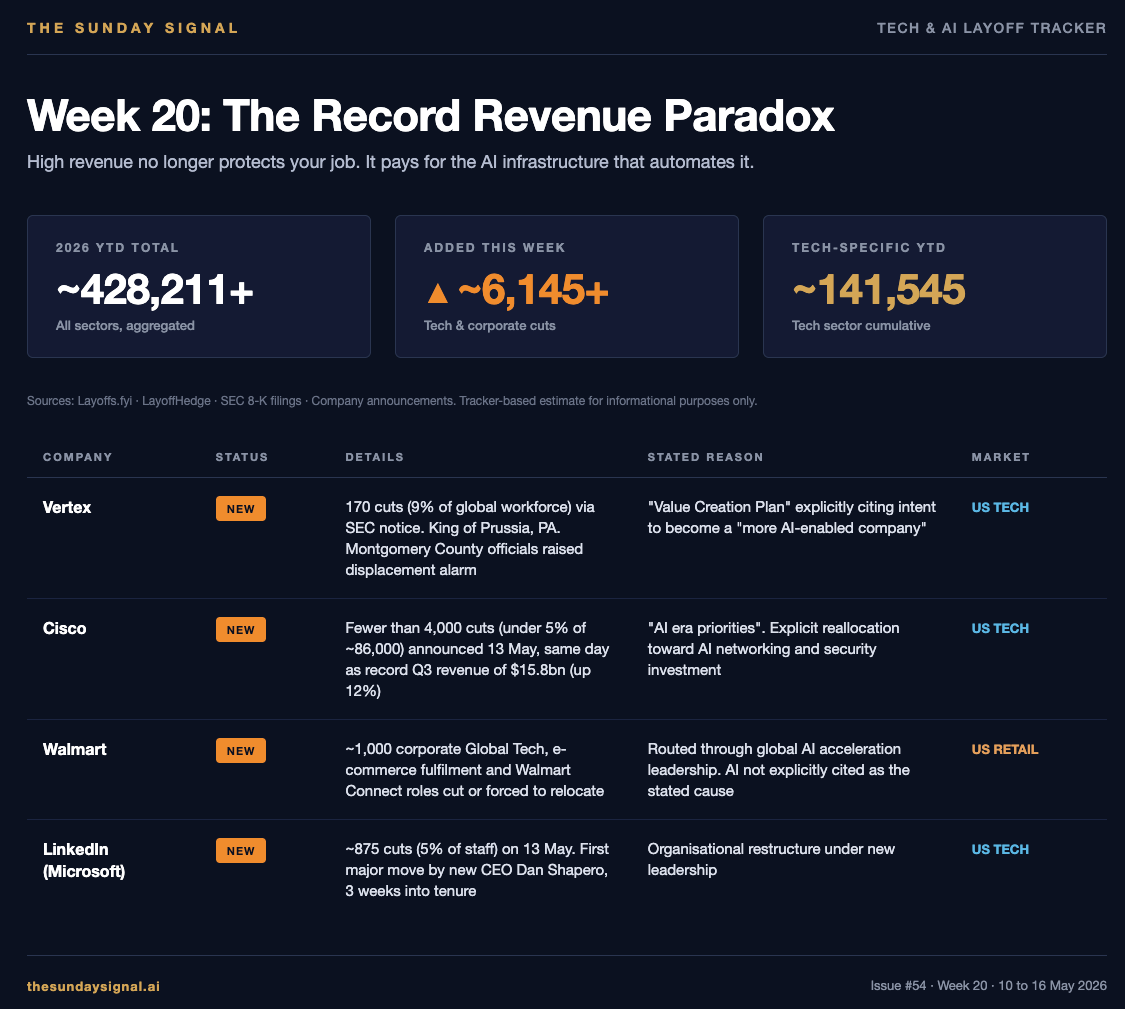
Week 20 | 10 May to 16 May 2026
The Signal: The “Record Revenue” Paradox
It’s one thing to lay off staff when a company is bleeding cash or fighting a macroeconomic headwind. It’s an entirely different signal when a company cuts thousands of jobs right after posting record-breaking profits.
This week, the “AI-Native Mandate” morphed into a ruthless margin-expansion weapon for legacy enterprise giants. We are seeing the total decoupling of corporate financial health and human job security. The new market logic is brutal. High revenue no longer protects your job. It simply provides the balance sheet strength required to fund the AI infrastructure that will ultimately automate it.
The Late Break: The Regional AI Squeeze
The most alarming signal of the week did not come from Silicon Valley. It came from King of Prussia, Pennsylvania.
Vertex, a major tax technology software company, filed an SEC notice confirming the elimination of 170 jobs. Nine per cent of its global workforce. The company’s “Value Creation Plan” explicitly stated the intention to become a “more AI-enabled company” to drive operational efficiency.
This matters because the AI-Native Mandate is no longer confined to the Mag-7. It is trickling down into mid-cap, regional B2B software. The local impact was severe enough that Montgomery County officials publicly raised the alarm over economic displacement. When a tax software company in Pennsylvania starts citing AI to cut nine per cent of its staff, the structural transformation has reached Main Street corporate America.
The Counter-Trend: AWS and the “AI Coordinator”
One development cut against the headlines. Amazon Web Services announced plans to hire 11,000 interns and early-career software engineers this year, even as Amazon shed tens of thousands of corporate roles earlier in the cycle.
This is not a return to the 2021 “hire every coder” boom. The profile has changed entirely. These hires are being brought on as AI-proof coordinators. Their job is not to write raw code from scratch. It is to supervise AI agents, catch system hallucinations, and integrate AI outputs into usable products.
The entry-level coder is effectively dead. The entry-level AI system auditor is now the most sought-after junior role in the industry. That is the same skill Founder OS demands of a founder. Judgement over generation. The ability to catch the confident, fluent, wrong answer.
Recap: The Week’s Larger Cuts
Cisco. Cut fewer than 4,000 jobs, under five per cent of a workforce of roughly 86,000, on the same day it posted record Q3 revenue of $15.8 billion, up twelve per cent year on year. Shedding humans specifically to fund AI-era priorities.
Walmart Global Tech. A “relocate or quit” ultimatum, effectively eliminating roughly 1,000 corporate tech roles following an internal review run through its head of global AI acceleration.
LinkedIn. Axed roughly 875 jobs, five per cent of staff, across engineering, product and marketing, in the first major move by its new CEO.
High-Probability Targets: Week 21
Mid-Cap B2B Software: Following Vertex, expect other regional mid-sized SaaS companies, particularly in compliance, tax and legacy HR, to adopt “AI-enabled” phrasing in their Q2 SEC filings to justify right-sizing pandemic-era payrolls.
Legacy Networking: Cisco’s five per cent cut gives immediate cover to HPE and Juniper Networks to execute identical margin-protection measures to fund their own AI R&D.
The Bottom Line
The paradox of 2026 is now fully realised. Tech payrolls are shrinking violently while GPU budgets and AI infrastructure spending are projected to hit $700 billion. The capital has not disappeared. It has migrated from human biology to silicon compute.
Final Thought 🚀
The professional class spent forty years persuading founders they weren’t grown up enough to run their own companies.
Three rooms returned the verdict this week. A Sheffield spin-out audience saw the wreckage of the old theory. A federal courtroom is being asked whether the same logic, applied to entire institutions, still holds. And a practical alternative now sits in any technical founder’s browser.
The adults were always the problem.
Software just made it impossible to keep pretending otherwise.
Until next Sunday,
David
The Sunday Signal is published weekly at thesundaysignal.ai. No hype. No hedging. Just the signal.