
The Decision Has Already Been Made
The boardroom, the market and the street are converging on the same answer. Most leaders are still pretending to debate it.

Issue #51 | Week 18 | Sunday 26 April 2026
This issue is also available as a podcast. Listen on Spotify, Apple Podcasts or YouTube and tell me what you think.
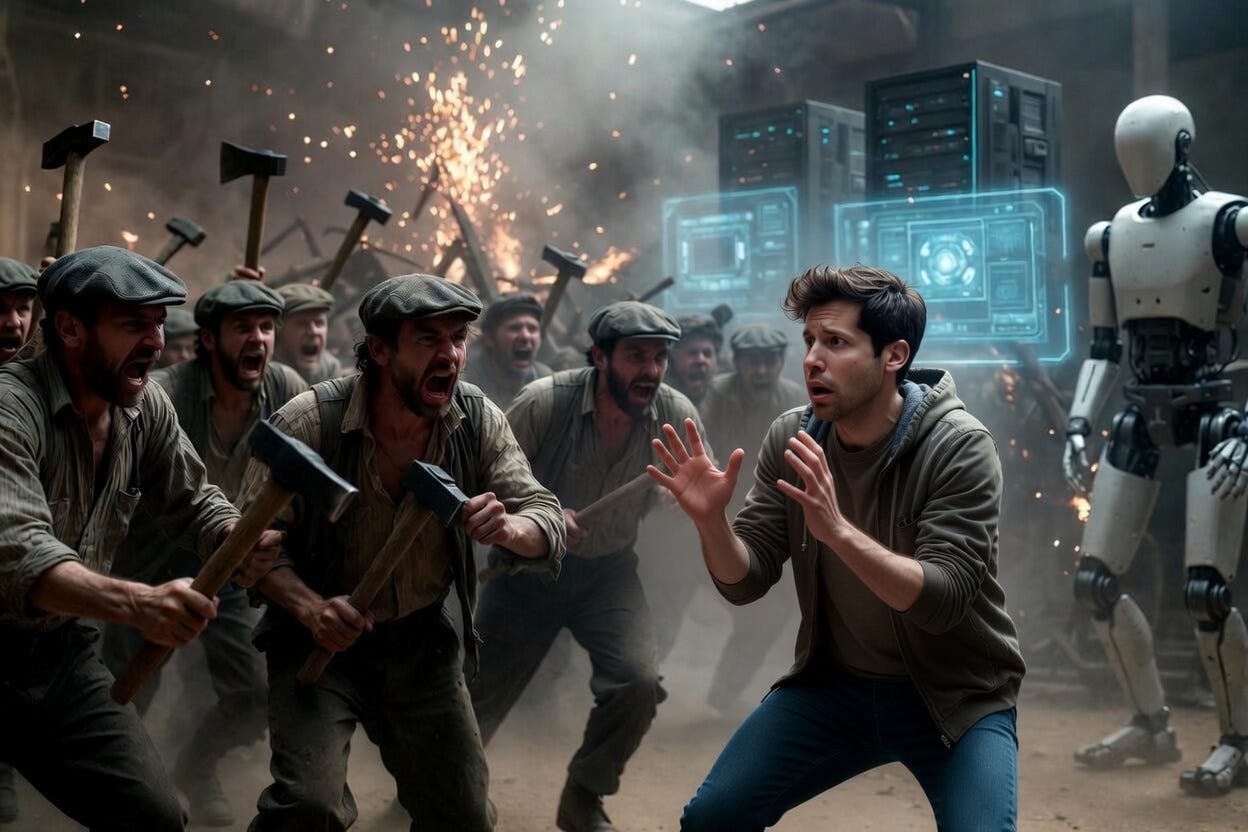
Bottom Line Up Front
Every company in the West is about to become a different company. Not in a decade. In months. The only question left is who moves first: the board, the market, or the mob. This week Microsoft picked one answer. The prediction markets picked another. Sam Altman’s front gate picked a third. A girl expelled from school at fifteen, now standing in a barrister’s robes, picked a fourth. Most leaders will misread all of them.
1. The Zombies on Your Payroll
Peter Drucker asked one question most managers spend their careers avoiding. If we were not already doing this, knowing what we now know, would we start today?
Try it on one of your own departments. The honest answer is almost always no.

Drucker called the consequence “systematic abandonment”. In plain English, it means stopping the activities that once made sense, still draw salary, and quietly crowd out whatever comes next.
For most of the last century, leaders could dodge that question for years. What they knew changed slowly. Strategy could wait.
That world has gone.
What we know now changes between one frontier model release and the next. Decisions Drucker imagined being taken every few years are now being forced on companies in months.
A clarification, because it matters. By zombies, I do not mean people. I mean functions, layers and workflows built for yesterday and never redesigned. The middle manager whose role is to summarise reports for the level above. The centre of excellence that exists mainly to explain itself. The team producing drafts that a model can now generate in seconds.
Zombies are not your colleagues. They are the structure around them.
And that structure is starting to break.
The evidence is arriving first from America’s corporate giants. Oracle has begun cutting 30,000 roles while investing heavily in AI infrastructure. UPS plans to shed up to 30,000 operational jobs as it consolidates into fewer, more automated hubs.
The causes differ. AI in one case. Automation in another. A changing customer mix in a third. What unites them is Drucker’s question.
Not one of those companies would build itself today exactly as it is.
Here is the uncomfortable truth. If I were running a 200-person company again, and I knew the real shape of the business was 25 to 50 people smaller, could I make those cuts? I do not know.
I have hired people across the companies I have built. I know what a job means to a mortgage, a family, a life. Leaders tell themselves people can be redeployed or retrained. Sometimes they can. Often, at the speed the market now demands, they cannot.
That is the part Drucker never quite captured. Abandonment is not a spreadsheet exercise. It is grief, entered into knowingly, because the cost of refusing is greater.
Most leaders cannot do it until the market does it for them. That is how you become Kodak, protecting film long after the digital future was visible. That is how you become Nokia, defending an ageing platform while a new one takes the world.
So here is the question for every chief executive. If you were founding your company this week, with a credit card and an API key, would you build what you have now?
If the answer is no, the decision is already made. The only question is whether you act on it, or wait for the market to act for you.
2. Microsoft Breaks Fifty-One Years of Silence
This week Microsoft did something it has never done in its history.
On Thursday the world’s most valuable software company offered voluntary retirement to roughly 8,750 American employees, about 7 per cent of its US workforce. It is the first such programme in the company’s 51-year life.
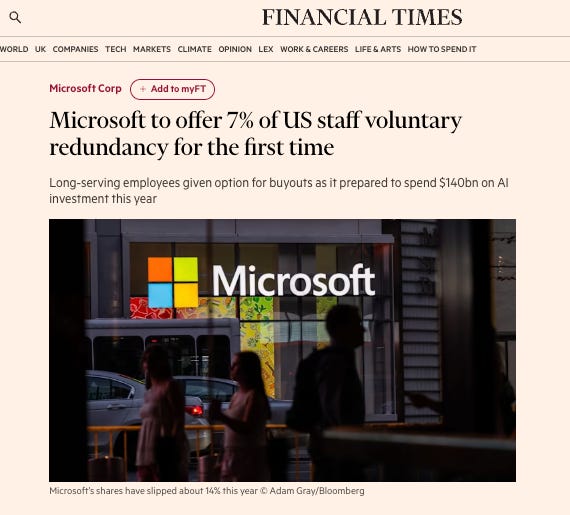
The eligibility rule is called the Rule of 70. An employee’s age plus their years of service must equal 70 or more. A 50-year-old with 20 years at the company qualifies. So does a 45-year-old with 25 years of service. Details land on 7 May. Eligible staff have 30 days to decide.
This is not a layoff. It is a buyout dressed as a benefit. And it is the clearest signal yet of what the AI transition actually looks like inside the world’s largest technology companies.
Microsoft reported 38.5 billion US dollars in net income last quarter. It is projected to spend between 110 and 120 billion US dollars on AI infrastructure this fiscal year. The company is not cutting because it cannot afford its people. It is cutting because it has chosen to afford something else.
Chief People Officer Amy Coleman’s internal memo framed the programme as giving eligible workers “the choice to take that next step on their own terms”. Read that carefully. The choice being offered is not whether to leave. It is whether to leave now, with dignity and a cheque, or later, with neither.
The Rule of 70 is not random. It targets long-tenured employees whose institutional knowledge was built around the pre-AI Microsoft. The Windows XP generation. The Server and Tools expansion. The early Azure buildout. These are the people whose expertise centres on systems Microsoft is now automating or deprecating.
Microsoft is not alone. Meta is cutting 8,000 jobs on 20 May. Oracle cut up to 30,000 in March. Amazon has signalled roughly 30,000 cuts across AWS and Alexa in the first half of the year. Meta’s capital expenditure on AI infrastructure is projected to reach 135 billion US dollars.
The arithmetic on Wall Street is now ironclad. You cannot fund a hundred-billion-dollar compute pivot while carrying pandemic-era headcount. Software engineers are no longer the most valuable asset on a technology balance sheet. Compute is.
Microsoft’s version is kinder than Meta’s, because Microsoft can afford to be. The financial payout, the extended healthcare, the 30-day window. All of it is designed to minimise legal risk and reputational damage. It is a polite exit.
The message is not polite. The veteran workforce that built the pre-AI Microsoft is being offered a seat in the lifeboat while the company sails into a different century.
This is not a transition. It is a replacement, conducted with paperwork and a 30-day window. Drucker would have recognised it instantly.
3. What the Betting Market Knows
The sharpest read on what is coming next is not in any analyst note or McKinsey deck. It is on Polymarket.
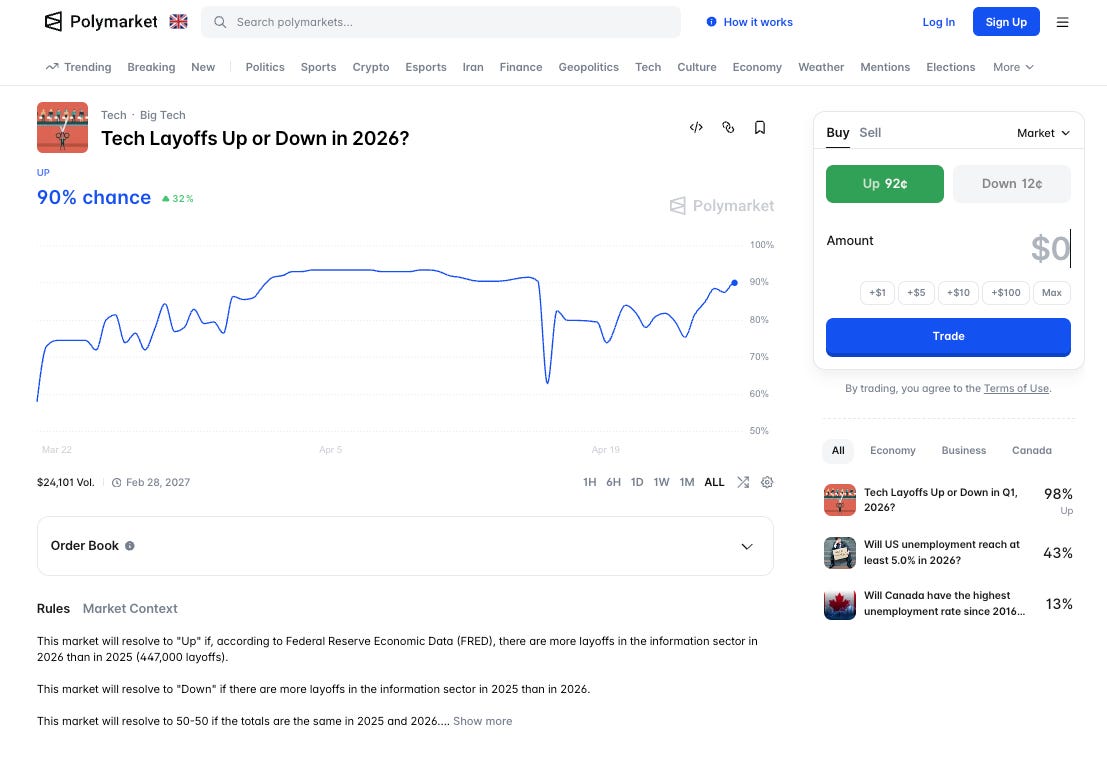
The contract on whether US technology layoffs in 2026 will exceed the 2025 baseline of 447,000 currently trades at a 90 per cent probability. Real money. Real traders. Real consensus. The sister contract on Q1 alone has already moved to 98 per cent. The market opened in March. It has barely wavered since.
Nobody is paid to be wrong on Polymarket. Strangers with no equity in any of these companies and no axe to grind are wagering their own wallets that this is the year the dam breaks.
The market has already made the decision that boards are still pretending to debate.
When the boardroom, the betting market and the street converge on the same outcome, only the timing is in dispute.
4. The Luddites Come for Altman
At four in the morning on 10 April, a 20-year-old man from Texas threw a Molotov cocktail at the front gate of Sam Altman’s house in San Francisco.
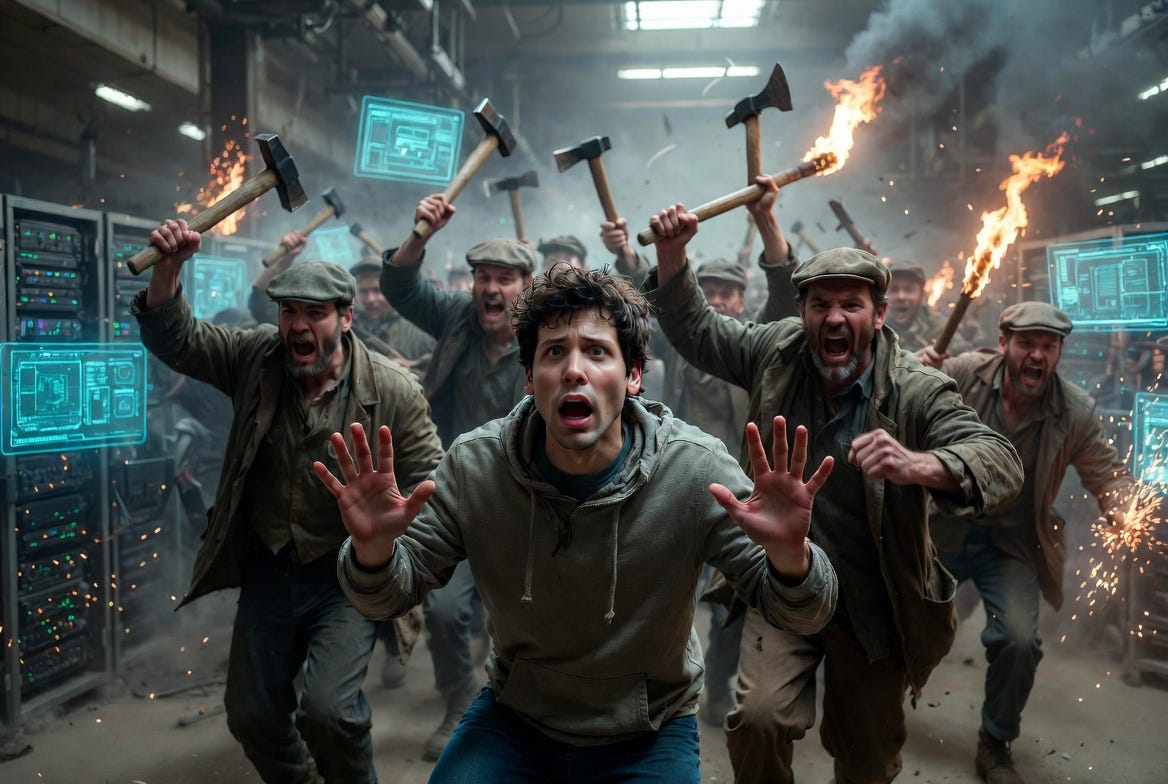
The gate caught fire. Nobody was injured. The attacker, Daniel Moreno-Gama, was arrested an hour later at OpenAI’s headquarters, carrying a jug of kerosene, a lighter, and a document prosecutors say outlined his opposition to AI and what he called humanity’s “impending extinction”. He had published similar views on a personal Substack. He is charged with attempted murder.
Three days later gunfire was reported near Altman’s home and two more arrests followed. Earlier this month someone fired thirteen rounds at the home of an Indianapolis city councillor who had voiced support for a local data centre. The note left behind read: “No data centres.”
This is the backdrop to everything else in this issue. It is also not new.
In 1811 English textile workers began breaking into factories and smashing the wide-frame looms they believed were destroying their livelihoods. They called themselves Luddites, after the mythical General Ned Ludd. Within five years the British government had made frame-breaking a capital offence.
The Luddites were not anti-technology. They were anti-accountability. They were fine with the looms. They were not fine with a generation of factory owners using those looms to bypass labour protections and drive wages to subsistence while getting rich. Parliament ignored their petitions. So they picked up hammers.
The pattern repeated a century later in France, where disgruntled workers supposedly threw their wooden shoes, or sabots, into the gears of new machinery. That is where the word sabotage comes from.
The template is consistent across two centuries. When people feel a technology is being used on them rather than for them, the response moves from vocal to physical. The violence is almost never about the technology itself. It is about the power dynamic the technology creates.
History teaches four lessons, and every boardroom should read them now.
Disruption without a safety net radicalises people. The Luddites did not reach for hammers the day the loom arrived. They reached for them after Parliament ignored seven years of petitions for transition assistance. Indifference is combustible.
Consent is the only durable business model. Apple scans your face, but gives you a lifetime of searchable photographs. Google tracks your location, but ensures you are never lost. Ambient, unavoidable technology breeds resentment. AI is currently being installed into daily life with neither opt-in nor recourse.
Transparency prevents conspiracy. When a technology is a black box, the public fills the void with its worst fears. Even the builders of the large language models cannot fully explain their internals. Into that gap walks every manifesto-writing 20-year-old with a grievance and a bottle of petrol.
Regulation is a pressure valve, not a burden. When consumers can sue, when governments can fine, when products can be recalled, anger has somewhere to go that is not a billionaire’s front gate. Remove those options and the only recourse left is the street.
Aaron Zamost argued in the New York Times this week that Americans now feel about Big Tech what they feel about health insurance companies. They cannot opt out, cannot switch, and cannot hold anyone to account. Seventy-seven per cent of Americans believe AI could pose a threat to humanity, an idea Altman himself has publicly advanced.
Altman will survive this. OpenAI will survive this. The industry should not act surprised.
The attack on his front gate was not a watershed. It was a warning shot.
5. What the System Missed
This week I wrote about Leonie Hughes.
Expelled from school at fifteen. A mother, in effect, to her younger sister at eleven. She grew up surrounded by domestic violence and substance abuse. The education system looked at her and decided she did not fit. Today she is a barrister. She chose law, she says, because it was one of the hardest careers to go into, and she wanted to prove the doubters wrong.
Her story is not an inspirational anecdote. It is an indictment of how we measure potential.
We have built an education system that rewards compliance over resilience. If you thrive within its rules, you are bright. If you struggle, you are sidelined. The children who fall out of the back of that system are not the ones lacking ability. They are often the ones carrying more than the system knows how to see.
In an economy about to be reshaped by machines that can pass exams better than most humans, this matters enormously.
AI can summarise. AI can draft. AI can predict. AI cannot know what it is to raise your sister while still a child yourself. AI cannot decide to become a barrister specifically to embarrass the people who wrote you off. AI cannot draw on a life to know which lie in a witness box is the dangerous one.
The qualities AI cannot replicate are the qualities we spent a century teaching children to hide. Stubbornness. Irregularity. Lived friction. The kind of grit that gets you kicked out of a classroom at fifteen and into the Bar at thirty.
Most of the Leonies this country has produced are not barristers. They are on zero-hour contracts, dismissed at sixteen, told by a system built for a different century that they were never going to amount to much. A decade from now, when half of what we currently call white-collar work has been absorbed into a GPU cluster, we will realise we discarded exactly the people the new economy needed.
It is time to stop asking what is wrong with the child and start asking what is wrong with the system.
The Sunday Signal Tech & AI Layoff Tracker | Week 18 | 19–25 April 2026
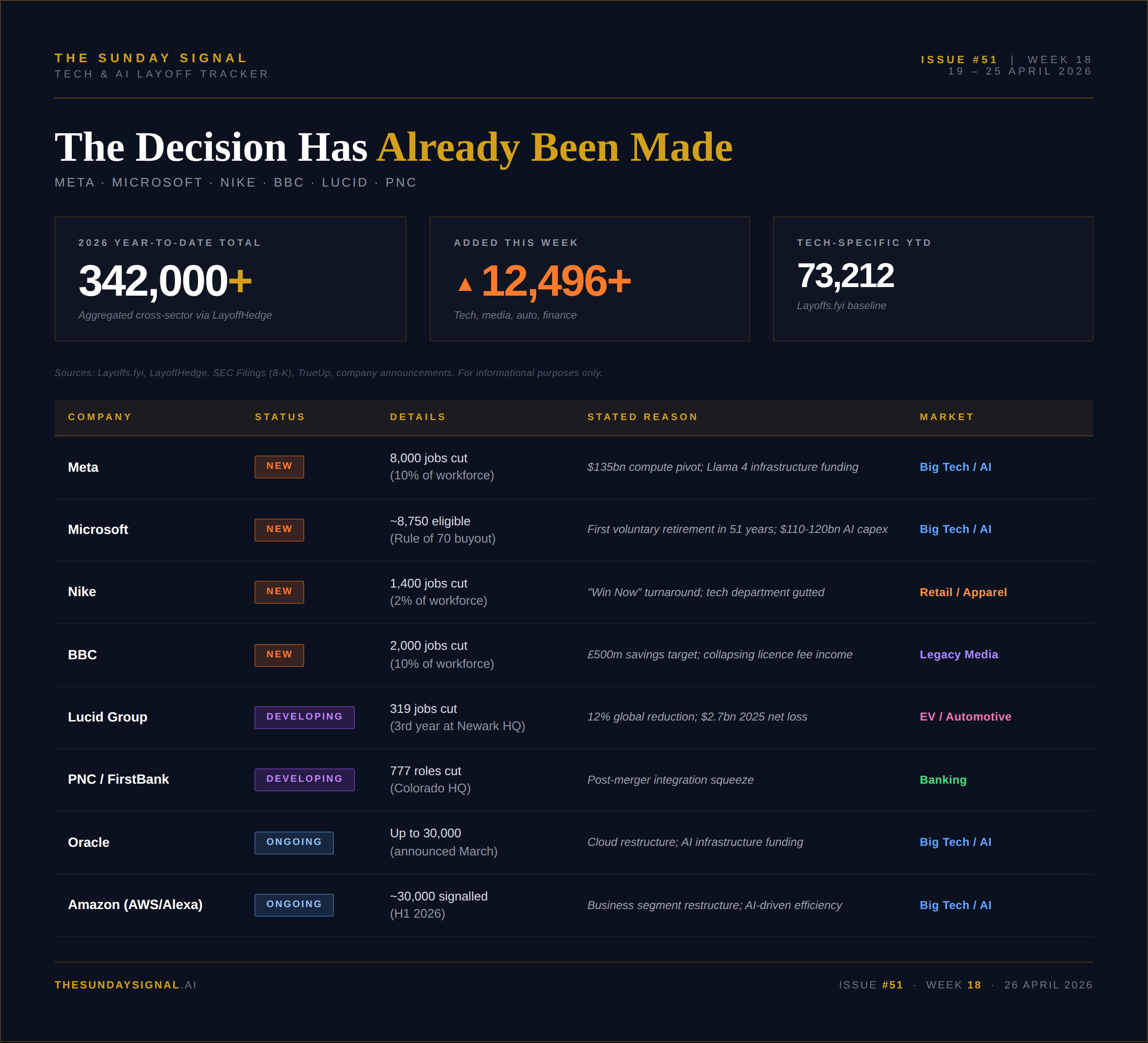
The Signal: Meta’s 135 billion-dollar compute bloodletting
The “Year of Efficiency” was a warm-up. Welcome to the era of the Mega Layoff.
This week Mark Zuckerberg dropped the largest single technology bomb of Q2. Meta Platforms announced it is cutting 8,000 jobs, roughly 10 per cent of its global workforce, and eliminating another 6,000 open requisitions. The rolling cuts officially begin on 20 May.
If there was any lingering doubt about the AI Launder thesis, Meta has now codified it. This is not a macroeconomic adjustment. It is a brutal, direct capital reallocation. Meta is accelerating its AI infrastructure buildout, projecting 135 billion US dollars in capital expenditure to fund data centres and liquid-cooled compute clusters.
The maths on Wall Street is ironclad. You cannot fund a hundred-billion-dollar compute pivot while carrying pandemic-era headcount. Oracle traded 30,000 humans for Nvidia chips in Q1. Meta is now trading 8,000 humans to feed the Llama 4 infrastructure. Software engineers are no longer the most valuable asset on a tech balance sheet. Compute is.
The blue-collar pivot: the rise of the AI plumber
As Meta axes its white-collar software engineering layers, a paradox is emerging. Employment at US data centres has surged, and Meta itself just launched a free fibre technician training programme.
The new six-figure tech job does not require a computer science degree from Stanford. It requires a hard hat. Senior electricians specialising in liquid cooling and high-density fibre cabling are commanding salaries of 200,000 to 300,000 US dollars. The white-collar trade job is booming. The builders of the physical AI infrastructure are inheriting the earth while the middle managers of the SaaS era are handed severance packages.
Nike’s tech wipeout
The rot is extending aggressively beyond traditional Big Tech. On Thursday, 23 April, Nike confirmed the elimination of 1,400 jobs, roughly 2 per cent of its 76,000-person global workforce.
The critical detail is not the total number. It is the target. The vast majority of these cuts are centralised entirely within Nike’s technology department. Under new chief executive Elliott Hill’s “Win Now” turnaround strategy, legacy non-tech brands are abandoning the zero-interest-rate fever dream of operating like technology companies. Nike is gutting its digital overhead to return to the core mechanics of making and selling shoes.
The restructuring reality check: BBC and Lucid
Not every cut this week was a compute pivot. The traditional margin crush continues across legacy media and automotive.
BBC (Media): 2,000 jobs cut, 10 per cent of the workforce. The biggest reduction in 15 years. A desperate attempt to find 500 million pounds in savings as traditional licence fee income craters.
Lucid Group (EV/Auto): 319 jobs slashed at the Newark headquarters. The third straight year of cuts at that address. Part of a broader 12 per cent global reduction following a 2.7 billion US dollar net loss in 2025.
PNC / FirstBank (Banking): 777 roles eliminated at FirstBank’s Colorado headquarters. A classic post-merger integration squeeze by PNC.
High-probability targets: Week 19
Non-tech “tech” departments. Nike’s move is a massive leading indicator. Expect major retail, CPG and legacy apparel brands to begin aggressively pruning their bloated in-house technology, app and digital innovation teams. If off-the-shelf AI tools can run your e-commerce stack, you do not need a 500-person in-house engineering squad.
Mid-tier social and ad-tech. With Meta setting the new efficiency baseline and weaponising its AI to monopolise advertising targeting, mid-tier social platforms and ad-tech vendors will be forced to slash headcount just to maintain acceptable operating margins.
🚀 Final Thought
Every boardroom will eventually answer Drucker’s question. Most will answer it too late, after the market has answered for them.
Microsoft has chosen a polite exit. Meta has chosen a brutal one. The prediction markets have priced in 90 per cent certainty. Sam Altman’s neighbours have installed extra security. A 20-year-old from Texas has chosen a Molotov cocktail. The same story, told in five registers.
The AI revolution will not be resisted in the ways its critics expect. It will be resisted by shareholders demanding the compute pivot. By traders pricing in the bloodletting. By employees refusing the package. By young men with manifestos. And by the Leonie Hugheses this country has already written off but who remain, somehow, the people the next decade needs most.
It is a power story. It always was.
This is not a transition. It is a replacement.
Most of them will realise this too late.
Until next Sunday, David