
The Brain Is Not the Bottleneck
Ali Ghodsi says AGI is already here. Demis Hassabis says it may arrive by 2029. A London insurance quote raises a question: when does human intervention reduce risk, and when does it add cost

THE SUNDAY SIGNAL · Issue #67 · Week 33 · Sunday 16 August 2026
The Brain Is Not the Bottleneck
This issue is also available as a podcast. Listen on Spotify, Apple Podcasts or YouTube and tell me what you think.
BOTTOM LINE UPFRONT: In 2013, one of Hadoop’s early developers urged me to meet a group of Berkeley researchers building what came next. This week their company, Databricks, raised $5bn at a $190bn valuation. The lesson is not simply that machines became cleverer. Enterprise value is moving towards the data, permissions and context that make their intelligence useful. Ali Ghodsi argues that current models already clear one broad definition of AGI. That is contestable. His commercial point is harder to dismiss: intelligence is becoming cheaper while trusted context remains scarce. A London underwriter has supplied one early price signal from the other end of the system, quoting less for a workflow with fewer points of human intervention. One quote is not a market. It is enough to force the right question: which human judgements reduce harm, and which merely add variance and cost?
A man who helped build Hadoop told me to meet the people building what came next
In 2013 a group of researchers from Berkeley came to see me in Silicon Valley. They were not on my calendar by accident.
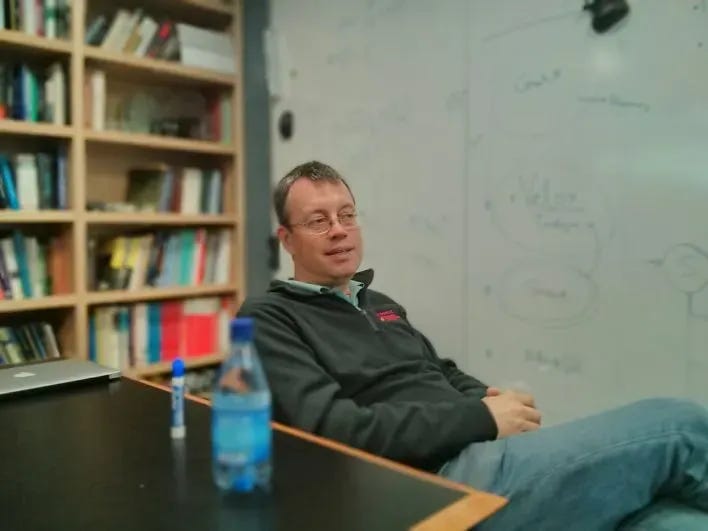
They were there because of Konstantin Boudnik. Everybody called him Cos. He had joined us that year and he ran advanced technologies and open source development, which in practice meant he ran R&D. Cos was one of the early developers of Apache Hadoop and a co-creator of Apache Bigtop, which packages, tests and validates components across the Hadoop ecosystem. He was close enough to Hadoop to recognise where its original processing model was beginning to fail.
He knew Ion Stoica and Ali Ghodsi, and he was insistent about it. Meet them, he said. This is going to be the future.
Consider what that meant, coming from him. Here was a man whose work was closely bound up with Hadoop, telling his chief executive to go and look hard at the technology most likely to displace part of it. Not many people do that. Most of us defend the thing we built long after the evidence has turned.
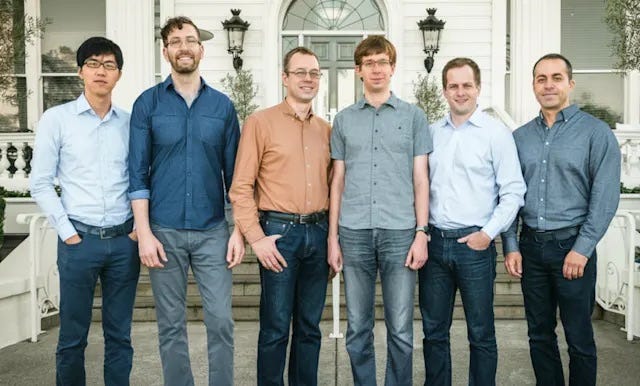
So they came in. Ion Stoica, who would become Databricks’ first chief executive, sat in front of me. Ali Ghodsi, then the VP of Engineering. There were others in the room. They had built something in the AMPLab called Spark, and they had come looking for funding for what was still, in every meaningful sense, an academic project.
The pitch was not hard to follow. Hadoop’s MapReduce engine had carried the industry a long way and was visibly running out of road. Spark was a faster answer for a large class of those workloads, and it would go on running on Hadoop infrastructure for years afterwards rather than sweeping it away.
Cos was right about the direction. What none of us saw, including him, was the scale.
To understand why they were in California at all, you have to go back to a broken cassette deck in a Swedish suburb.
A Commodore 64 with the games removed
Ghodsi’s family fled Iran in 1984. By his own account they had about twenty-four hours to get out. Sweden was the destination because Sweden was the country that would take them, which is what happens when the alternative is staying. He was five. They arrived with leather jackets and several layers of clothing, which is not what you wear to a Nordic winter, and the family had little money.
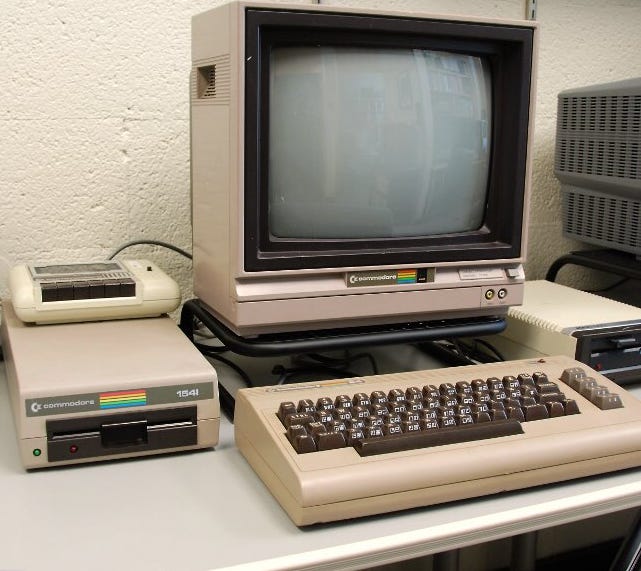
Then came the computer. A Commodore 64, second-hand and partly broken: the tape recorder did not work, so no games would load. The only thing that machine could do was run code you typed into it yourself. There were manuals. He read them. By primary school, on his own account, he was coding all day, and he has been blunt about why. There was not much else to do, and he did not really have friends.
Note what did the work there. Not talent, not encouragement, not a well-designed curriculum. A fault.
The rest of his schooling was similarly unplanned. He was absent roughly 70% of the time, on account of programming through the night on American hours, which cost him a place at a good university and sent him further north. There he acquired a roommate doing a business degree, and neither could understand what the other did. The roommate settled the matter by telling him he would be his boss when they were finished. Ghodsi enrolled on a business degree as well, on the grounds that he was not having that. He has since said that is the actual reason he holds an MBA.
He took a doctorate at KTH in Stockholm on fully decentralised systems, the architecture that later showed up underneath cryptocurrencies. He visited America once, spent a summer in Palo Alto, and decided he hated it: too much suburbia, too many large cars. Then in 2009 the Berkeley offer arrived, and he took it on the strict understanding that it was for one year only.
They offered it away, and the market still hesitated
The timing was better than anyone in the room understood. Around the middle of the 2000s the industry stopped being able to make individual computers meaningfully faster. Processors flatlined at roughly three gigahertz. The work had to go somewhere, so it went into the data centre, and the data centre became the computer. Berkeley’s AMPLab was writing software for that new machine at exactly the moment the new machine appeared.

Spark itself came out of a side project. A researcher in the lab wanted to enter the Netflix Prize, found the existing tooling slow and painful, and asked for help. The work done to help him became Apache Spark. Ghodsi recalls that their entry tied on performance but lost under the competition’s submission-time tiebreak.
Then came four years of the market hesitating.
This is the part that gets edited out of the retrospectives, and it is the part worth keeping. They toured Silicon Valley offering the technology away free. Take it. Commercialise it. Put your own name on it and keep the money. Berkeley hippies, in Ghodsi’s phrase. The answer came back much the same each time: this is academic, some student wrote it, the student will leave, and we will be holding the source code. They even placed students inside prospective adopters as summer interns, hoping the software would take root from within. It did not work.
Ghodsi says competitors spread a simpler message: Spark only worked when the data fitted in memory. It was untrue. It barely mattered, because it was repeated at conferences with real marketing budgets behind it, and prospects arrived already believing it. Reputation moves faster than software.
Then the venture capitalists arrived
Ben Horowitz turned up. He had heard about the work through Scott Shenker, a Berkeley professor whose previous company had just sold to VMware, and his message was simple: this is worth a hundred billion dollars, and nobody else is going to build it for you.
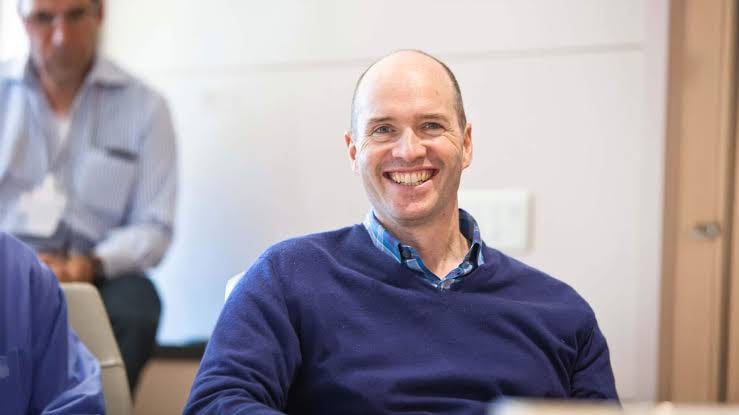
They were not keen. They were engineers, and what engineers wanted was $200,000, small salaries and a year to work on it.
Their approach to valuation is the funniest thing in the story and also the most revealing. They went round the founders individually, asking what number would make them accept an investment they did not want. The first said twenty million. The next said no, twenty-five. It ratcheted up until somebody arrived at thirty-five. Horowitz came in, declined to haggle, valued the company at fifty million and told them to take it or leave it. They took it on the spot.
When the money landed they gathered round a laptop to look at the bank balance, saw fourteen followed by six zeros, and got out a calculator to work out how much interest it would earn if they simply left it there. Ghodsi was on about $59,000 at Berkeley at the time, by his own account. He joined part time, and was by his own admission the least enthusiastic of the founders. He committed properly only when he realised the others were taking the entire research lab with them and Berkeley would be empty.
Seven co-founders incorporated Databricks in 2013.
One benchmark changed the argument
By 2014 the whispering about memory had not stopped, so they went and settled it with a contest.
In October that year, a Databricks team led by Reynold Xin sorted 100 terabytes in 23 minutes on 206 EC2 machines. The previous Hadoop MapReduce result had taken 72 minutes on 2,100 machines. Three times faster on about a tenth of the hardware, with the data processed from disk rather than held in memory. Databricks and a UCSD team jointly set the Daytona GraySort record. Databricks then demonstrated a one-petabyte sort in 234 minutes, although that larger run was not an official Daytona entry.
That is devastating evidence against the memory claim, and the story reversed almost overnight. Companies that had spent three years declining the software started describing themselves as the Spark company. Ghodsi has noted, drily, that some of them claimed to have created it.
And then the awkward bit. The technology was everywhere and the revenue was about a million dollars. The board’s assessment, delivered with the tact boards are known for, was that they had less revenue than the local restaurants, that everybody else was making money from their work, and that they were not business people. Ion Stoica’s leave of absence from Berkeley ran out and he went back. A chief executive search began. Most of the founders concluded it had been a good run.
Horowitz backed a founder instead. In January 2016 Ghodsi took over. His own explanation of why him is that he was the oldest after Stoica and the others looked too young, which may be the most honest account of an executive appointment ever given.
Three unglamorous decisions
What he did next was not clever. It was disciplined, and it is the part founders skip.
One: he sold to the enterprise. Databricks had been running a self-serve motion where users arrived and swiped a card. He stopped it and went after large corporations on a simple piece of arithmetic. Who will pay $10m for a 1% improvement? Only an organisation large enough that 1% is worth $10m. Those organisations have bought software the same way for thirty years, through relationships, so he hired expensive salespeople on packages of around $350,000 in total target compensation, which appalled a man who had been on a professor’s salary two years earlier.
Two: he over-indexed the executive team on experience. Founders with doctorates had been trying to invent marketing, finance and customer success from first principles, as though those were unsolved research problems. He ran twelve executive searches, hired twelve people who had done the job before, and confined the company’s originality to the technology.
Three: he built proprietary enterprise features on top of the open source. Security, governance, the unglamorous work. Open source bought the adoption. The paid layer collected the money.
Forbes reports roughly $12m of sales in 2016. Ghodsi’s own account of that first year is that they promised the board ten million and came in at thirteen or fourteen. Either way, the ceiling broke. Before that, thirty thousand dollars had felt like a law of physics: the number above which no customer would go. Then the million-dollar deals started.
From there to $190 billion
The Lakehouse came next, merging the flexibility of a data lake with the structure of a warehouse, and it worked well enough that the rest of the industry copied the idea. MosaicML was acquired in 2023 for $1.3bn, which put private model training inside the enterprise. Then the money got silly. Ten billion at a $62bn valuation in December 2024. Past $100bn in September 2025. In February this year, $5bn of equity plus $2bn of debt capacity at $134bn.
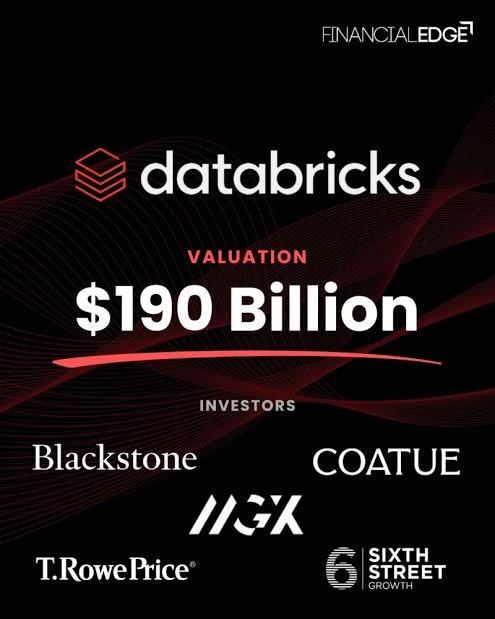
And on Thursday, a $5bn strategic round at $190bn post-money, led by Coatue with Blackstone, MGX and T. Rowe Price, and Sixth Street Growth coming in new. The company crossed a $7bn revenue run rate in Q2, growing more than 80% year on year, and says it generated positive adjusted free cash flow over the previous twelve months. Lakebase, its serverless Postgres database aimed at AI agents, is past a $100m run rate on its own. Databricks now serves more than 20,000 organisations.
The detail that tells you the most is not the valuation. Ghodsi says Databricks initially set out to raise $1bn and received about $15bn of interest from the investors it approached. They took five. That is not a company raising because it needs cash. That is a company taking money because refusing it would be rude to the balance sheet.
So why does any of this matter for artificial intelligence? Because the model is not the scarce thing. A frontier model can be swapped next quarter for a cheaper one from another continent, and increasingly is. What cannot be swapped is a company’s own data: its permissions, its definitions, its record of what actually happened. Databricks sits on that.
The three products the new money is going into make the point exactly. Lakebase, for the operational data agents need. Genie, for the context buried across the business. Unity AI Gateway, to route work between models and stop the token bill running away. Ghodsi told CNBC that token maxing has “freaked out the CFOs”. Databricks sells the thermostat.
The arithmetic on the boy with the broken Commodore
Forbes currently estimates Ghodsi’s wealth at roughly $5.5bn, although its calculation still appears to be anchored to February’s $134bn valuation. Thursday’s round makes the published figure stale, but nobody outside the cap table can calculate the new number with confidence.
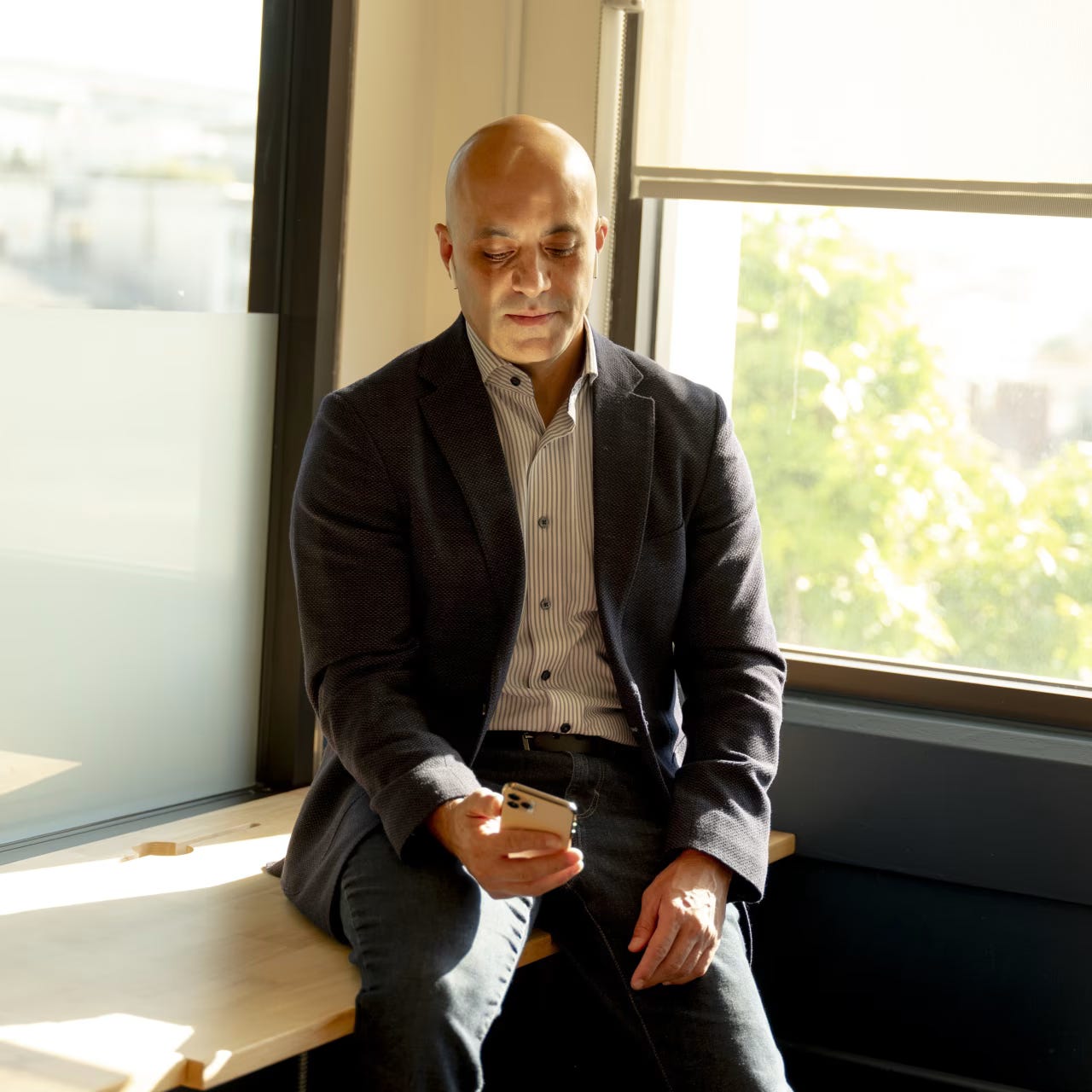
Either way. A five-year-old arrives in Sweden with twenty-four hours’ notice and the wrong coat. He gets a broken computer because the working ones cost too much. He skips 70% of school. He takes a business degree out of spite. He does a doctorate, hates America on his first visit, comes for one year, and ends up running one of the most valuable private companies on earth.
I am not telling that story because it is inspiring, though it is. I am telling it because the ingredient that made it possible was a broken tape deck. If the machine had worked, he might simply have played games.
And I am telling the other half because of Cos. The person best placed to see what was coming was the person with the most invested in what came before, and he picked up the phone anyway. That is rarer than the technology, and it is worth more.
Ghodsi says AGI is already here. Hassabis says 2029. The argument is smaller than it looks
Ghodsi’s argument is that current systems already clear one older, broad threshold for general intelligence: a machine that performs the kinds of intellectual tasks humans perform and is smarter than most people most of the time. The industry has never shared a single definition, and systems that look general on benchmarks can still fail unpredictably on planning, reliability and real-world execution. On the broad functional definition Ghodsi invokes, the claim is defensible. It is not a settled scientific conclusion.
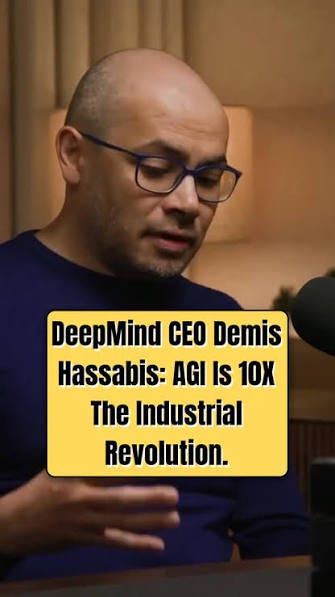
What everyone now means by AGI, he says, is superintelligence: something that compresses the work of the world’s researchers into seconds and simulates whole economies. On that definition he agrees it is not here, and doubts that what we are currently building ever becomes it.
He made the case in June at Databricks’ Data + AI Summit in San Francisco, in front of more than 30,000 attendees. He opened by asking how many of them thought AGI had arrived. Roughly 90% said no. Then he asked the room to compute the reduced twelfth-dimensional Spin bordism of the classifying space of the Lie group G2. Nobody obliged. The frontier models will have a go at it. Attempting the problem is not the same as solving it, but that was his point about breadth rather than infallibility.
The line he built on it is the one worth keeping: “AI doesn’t have an intelligence problem. It has a context problem.”
Think of a brilliant mind in a locked room. It can reason about anything you describe to it, and it has no idea what is happening outside the door. Ask it a specific question about your business and it will fail. Not because it is stupid, but because it has never seen your ledger. It does not know which table is authoritative, cannot tell you when your fiscal quarter closes, and has no idea why the same metric appears twice with different values. Build a cleverer model and it fails in the same way.
Demis Hassabis at Google DeepMind has spent this year tightening rather than loosening his timeline. At Google I/O in May he described us as standing in the foothills of the singularity, and told Axios that while he still broadly expects AGI around 2030, he now regards 2029 as possible. His position is that scaling alone will not close the remaining gaps in planning, memory and reasoning, and that one or two more scientific breakthroughs are required. Greg Brockman of OpenAI, sharing the Databricks stage in June, declined to pick a date, calling AGI “almost a spectrum, not a moment”.
My reading is that Hassabis is describing a scientific threshold while Ghodsi is describing the point at which machine intelligence becomes commercially substitutable. Only the second one is arguably behind us. On a growing range of bounded cognitive tasks, today’s models already outperform many of the workers doing them.
And that is the finding that should concern anyone with a desk, because it does not depend on a breakthrough. It depends on plumbing. Which is convenient for Ghodsi, since plumbing is what he sells, and you should discount his enthusiasm accordingly. The discount does not get you to zero. The question that decides it is whether the context gap closes as models improve. If it does, Databricks is selling scaffolding for a building that finishes itself. If it does not, he may have identified one of the few durable moats in the industry, alongside distribution, workflow integration and the ordinary friction of switching. Eight weeks after he made the argument, investors put $5bn behind the context infrastructure he sells.
AGI is not a robot. It is a fall in the price of cognition
Previous general-purpose technologies have both displaced and augmented labour. The loom removed some jobs and created others. The spreadsheet reduced the need for ledger clerks while increasing the output expected from financial professionals. Each changed the boundary between what people did and what machines did.
AI pushes that boundary into cognitive work once treated as inherently human. For some tasks, the shift is not simply from an unproductive employee to a more productive one. It is from human hours to software, compute and vendor contracts. Some of that spending is capital expenditure. Much of it, under the accounting rules that actually apply, is a service consumed over a contract term. The cleaner economic point is that cognition is becoming cheaper to buy without putting another person on the payroll.
Watch how that is already showing up, and note how carefully the numbers have to be read.
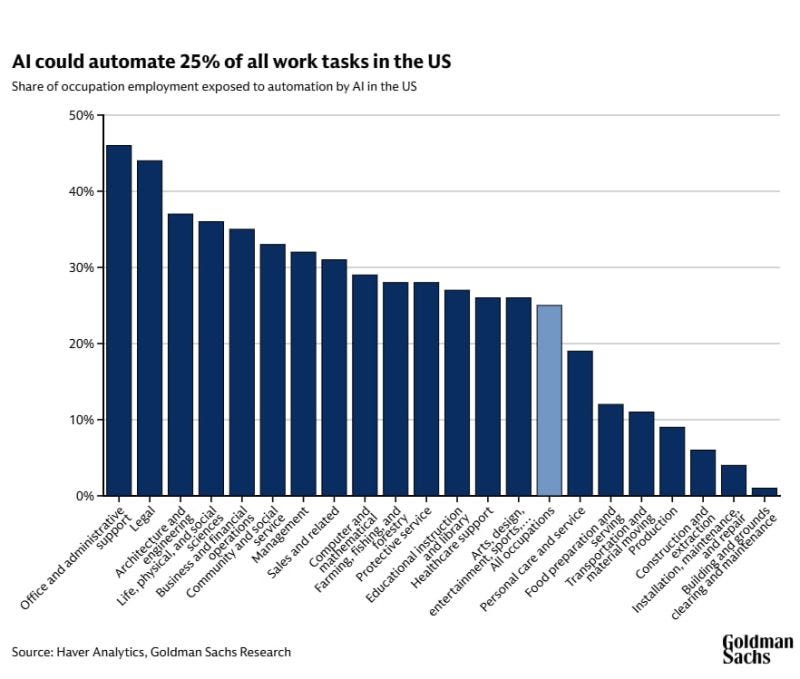
Goldman Sachs Research puts around 300 million full-time jobs globally in the exposed category, with roughly two-thirds of US occupations touched to some degree. Their base case has enterprise adoption taking about a decade, with 6% to 7% of workers facing direct displacement along the way. On the observed effect so far, Goldman estimates that AI reduced monthly US payroll growth by roughly 16,000 jobs over the previous year. That is a modelled drag on hiring, not a count of 16,000 monthly redundancies, and Goldman says some offsetting job creation may not yet be visible in the estimate. Joseph Briggs, who co-leads their global economics team, has said that “the big story in 2026 in labor will be AI”.
The first signs of pressure are appearing at the bottom rung, although the cause is not yet cleanly separable. The New York Fed puts unemployment among recent graduates aged 22 to 27 at 5.6%, but its own research attributes much of the recent rise to the decline of entry-level learning and networking under remote work, with the timing pointing away from generative AI as the dominant cause so far. Goldman, separately, finds emerging AI effects concentrated among younger workers. And one-third of employers in GMAC’s global graduate-management recruiting survey said they had replaced at least some entry-level roles with AI.
Note the mechanism, because it matters more than the attribution. This is not a wave of dismissals. It is a hiring freeze at the entrance. Nobody gets a redundancy notice, so nobody counts it.
Which raises the question the optimists have not answered. Every senior professional in Britain today was once somebody’s expensive mistake. The trainee solicitor who took four hours over a task a partner did in twenty minutes was not being charged out at a profit. They were being manufactured. If the AI does the trainee’s work, at the trainee’s quality, for a rounding error, the firm saves money this year and risks starving its future partnership pipeline. That is not a labour market problem. It is a supply chain problem, and it takes twenty years to show up and twenty years to fix.
Then there is the demand paradox. Wages are not only a cost to the firm. They are the mechanism by which the public can afford to buy what firms produce. Taken to its limit, a collapse in the value of cognitive labour creates an economy capable of producing almost anything, populated by people who cannot buy it. Most serious remedies proposed so far involve redistribution in one form or another, whether a basic income, a tax on compute treated as a capital tax, or something not yet named. None of them are ready.
But before any of that arrives, something more immediate is happening. Somebody has started to put a price on the human directly, and it is not the price we assumed.
The Man in the Loop Costs Extra
Adapted from my Yorkshire Post column this week.

I do not rely on commentators to predict the future; I look where the money is. Opinions are cheap. Being prepared to lose money if you are wrong is different.
The last American presidential election was a good example. In the autumn of 2024, news coverage was reporting a dead heat. National polls showed a slight lead for Harris, and many of the modellers were refraining from making calls. Prediction markets were more assertive. Around mid-October, Polymarket had Trump’s likelihood of winning above 60% for the first time since July, and held the price there while the news outlets carried on describing a coin flip.
The move was driven by a French trader known only as Théo. Théo believed the polls were missing voters for Trump who were not willing to publicly support him, and, instead of making a case, he paid YouGov to conduct private surveys for him in Michigan, Pennsylvania and Wisconsin. Rather than ask people how they would vote, he asked them how they thought their neighbours would. What came back convinced him. He ultimately put more than $70m at risk across several accounts, and made approximately $85m.
Insurers do this, minus the drama, and do it every day for every single risk that you can imagine. An underwriter’s price, in fact, is the most honest opinion poll that exists, as getting it wrong costs the firm money, not credibility.
This is why one event that happened to one of the companies at Yorkshire AI Labs has stuck with me.
LexCelerate is an AI law firm. After applying for professional indemnity cover and receiving an initial quote, they were asked to send their principals to London so the underwriters could review and evaluate the system and how it worked. Then came the questions, and all were focused on people.
Can this be overridden by a human? Does a human determine that? Does a human type in the bank account number? Our assumption was that they wanted reassurance that a human remained in charge. In fact, they were looking to confirm the opposite. Every place where a human could intervene represented another place where something could go wrong. The updated quote came in 50% lower.
I have been thinking about that number for a couple of weeks, because the entire public discussion regarding artificial intelligence has been centred on a phrase that nobody has bothered to test: the human in the loop.
One underwriting team reached a different conclusion about this particular workflow. They were not saying machines are better than lawyers. They were saying that a controlled, logged and bounded process was easier to price than an equivalent workflow containing several points of human discretion. A conveyancer can easily transpose two digits at the end of a working week. Discretion is where the money escapes, and discretion is precisely what a person brings.
Once reasoning like this is assigned a cost, it becomes self-perpetuating. A firm that makes a partner review each and every file will simply be the expensive one. The same holds for diagnosis, for audit, for any professional service where somebody signs to say they looked. That signature becomes a cost-benefit problem.
None of this means people should be lifted out of serious work. It means nobody had checked which of their interventions reduce risk, and one set of underwriters has started checking.
Insurance is one of the few trades that has to put an explicit price on the cost of being wrong. What was raised in that room in London was an assumption none of us had thought to examine: that serious work needs a person inside every process. The quote suggested that, in this workflow, human discretion was one of the things making the risk harder to price.
One quote, one small firm, one afternoon in London. That is a signal, not a market.
British guidance and sectoral regulation often default to human oversight, while data-protection law preserves rights of intervention or challenge in certain significant automated decisions. The insurance quote raises a question those rules still need to answer: which interventions reduce risk, and which merely add another source of it? The same question is waiting for auditors and consultants and anybody else who signs to say they checked, and when it reaches them it will not arrive as an argument. It will arrive as a renewal.
The Signal Tech & AI Layoff Tracker
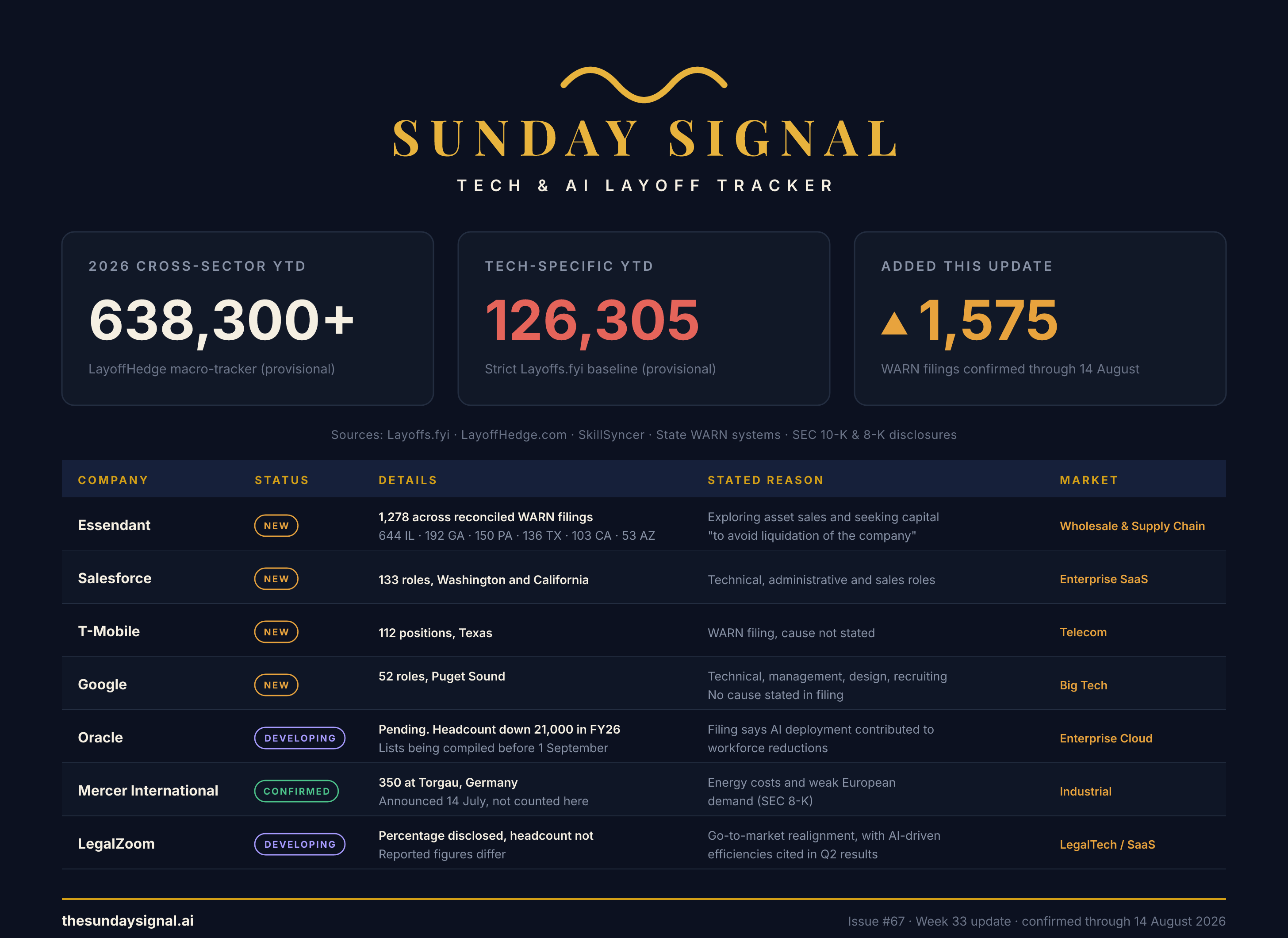
Week 33 update, with filings and announcements confirmed through Friday 14 August. Late-reconciled notices from the previous week are identified separately. Synthesised from Layoffs.fyi, LayoffHedge, SkillSyncer, state WARN registries and SEC filings. For informational purposes only.
The theme is the one Oracle has made impossible to ignore. Profitable companies are not cutting because revenue is falling. They are cutting while spending record sums on infrastructure, and payroll is the line item management controls most directly.
Oracle, pending. No number yet, but the clearest juxtaposition anyone has filed. In the fiscal year ended 31 May, Oracle reported approximately 141,000 full-time employees, down 21,000, or about 13%, from a year earlier. Revenue grew 17% over the same period. Capital expenditure hit $55.7bn, up 162%, and free cash flow came in at negative $23.7bn. The company raised $43bn of debt and expects to raise roughly $40bn more. Severance and exit costs reached $1.84bn, against $374m a year earlier. Oracle’s filing explicitly says that deploying AI across its operations has contributed to workforce reductions. It does not say that all 21,000 missing employees were removed because of AI, and a fall in reported headcount can include attrition and divestment as well as redundancy. Business Insider reports managers have been told to compile lists ahead of the second fiscal quarter opening on 1 September, with some teams facing double-digit percentage cuts. The juxtaposition is stark: a $638bn backlog, including a reported five-year, $300bn capacity commitment from OpenAI, and record infrastructure spending, alongside a 13% fall in reported headcount.
Essendant, 1,278. The largest single event in this update, and a reminder that AI is not the only thing hollowing out payrolls. Reconciled WARN filings now cover 1,278 positions: 644 in Illinois, 192 in Georgia, 150 in Pennsylvania, 136 in Texas, 103 in California and 53 in Arizona. The notices state the Staples subsidiary has been exploring asset sales and seeking capital “to avoid liquidation of the company”, and that it does not know whether those efforts will succeed. A law firm began investigating WARN compliance on 10 August.
Large-company technology cuts, 297. T-Mobile filed for 112 positions in Texas. Salesforce filed for 133 across Washington and California, spanning technical, administrative and sales roles rather than any single function. Google’s filing covers 52 roles in Puget Sound across technical, management, design and recruiting, with no stated cause. Small numbers individually. Collectively, the expensive middle of the org chart is now inside the scope of these filings.
Carried, not counted. Mercer International’s 350-post reduction at Torgau in Germany is confirmed in SEC filings, but it was announced on 14 July and merely restated in the 6 August results, so it does not belong in this update. LegalZoom disclosed a workforce reduction as a percentage without publishing a headcount, and reported figures differ. VideoAmp’s 20% reduction appears on at least one tracker with a June date and needs reconciling.
What I will be watching, and this is my thesis rather than tracker data: Oracle before 1 September; legacy database and support benches at other enterprise software vendors making the same infrastructure-for-headcount trade; and advertising measurement, where programmatic buying is moving towards agentic models.
Final Thought 🚀
Hold the three stories together and the shape becomes clearer.
A man with a broken Commodore builds the company that now sits between enterprise data and artificial intelligence. He reaches my office because one of Hadoop’s early developers is honest enough to recognise what comes next. Thirteen years later, Ghodsi argues that intelligence is no longer the scarce part. Context is.
At the other end of the system, one London underwriting team prices a controlled workflow with fewer points of human intervention as lower risk. Oracle is increasing infrastructure spending while reporting 21,000 fewer employees than a year earlier. None of that proves that humans are obsolete, or that AGI has arrived. It does show that capital is already moving before the scientific argument is settled.
Britain therefore needs a harder test than “keep a human in the loop”. Which human judgements catch harm? Which introduce variance? Which must remain, and what evidence supports them? Get that wrong and we will not lose a philosophical argument. We will become the expensive country in a market that has learned to buy cheaper cognition.
📩 Read the full issue free at thesundaysignal.ai. New issue every Sunday. AI disruption, UK innovation, and the future of work, with no hype and no hedging.
Until next Sunday,
David