
The Bear and the Fly
I wrote this newsletter on Friday with Claude Fable 5 as my research assistant. It was fast. Very fast, & a step ahead of anything else I have used. By Friday evening the US government switched it off

THE SUNDAY SIGNAL · Issue #58 · Week 25 · Sunday 14 June 2026
By David Richards MBE
This issue is also available as a podcast. Listen on Spotify, Apple Podcasts or YouTube and tell me what you think.
Bottom Line Upfront: On Friday, SpaceX floated and pushed Elon Musk past the trillion-dollar line on paper. Then, after the market closed, the US government ordered Anthropic to suspend access to its two most advanced models for foreign nationals anywhere in the world, forcing the company to disable them for every customer. One event showed how concentrated ownership of the machine economy has become; the other showed how fragile its infrastructure is. Several thousand years of history suggest that societies which fail to level extreme wealth peacefully are eventually levelled by violence, war, collapse or plague.
Aesop warned us centuries ago about the bear who crushed his master’s skull to kill a fly. This week the US Commerce Department played the bear, and Claude Fable 5 was the fly. Read on for what happened, why it matters far beyond one company, and how it connects to the larger story I took to the Doncaster Chamber of Commerce this week: that artificial intelligence may grow the world economy fivefold while handing ownership of that growth to fewer people than any democracy should tolerate.

The Bear, the Fly, and the Kill Switch
Friday, 5:21pm Eastern. Anthropic, the company behind the Claude models and one of the most valuable private firms on the planet, received a letter from the US government. Citing national security and export-control authorities, the directive ordered it to suspend all access to its two most capable models, Fable 5 and the restricted Mythos 5, for any foreign national anywhere in the world, including Anthropic’s own foreign-national employees. Cloud software does not have borders. You cannot check the passport of every user calling a model through Amazon’s servers. So the only way to comply was the bluntest one available: shut the models down for everyone, in every country, at once. Access to all other Claude models was left untouched.
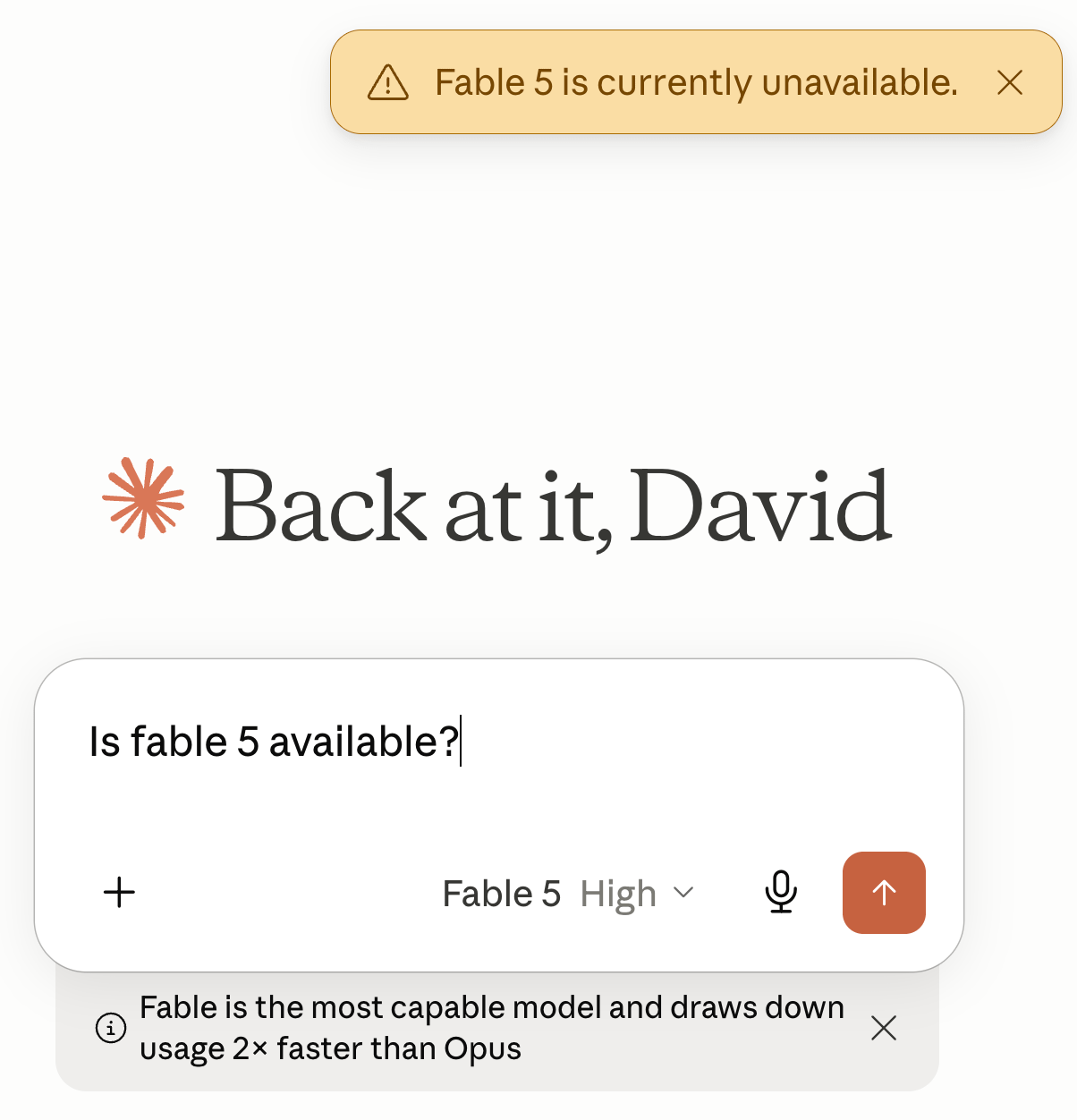
Here is the part that should worry every business now building on AI. The government’s stated concern was a jailbreak, a prompt that slips past a model’s safety filters. The specific technique it cited, by Anthropic’s account, amounted to asking the model to read a codebase and fix any flaws it found. Anthropic reviewed the demonstration and said the vulnerabilities it surfaced were minor, previously known, and discoverable by other public models, including OpenAI’s GPT-5.5, without any bypass at all. Developers call reading code and fixing flaws debugging. They do it every day. The government looked at the same capability and saw automated discovery of weaknesses in critical infrastructure, a cyber-weapon in commercial clothing.
Recall the fable. A tame bear guards its sleeping master. A fly lands on the man’s face, and the bear, meaning only to protect him, picks up a rock and brings it down on the fly. The fly dies. So does the master. The moral Aesop left us is that misguided zeal can do the work of malice, and that the cure is sometimes worse than the disease. Washington wanted to swat a narrow vulnerability. It used an export-control sledgehammer, and in a single stroke it disabled the most advanced commercial software in the world for hundreds of millions of users, crippling an American champion on the eve of its stock market debut. The fly is dead. Look what happened to the master.
Anthropic is complying, and says it disagrees. Its public position is sharp: recalling a model used by hundreds of millions of people over one narrow, non-universal jailbreak sets a standard that, applied across the industry, “would essentially halt all new model deployments for all frontier model providers.” That is the chilling line for anyone running a company. If Washington can flip the kill switch on a Friday afternoon over a routine debugging prompt, then no enterprise can treat frontier AI as stable infrastructure. You do not build a factory on land the state can repossess without notice. Overnight, every firm with a workflow wired to a single model learned that its supplier can be switched off by a third party it never signed a contract with.
And here is the part that should keep Anthropic’s bankers awake. The company closed a 65 billion dollar funding round in late May at a valuation near 965 billion dollars, and filed confidentially days later to go public in what would be the first near-trillion-dollar AI listing. That valuation rests on a simple promise: that the company can keep shipping frontier models and charging a premium for them. Fable 5 was the proof. Friday added a new line to the risk register that no prospectus has ever had to carry: sovereign recall. What exactly are you worth, if the product that justifies the valuation can be removed from the market by a letter at 5:21 on a Friday afternoon?
Rockefeller Could Be Broken Up. Musk Is Harder
Rewind a few hours, to before the directive landed. While the markets were still open that Friday, the state let a milestone pass without a murmur. Start with the facts. SpaceX priced its IPO at 135 dollars a share and began trading on the Nasdaq under the ticker SPCX. The company sold 555.6 million shares and raised 75 billion dollars, the largest flotation in stock market history and nearly three times the size of Saudi Aramco’s 2019 record. The offer valued the company at 1.77 trillion dollars. Then the market got hold of it. The stock closed its first day up 19 per cent at 160.95 dollars, pushing the valuation above 2 trillion dollars and making SpaceX one of the most valuable listed companies on earth.
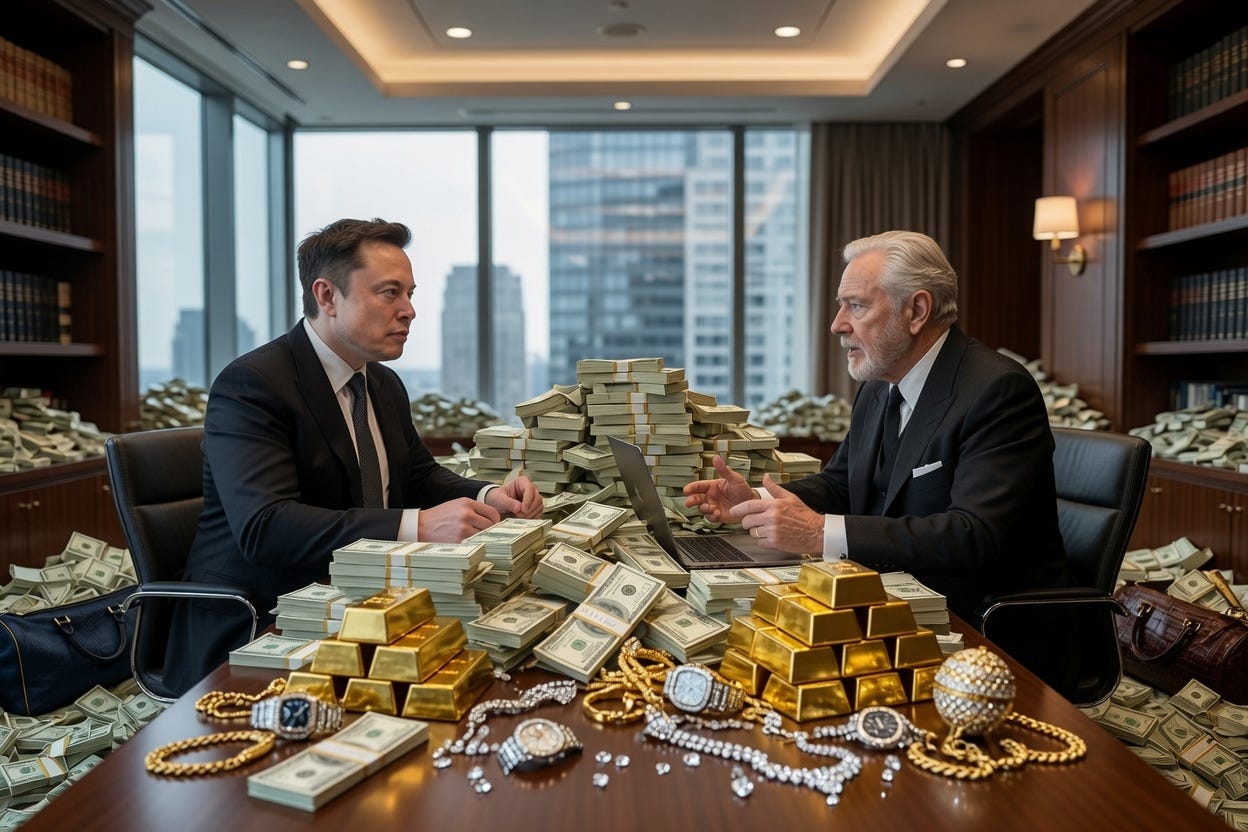
Now the man. At the offer price, the prospectus put Musk’s SpaceX stake at 866 billion dollars. After Friday’s 19 per cent jump it is worth comfortably over a trillion on its own, and his Tesla holding adds several hundred billion more. His paper wealth has cleared 1.3 trillion dollars, which is north of 4 per cent of American GDP. He retains more than 82 per cent of SpaceX’s voting control. One shareholder, one vote that counts.
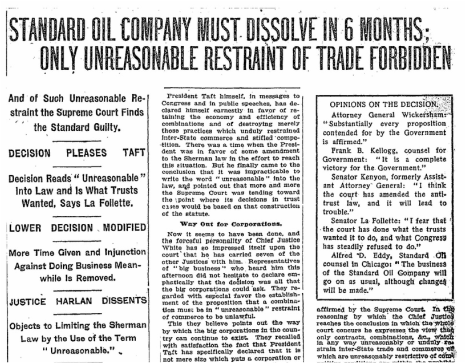
We have been somewhere near here before, and it is worth remembering how it ended. At his peak, John D. Rockefeller’s Standard Oil refined around 90 per cent of America’s oil, and his personal fortune amounted to roughly 1.5 to 2 per cent of US GDP. The American state looked at that and decided a republic could not carry it. In 1911 the Supreme Court broke Standard Oil into 34 companies under the Sherman Antitrust Act. The breakup made Rockefeller richer in the short term (his shares in the successor companies soared as the motor car arrived), but it shattered his structural grip on the economy. Then came the income tax in 1913, the estate tax in 1916, the gift tax in 1924, and four decades of deliberate philanthropy. When Rockefeller died in 1937, his personal estate held 26.4 million dollars. The fortune that once dwarfed the federal government had been dissolved into universities, foundations and hundreds of family trusts. The system was slow and imperfect. But it worked.
Here is the uncomfortable truth about 2026: the 1911 hammer does not fit. Antitrust law polices monopolies within a single market. Musk does not run one monopoly; he runs a portfolio of separate dominant positions across entirely different sectors. Rockets and global satellite internet through SpaceX and Starlink. Frontier AI through xAI, folded into SpaceX in February’s merger. Electric vehicles and grid batteries through Tesla. Social data through X. Modern competition law has no simple Standard Oil remedy for the problem of one person holding commanding influence across many markets at once. The law was built to break up companies. Nobody ever wrote one to break up a person.
And rather than restraining this, the machinery of modern markets reorganised itself to accommodate it. Nasdaq rewrote its index rules last month so that the largest IPOs can enter the Nasdaq 100 after just 15 trading days, scrapping its 10 per cent minimum float requirement in the process. SpaceX floated barely 4 per cent of itself, which means index funds could be forced to absorb an estimated 22 to 27 billion dollars of stock mechanically, at whatever price prevails. Many pension savers with passive exposure to Nasdaq-linked products would end up owning SpaceX whether an active manager chose it or not. This for a company that lost 2.6 billion dollars from operations last year on revenue of 18.7 billion, and which Morningstar values at 780 billion dollars, less than half the offer price. Rockefeller had to fight the state. Musk has the machinery of modern passive markets carrying his bags.
The point is not that Musk is uniquely wicked. The point is that the system has discovered how to manufacture Rockefeller-scale power without triggering Rockefeller-era remedies.
Roosevelt or the Horsemen
If the legal toolbox is empty, it is worth asking what actually happens to societies that let wealth concentrate this far. The answer is uncomfortable, because we have a great deal of evidence, and none of it is reassuring.
The historian and complexity scientist Peter Turchin has spent his career modelling how civilisations decay, and he keeps finding the same mechanism. Mature societies develop what he calls a wealth pump: a structural arrangement that steadily moves wealth from the people who work to the people who own. In Rome it was conquest and slave labour. In feudal Europe it was land tenure. In our era it is asset inflation, and increasingly it is the replacement of paid human labour with machines that work for the price of electricity.
The pump produces two effects, and both are visible in the historical record again and again. The first is mass immiseration: living standards stagnate for the majority, social mobility seizes up, and even basic measures such as life expectancy begin to slide. The second is what Turchin calls elite overproduction. As wealth explodes at the top, a society mints more rich, educated and ambitious people than it has positions of power to absorb. The surplus elite do not retire quietly. They factionalise, fight each other for the remaining seats, and wage their wars through politics and the media until the state itself seizes up. If that description sounds familiar, it should.
When immiseration meets a divided elite, societies break, and the precedents are brutal. In the late Roman Republic, conquest flooded the elite’s mega-estates with slave labour, the ancient equivalent of automation, and ordinary citizens who could not compete with workers who cost nothing lost their farms and crowded into Rome as a dispossessed underclass. A century of populist uprisings and civil war followed, and the Republic did not survive it. In eighteenth-century France, the nobility and clergy hoarded the nation’s land while exempting themselves from the taxes that paid for the state, leaving the burden on the peasantry; when the harvests failed, the result was not a renegotiation but a revolution that took the elite’s heads along with its property. In nineteenth-century China, extreme inequality under the Qing helped ignite the Taiping Rebellion, a civil war that killed more than twenty million people.
The economic historian Walter Scheidel surveyed several thousand years of this record and reached a conclusion he called the Great Leveler thesis: extreme inequality has never once, in recorded history, been substantially reduced by peaceful market forces. It has only ever been flattened by four kinds of shock, his Four Horsemen. Transformative revolution. State collapse. Mass-mobilisation warfare, which forced governments to tax the rich at near-total rates to fund the World Wars. And lethal pandemics: the Black Death killed a third of Europe and, by making labour scarce, handed the surviving peasants the bargaining power that broke feudalism. The ledger always balances. The only question history leaves open is who pays, and how violently.
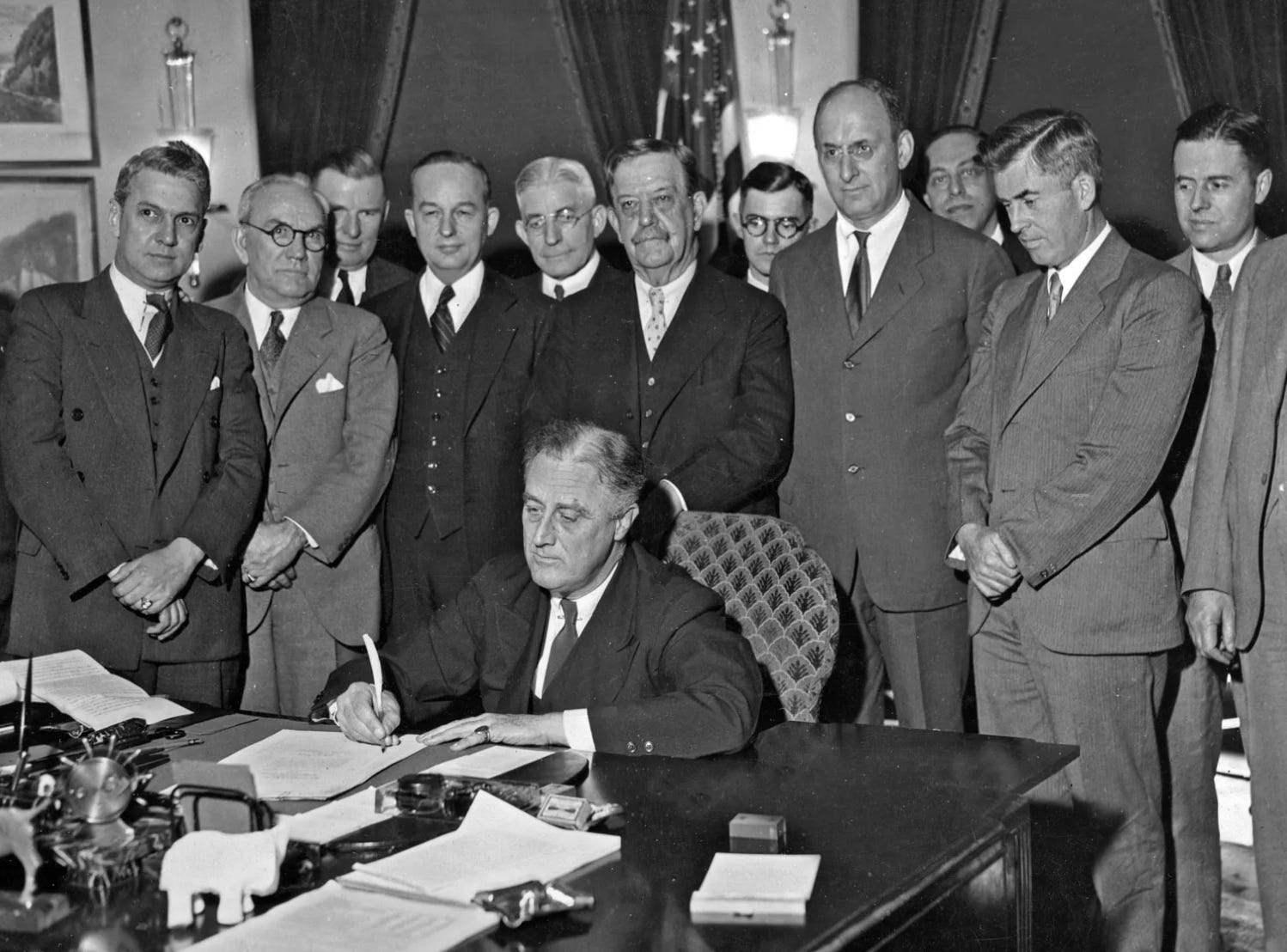
There is one recorded exception, and it is the one that should interest us most. Occasionally a faction of the elite sees the cliff edge in time and chooses to give up a portion of its own wealth to preserve the system that created it. The clearest modern case is America in the 1930s. Facing depression, extreme concentration and the live threat of revolutionary politics spreading from Europe, Franklin Roosevelt, himself a child of the elite, built the New Deal: aggressive antitrust enforcement, empowered unions, a welfare state, and top marginal tax rates that eventually passed 90 per cent. It was state-mandated redistribution, chosen by the wealthy class’s own representatives, and it engineered the Great Compression that built the twentieth-century middle class without a shot being fired. It is also, in several thousand years of records, very nearly the only time the off-ramp was taken.
Now look at the pump we are building. If AI substitutes for human labour at scale, it funnels the economic value of both muscle and mind permanently upward to whoever owns the compute. That is not a side effect of the technology. It is the business model. Which makes the only question that matters a simple one: are we heading for Roosevelt’s exit, or one of the other four?
And what would Roosevelt’s exit even look like now? The policy debate is already circling three ideas. A compute tax would levy the GPU hours and electricity that power AI, though taxing compute risks taxing the steel of this industrial revolution and crippling everything downstream of it. A robot tax, or agentic output tax, would charge firms at the point an AI agent replaces a human department, taxing the deployment rather than the invention. And structural capital reform would do the unglamorous work the 1930s did: tax capital gains like income, close the inheritance loopholes, and reach the unrealised paper fortunes that make trillionaires possible in the first place. None of the three is simple. All of them are easier than the horsemen.
The Money Is Not Going Where You Think
The comforting story about the AI boom is that it mints brilliant founders, and brilliance is at least a defensible lottery. The story is wrong. The founders are being diluted out of their own revolution, and the wealth is pooling somewhere far less accountable.

Consider the people actually building frontier AI. Sam Altman famously holds no equity in OpenAI. Dario and Daniela Amodei hold low single-digit stakes in Anthropic. Why? Compute. Training frontier models devours capital at a rate no industry has ever seen, and when you must raise tens of billions of dollars a year simply to keep the servers running, you sell your company, piece by piece, to whoever has tens of billions of dollars. Anthropic raised 30 billion dollars in February, in a round led by Singapore’s sovereign wealth fund GIC alongside Coatue, at a 380 billion dollar valuation. By late May it had raised another 65 billion at a 965 billion dollar valuation. Ninety-five billion dollars in under four months. The scientists get the bylines. The funds get the company.
So follow the money to where it is actually settling: the infrastructure layer. Sovereign wealth funds committed an estimated $120 billion across 2025 and 2026 to data centres, chip fabrication and compute networks. Abu Dhabi’s MGX, a dedicated AI investment vehicle, co-led the 40 billion dollar acquisition of Aligned Data Centers with BlackRock and anchors the AI Infrastructure Partnership alongside Microsoft, Global Infrastructure Partners and Kuwait’s KIA. A 1 gigawatt Stargate UAE cluster is being built inside Abu Dhabi’s wider 5 gigawatt UAE-US AI campus, with the first 200 megawatts expected online this year. Saudi Arabia’s Public Investment Fund launched HUMAIN to build the entire national AI stack, targeting more than 6 gigawatts of data centre capacity by 2034, with Nvidia and Qualcomm signed up and a $10 billion partnership with Google Cloud. The Gulf’s sovereign funds collectively manage close to 6 trillion dollars, and they are executing the most coherent strategy on earth: convert oil money into compute, because compute is the commodity every AI company must buy regardless of which one wins. They have worked out that they cannot out-engineer the founders. So they have become their landlords instead.
Turchin would recognise the machinery instantly. This is the wealth pump being assembled in plain sight, with quarterly reporting.
Set Britain’s response beside that. The Sovereign AI Unit, launched in April with 500 million pounds, was described by the venture community as a drop in the ocean, and the venture community was being polite. France assembled a 109 billion euro package. The Gulf deploys more than Britain’s entire fund in a single building. Britain helped invent much of this field. We are now negotiating for a seat in the cheap stands.
Hold the full picture in your head. The founders are diluted. The engineers are salaried. The state is outbid. What remains is a new class of owner, the institutional landlord of the machine economy: hyperscalers, silicon monopolies and petro-states converting one strategic commodity into the next. When the historians of the 2030s ask who captured the value of the AI revolution, the answer will not be the people who built it. It will be the people who owned the buildings it ran in.
The Pause and the Promise
Once the machine economy is this capital-intensive, even the companies building the frontier are trapped by the capital structure around them. And capital this size plays defence: a lab that has just banked the largest war chest in the industry has an obvious interest in anything that freezes the race while it leads. Which returns us to Anthropic, and to the bitter irony buried in Friday’s shutdown.
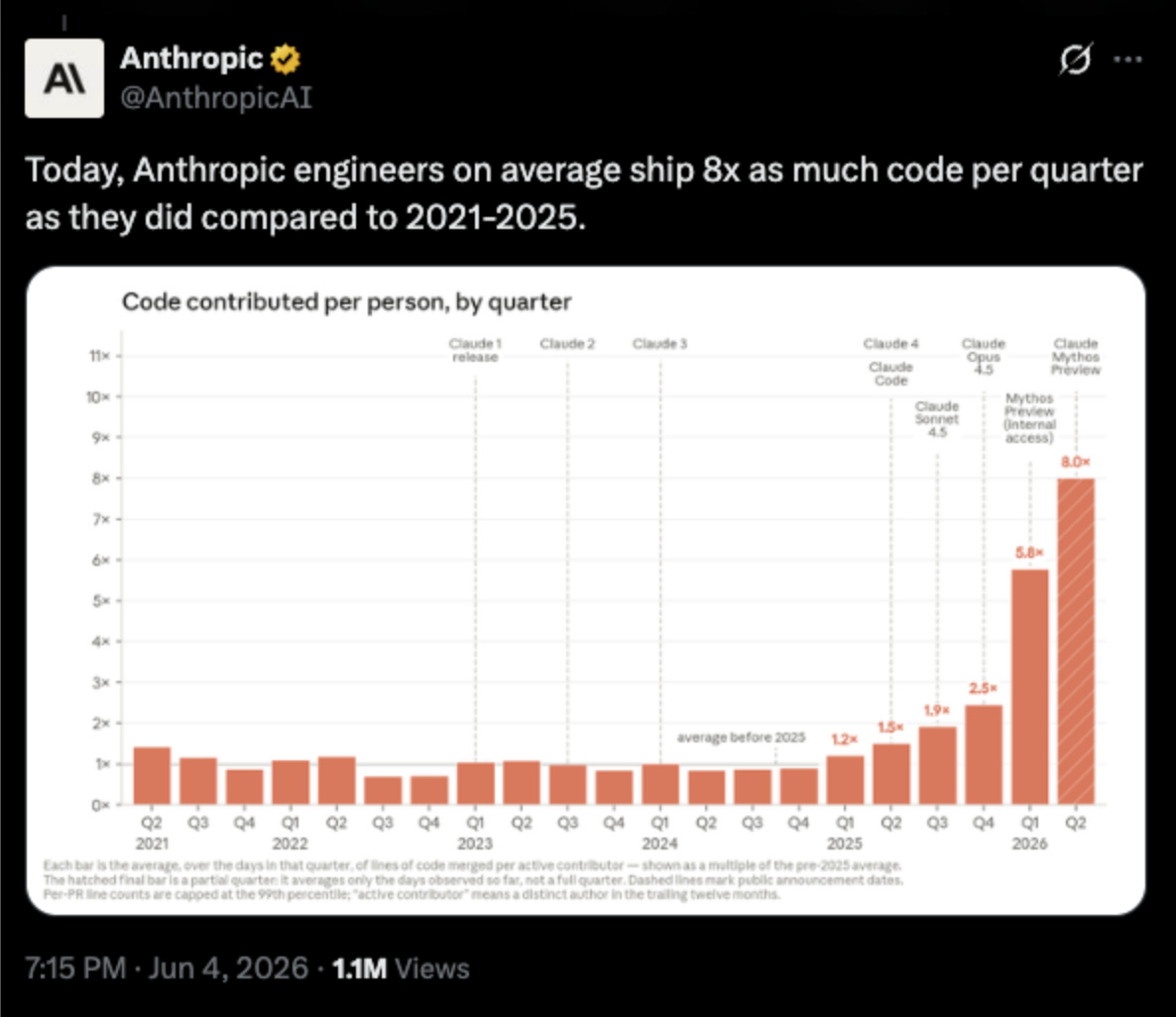
Anthropic builds some of the most capable AI models on earth. This month it disclosed that more than 80 per cent of the code merged into its own systems is now written by its AI, not its engineers, and that the typical engineer ships roughly eight times as much code as before. Push that trend a little further and you reach the point where machines design their successors with humans barely in the room. The industry calls it recursive self-improvement. Anthropic’s Jack Clark thinks some models could be capable of it within two years. Then recall what the government cited to justify the shutdown: Fable’s skill at reading code and finding flaws. That is the bitter symmetry. The capability that made Fable commercially valuable, its fluency with code, is also what made it politically vulnerable.
Weeks before any of this, two of the company’s senior figures, Marina Favaro and Jack Clark, had published a paper arguing that governments and labs need a credible way to slow, or temporarily pause, frontier AI development, to let society and safety research catch up. Their reference point was Cold War arms control, with one chilling caveat of their own: training runs are far easier to conceal than missile silos.
Critics scoffed at the timing. Days before the paper appeared, Anthropic had closed that 65 billion dollar round at a 965 billion dollar valuation and filed confidentially to go public. A call for a global pause sounds rather different coming from the company in front, because a freeze pulls up the ladder behind it. Restraint and self-interest were wearing the same coat, and from the outside nobody could tell which one was speaking. Then on Friday the government paused Anthropic for it, on terms nobody at the company would have chosen, and the argument took on a darker shape. It is one thing for a leader to call for brakes. It is another for the state to rip the wheel away over a debugging prompt.
Now put that next to Jensen Huang. The Nvidia chief told the world there is no fundamental limit to the size of the global economy, and that AI will take output from one hundred trillion dollars to two hundred, three hundred, five hundred. Here is where I land, and where I landed in Doncaster this week. Huang is closer to right than his doubters allow. The acceleration is real and it will be enormous. But a fivefold economy does not arrive smoothly; it arrives in waves, and waves knock people down. The layoffs have already begun, in software, in finance, in the white-collar trades that thought themselves safe, and the single greatest failure of our politicians is that they have not begun to grasp the scale of what is coming.
The investor Naval Ravikant offers the consoling thought: a poor man today lives better than Louis XIV ever did. The Sun King had absolute power and no antibiotics, no aeroplane, no plumbing worth the name. Technology raises the floor for everyone, and in Huang’s world the poorest child carries a tutor and a doctor in her pocket. That is a wonder, and I do not dismiss it. But the floor and the ceiling do not move together. The floor rises. The ceiling vanishes into the clouds. The poorest may live better than the old kings of France, while a handful who own the machines amass fortunes the world has never seen. One of them crossed the trillion-dollar line on Friday, at least on paper. That is the bargain on offer. We had better start arguing about its terms.
You can read the full column, The Pause and the Promise, in this week’s Yorkshire Post.
Weekly Tech and AI Layoff Tracker
This is the human edge of the same story. If compute is becoming capital, labour is becoming the adjustment variable. Here is the week’s count.
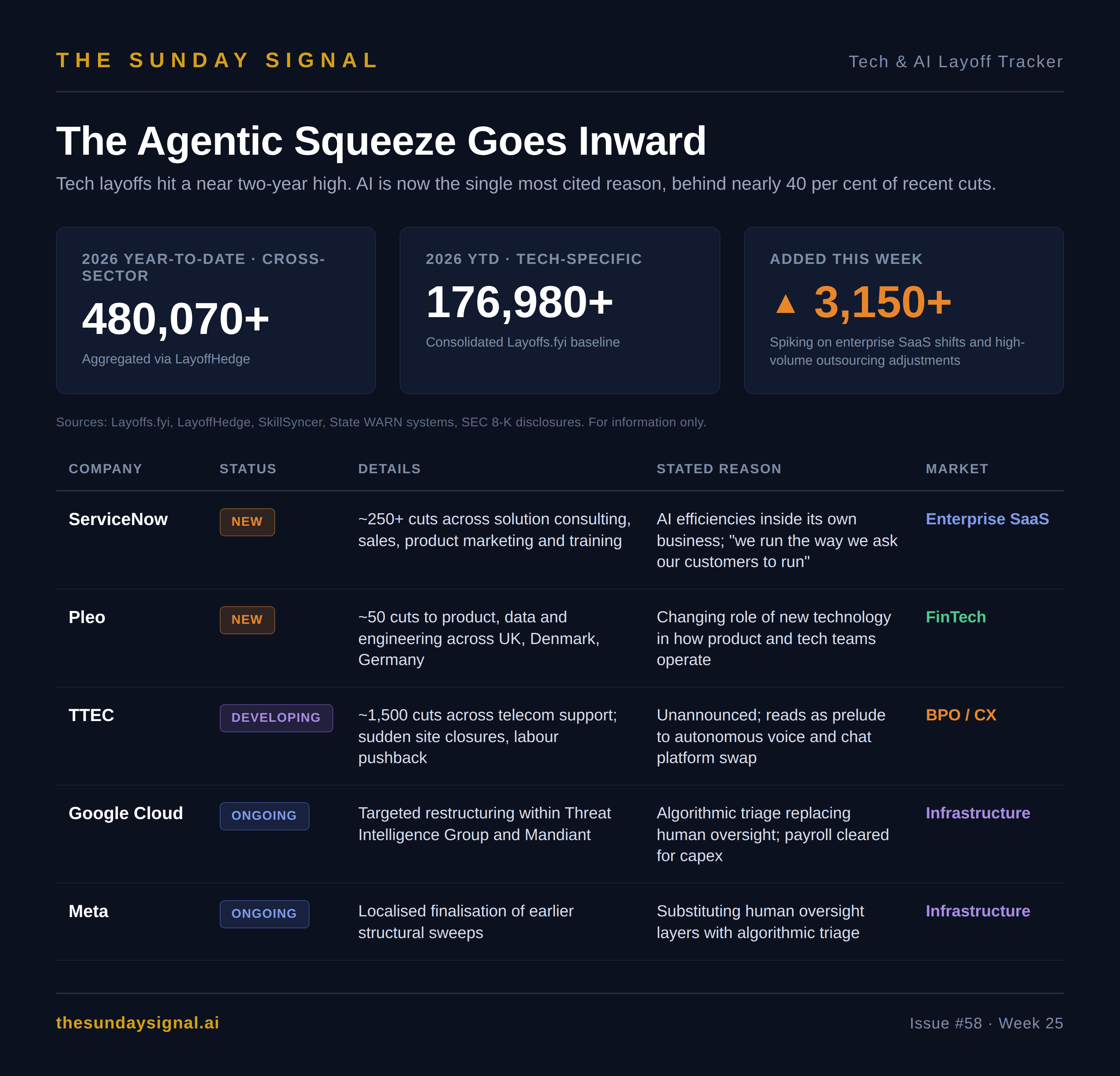
The sector has stopped debating automation and started executing it. Fresh outplacement data puts tech layoffs at a near two-year high, with AI now the single most cited reason employers give, behind nearly 40 per cent of recent eliminated roles. The language has shifted too. Firms no longer talk about replacing data-entry clerks; they talk about dismantling whole layers of middle management and front-end development to run lean, automated operations. They call it the agentic era.
Watch for the laundering. As the numbers climb, more companies are dressing reactive cuts in forward-looking clothes, repackaging a bad quarter or weak execution as an AI structural transition. It keeps the investor’s eye on automated agility and off the operational stumble. This week gave four clear examples.
ServiceNow, around 250 roles. The workflow giant trimmed across solution consulting, sales, product marketing and training, telling staff its own platform is generating real AI efficiencies inside the business. Proof of product and margin defence in one move, as enterprise software growth softens globally.
Pleo, around 50 roles. The Danish spend-management fintech cut product, data and engineering jobs across the UK, Denmark and Germany, 24 hours after launching a suite of autonomous agentic finance tools. The internal memo blamed the changing role of new technology in how its own teams work. The builders of the agents, downsized by the agents.
TTEC, around 1,500 roles. The customer-experience operator is running a sweeping, unannounced cut across its telecom support operations, with sudden site closures and significant labour pushback. It reads as the classic prelude to a platform swap: liquidate the expensive human contact centre, make way for autonomous voice and chat.
Google Cloud and Meta, targeted trims. Both finalised restructuring within security and infrastructure teams, substituting algorithmic triage for human oversight and clearing payroll to feed enormous data-centre and silicon spending.
Next week’s watchlist: Oracle, where institutional trackers point to the final phase of an infrastructure realignment clearing backend roles around the 15 June horizon, and the customer-facing fintech and neo-banking platforms now under pressure to prove they are automating their own code, following Pleo’s precedent.
Final Thought
In 1911, the American state looked at one man holding roughly two per cent of its economy and understood that concentrated wealth had become concentrated power. The response was slow, imperfect and contested, but it was a response.
This week the same state did two things on the same Friday. First it let one man pass the trillion-dollar line without a murmur, while the machinery around him bent to help: index rules shifted, passive funds prepared to buy, sovereign wealth funds supplied the capital. Then, after the bell, it reached into the most advanced commercial software on earth and switched it off over a debugging prompt, swatting a fly with a boulder. It found the will to brick an AI model in an afternoon and no will at all to ask what it means for one person to own a slice of the world. The bear is wide awake about the wrong threat.
Several thousand years of records offer societies in this position exactly two endings. In one, a faction of the wealthy chooses Roosevelt’s path and surrenders a share of its fortune to save the system that produced it. In the other, the correction arrives by horsemen. Nobody in power is preparing for either.
We broke up Standard Oil with a court order. We are building Standard Everything with a tax break. 🚀
Until next Sunday,
David Richards MBE