
The AI Wars Go Agentic
In three days this week, four labs shipped four major AI models and cut the price of machine cognition.

THE SUNDAY SIGNAL · Issue #62 · Week 28 · Sunday 12 July 2026
Four major models landed in three days, the price war intensified below the flagship tier, and Anthropic began the month restored from a short-lived export-control suspension. Raw intelligence is no longer enough. Execution economics increasingly decide what gets deployed.
This issue is also available as a podcast. Listen on Spotify, Apple Podcasts or YouTube and tell me what you think.
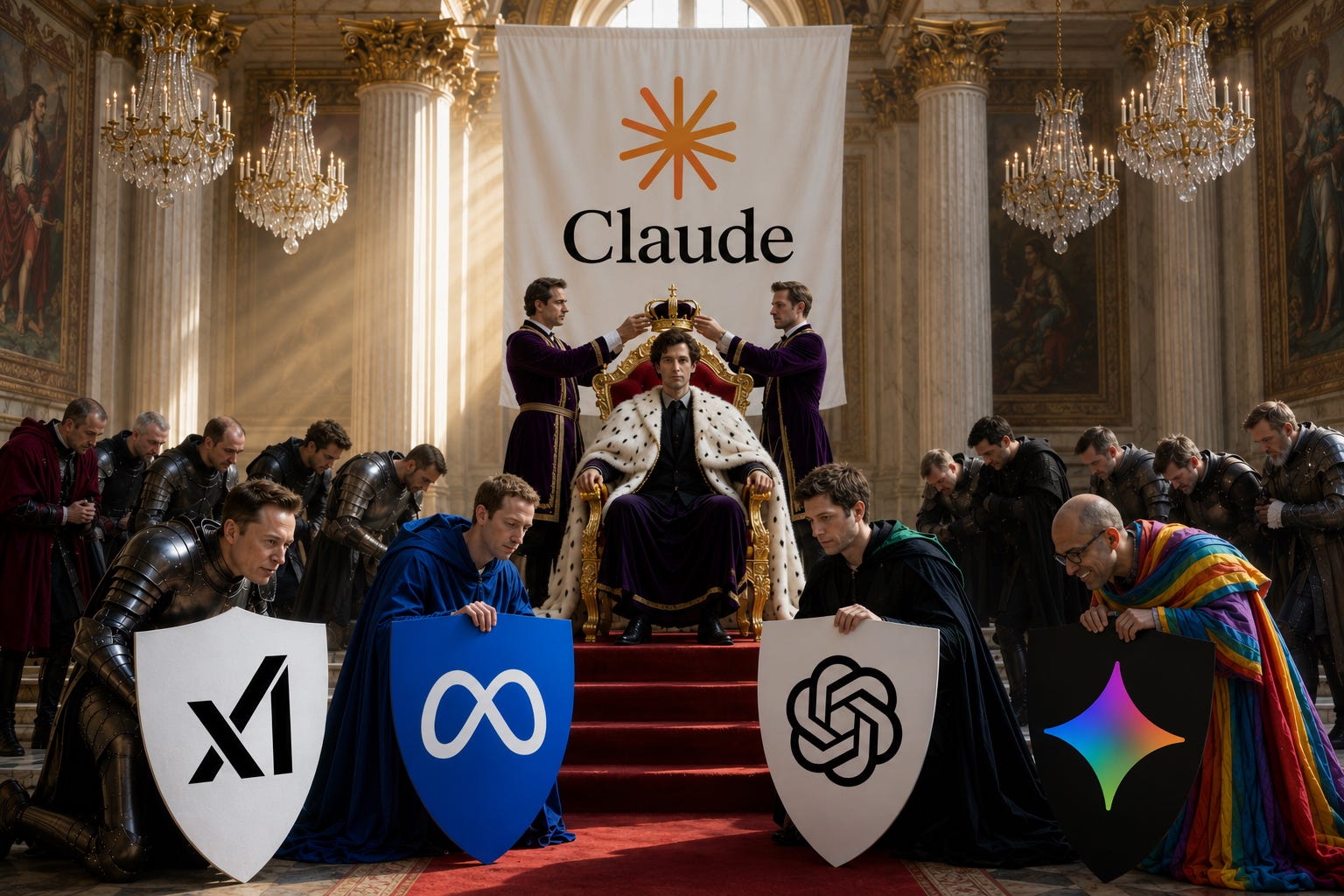
Bottom Line Upfront: The frontier AI market has stopped rewarding cleverness for its own sake. In the space of three days this week, Tencent, xAI, Meta and OpenAI all shipped major new models, while Anthropic, restored at the turn of the month from a short-lived export-control suspension, holds the published lead on the hardest coding benchmark. There is no single winner, and that is the story. Leadership now depends on the workload and the evaluation, and what the market pays for is agentic efficiency: useful work completed per unit of time and cost. This issue maps the new hierarchy, sets out how to choose between the contenders (test first, route second), launches a new free feature (The Signal Playbook), and closes with a layoff tracker that shows exactly who is paying for all this compute. Spoiler: it is the payroll.
Intelligence is table stakes. Agency wins the contract
The sequence ran like this. Tencent released Hunyuan Hy3 on Monday 6 July. xAI followed with Grok 4.5 on Wednesday 8 July. On Thursday 9 July, Meta and OpenAI released Muse Spark 1.1 and GPT-5.6 within hours of each other. Four major models in three days, with one caveat that belongs up front: Tencent’s claim that Hy3 competes with the larger flagship systems is, for now, Tencent’s claim.
Anthropic’s return is the other story, and the chronology matters. The US export controls that suspended their most powerful models were lifted on 30 June, and Claude Fable 5 access was restored on 1 July. Mythos 5 has not returned to general availability; access remains limited to approved organisations and Glasswing partners. The frontier’s most watched model family entered July operational, but not unrestricted.
Strip away the launch theatre and one pattern emerges. Every lab, without exception, has pivoted its pitch away from raw foundational intelligence and towards agentic efficiency: long-horizon, multi-step task execution, run autonomously, priced to deploy at scale. The customer being courted is no longer the curious consumer. It is the chief operating officer with a headcount spreadsheet open in the next window.
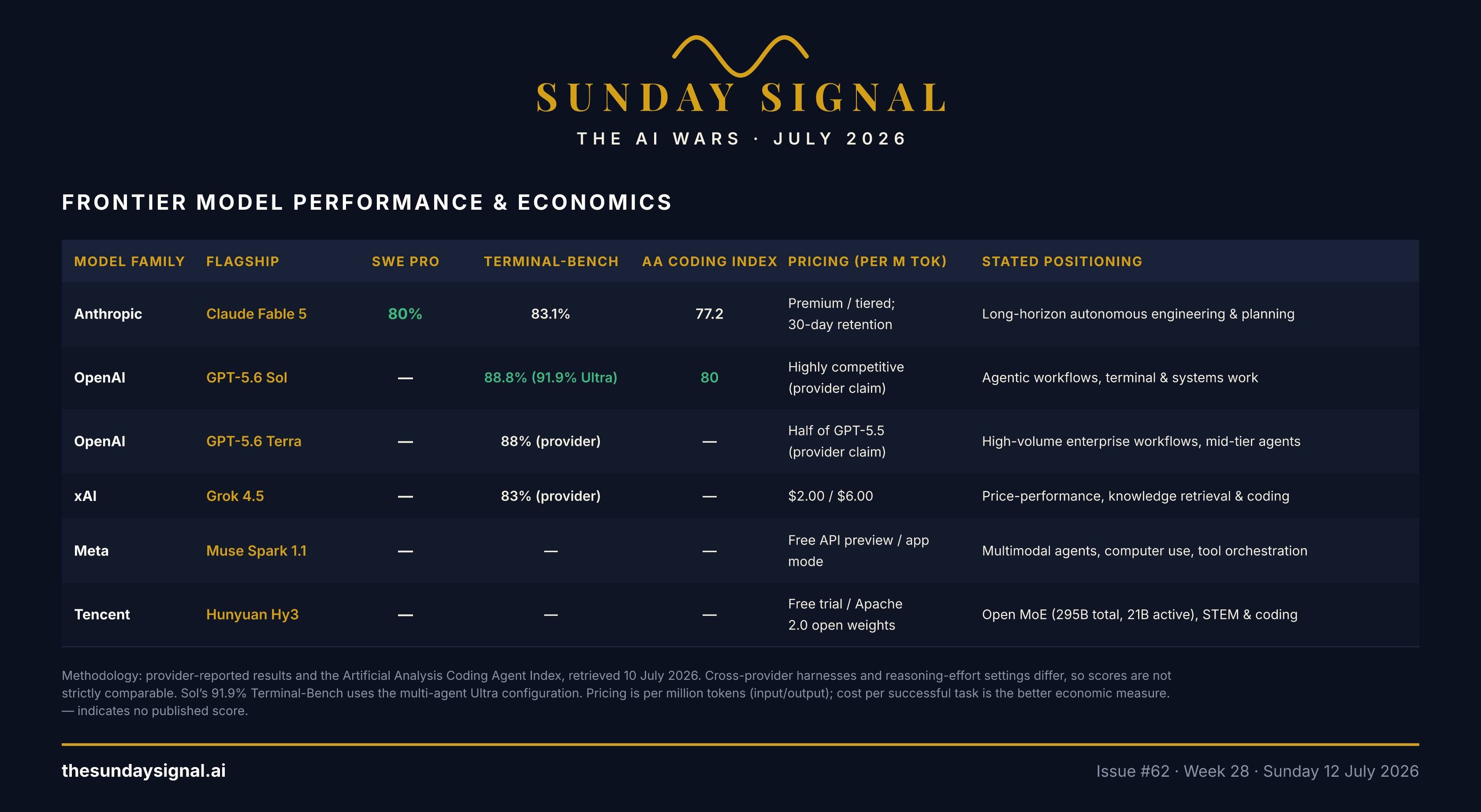
To see where compute is delivering return, here are the leading models across the published evaluation vectors, with the methodology caveats that launch-week coverage tends to omit.
Why Anthropic still lead on one important coding measure
Claude Fable 5 retains the published lead on SWE-Bench Pro, resolving 80% of tasks on the hardest widely cited software engineering benchmark. But the broader coding crown is workload-dependent. GPT-5.6 Sol leads the Artificial Analysis Coding Agent Index at 80 to Fable’s 77.2, and Sol tops Terminal-Bench at 91.9% only in its multi-agent Ultra configuration; standard Sol scores 88.8%, Fable 83.1%.
The practical case for Fable is its strong performance on difficult, long-horizon software work, not a disclosed architectural advantage over every competitor. Partner testimony from testing reports that, at its highest effort setting, Fable reflects on and validates its own work before returning it. Treat that as observed behaviour, not a documented mechanism; Anthropic have published no architecture details for the Mythos class beyond defining it as a capability tier above Opus.
The trade-offs matter just as much as the scores. Fable carries premium token pricing. Its safety classifiers route flagged cybersecurity, biology, chemistry and model-distillation requests to Opus 4.8, and Anthropic acknowledge false positives, so sensitive-domain workflows can hit fallbacks. And all Mythos-class traffic, Fable 5 included, carries mandatory 30-day retention. Any organisation weighing a move of proprietary code or scientific work onto it should price all three factors in before committing.
The chips underneath the software
To view this race purely through software benchmarks is to miss the tectonics underneath. The race for hardware independence is accelerating on both sides of the Pacific. Reuters report that an internal memo shows Meta plan to begin manufacturing their Iris accelerator in September, augmenting rather than replacing their Nvidia and AMD fleet. DeepSeek have optimised V4, their 1.6-trillion-parameter mixture-of-experts model with 49 billion active parameters, for Huawei’s Ascend platform, and Reuters separately report they are developing an inference chip of their own. The common objective is not immediate independence but greater control over cost, supply and inference capacity.
The regulatory lesson runs alongside it. Anthropic’s June suspension and July restoration is a live demonstration of the geopolitical risk premium embedded in AI supply chains. Architect for model agnosticism: your API abstraction layer should be able to swap one frontier family for another before lunch if trade friction locks one down again.
The bottom line: there is no uncontested technical crown. Fable 5 owns the hardest published coding benchmark, Sol owns the terminal and the composite coding index, and Terra and Grok 4.5 are forcing a commoditisation curve below the flagship tier. Leadership depends on the workload and the evaluation. Which is exactly why the next section exists.
Stop asking which AI is best. Ask which AI is best at this, then prove it
With the frontier fracturing into specialisations, multi-model orchestration is no longer a luxury. It is an operational necessity. But the market changed on Thursday, and categorical verdicts written on Friday deserve your suspicion, including mine. What follows are default candidates, not conclusions. The conclusions have to come from your own evaluation, on your own work.
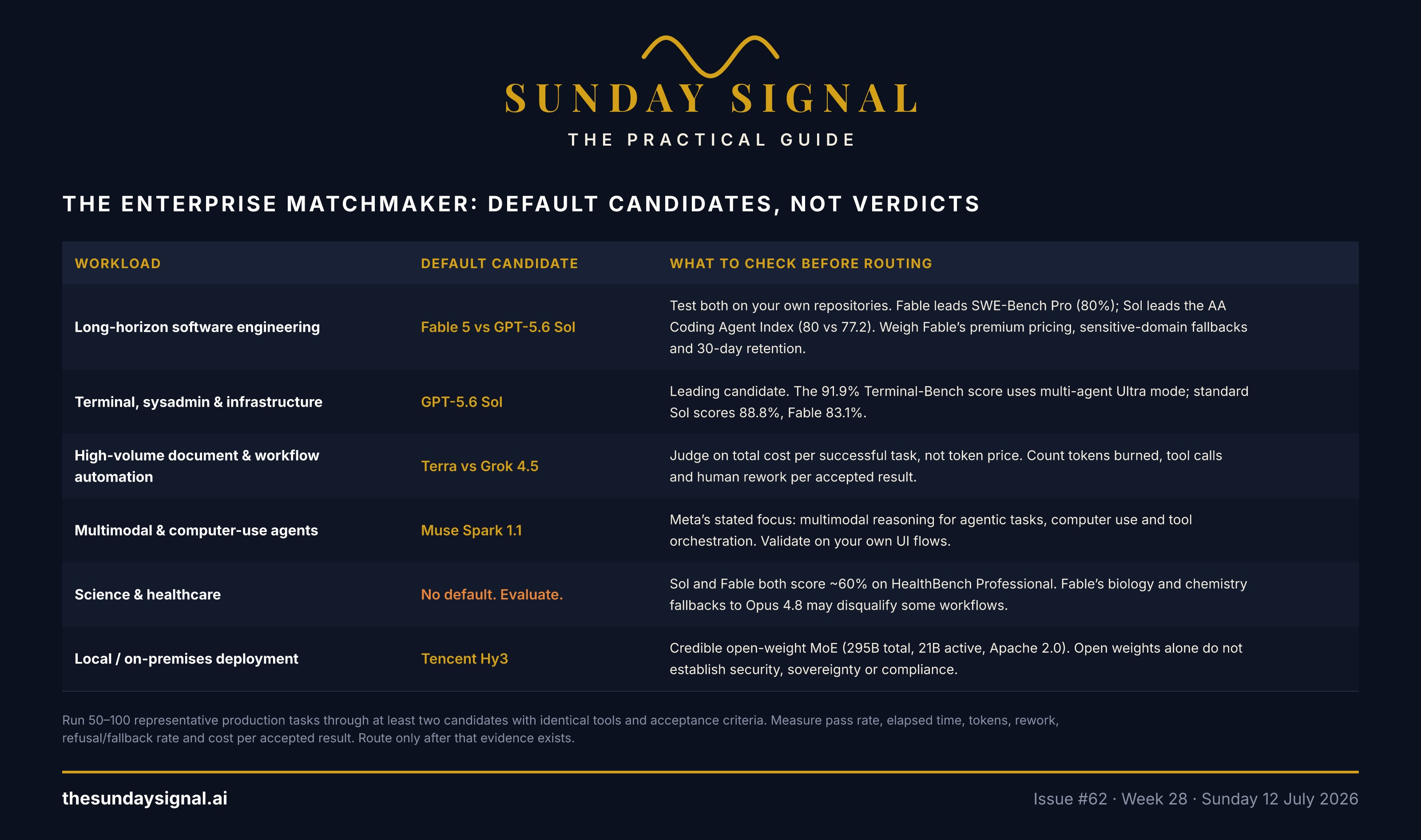
💻 Long-horizon software engineering. Shortlist Claude Fable 5 and GPT-5.6 Sol, and test both against your own repositories rather than the leaderboards. Fable leads SWE-Bench Pro; Sol leads the Artificial Analysis Coding Agent Index. Weigh Fable’s premium pricing, sensitive-domain fallbacks and 30-day retention against what the benchmark deltas are worth on your codebase. Budget option for lower-stakes internal tooling: Grok 4.5.
🛡️ Terminal, sysadmin and live infrastructure. GPT-5.6 Sol is the leading candidate. Be precise about the headline number: the 91.9% Terminal-Bench score uses the multi-agent Ultra configuration, while standard Sol scores 88.8%. Both make it the natural first test for SecOps and SRE copilot work.
📊 High-volume document and workflow automation. Test GPT-5.6 Terra against Grok 4.5, and judge them on total cost per successful task, not token price. A cheaper model that burns twice the tokens, makes more tool calls or needs more human rework costs more per completed job. Token price is the sticker; cost per accepted result is the invoice.
🖥️ Multimodal and computer-use agents. Muse Spark 1.1 is the natural first candidate. This is Meta’s stated focus for the model: multimodal reasoning for agentic tasks, computer use, tool orchestration and coding.
🧪 Science and healthcare. No crown here, and be wary of anyone offering one. OpenAI’s published table puts Sol and Fable both around 60% on HealthBench Professional, and Fable’s biology and chemistry fallbacks to Opus 4.8 may disqualify it for some workflows outright. Evaluate Sol and appropriate specialist systems against your own protocols.
🔒 Local and on-premises deployment. Tencent’s Hy3 is a credible open-weight candidate: a 295-billion-parameter mixture-of-experts design with 21 billion active parameters, released under Apache 2.0. One discipline, though. Open weights make local operation possible; they do not by themselves establish security, sovereignty or regulatory compliance. Hosting, telemetry, data flows, model provenance and local regulation still need their own review.
Before you route anything: the evaluation playbook
The efficient enterprise does not let developers pick their favourite model, and it does not route on launch-day adjectives either. It routes on evidence gathered like this.
Select 50 to 100 representative production tasks. Include your difficult failures, not just the average cases. An evaluation built on easy tickets flatters every model and informs nothing.
Run them through at least two candidate models. Identical tools, identical harness, identical acceptance criteria. Cross-provider launch tables are not apples-to-apples; your evaluation must be.
Measure what the invoice measures. Pass rate, elapsed time, total input and output tokens, human rework, refusal or fallback rate, and total cost per accepted result.
Route only after that evidence exists. Then keep the abstraction layer (LiteLLM or an internal gateway) between your applications and every provider, because Thursday will happen again.
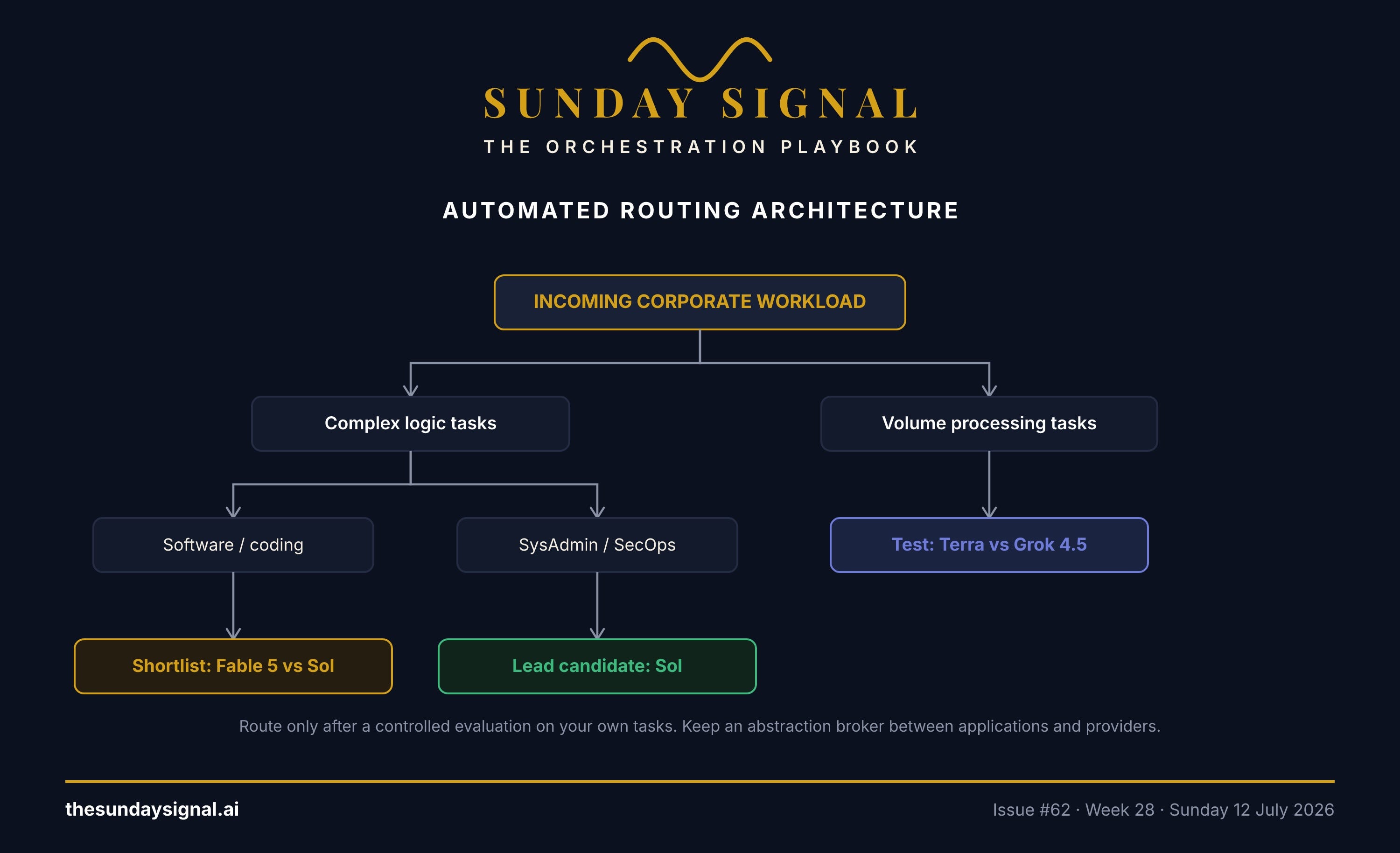
Route on evidence, not on press releases. The companies that learn this in Q3 will be the ones still solvent enough to enjoy Q4.
The other side of the ledger
I have spent much of this newsletter’s life, and most of my Yorkshire Post column inches, warning about what AI will do to white-collar work. I retract none of it, and the tracker below will make that point again shortly. But the ledger has two sides, and my column in Friday’s Yorkshire Post is about the other one. Here it is in full.

The Historian in My Pocket
A note on timing: this column was written on Friday morning and went to the Yorkshire Post before England’s quarter-final against Norway in Miami on Saturday night. It is reproduced here unchanged, pre-match optimism included.
Two weeks ago I found myself in Boston with a free afternoon, which in thirty years of visiting the city on business had never once happened. I was there for the World Cup, ahead of England’s goalless draw with Ghana at Foxborough, and this is the 250th anniversary year of American independence. So I finally did the thing I had always skipped: I walked the Freedom Trail.
A quick aside. During my twenty-three years in California, someone would ask me almost every July whether we celebrate the Fourth of July in Britain. My answer never varied: of course we do, we call it Loss of Colony Day.
Rather than buy a guidebook or surrender to Google, I built my own tour guide. I gave an AI a role: an elite Harvard historian specialising in the American Revolution, acting as my private guide in real time. Keep each stop under 250 words. Never jump ahead. Skip the textbook summaries in favour of gritty realities, human flaws and political scheming.
I used Claude’s audio function, so I put my earphones in and set off from Boston Common with a voice in my ear. At each stop I said two words, “I’m here,” and the history arrived, told like a thriller.

At the Granary Burying Ground it introduced me to Paul Revere and Sam Adams, lying a few feet apart. At the Old North Church it told me the famous two lanterns burned for less than a minute before being snuffed out, and that the man who hung them was Robert Newman, a 23-year-old church caretaker history forgot. The bells in that steeple, it added, were cast in Gloucester in 1744, the oldest change-ringing bells in North America; among the teenagers who once rang them was Paul Revere himself. On Copp’s Hill it showed me Captain Daniel Malcolm’s gravestone, still dented by British musket balls fired at a dead patriot’s defiant epitaph for target practice.
Best of all, I learned Revere never shouted “The British are coming.” The colonists still considered themselves British. The warning that passed through the countryside was that the Regulars were out.
I also discovered that the Liberty Bell has an English prehistory. Its first incarnation came from London’s Whitechapel Foundry, but it cracked on its first test. Philadelphia metalworkers John Pass and John Stow melted it down and recast the bell in 1753. Its inscription still spells Pensylvania with a single N. That was acceptable at the time. Today it reads like a typo on a national relic.
The same technology handled the rest of the trip. One prompt cast the AI as a corporate travel expert, comparing flights by on-time performance and aircraft comfort. Another played hospitality analyst, offering three hotels with a bull case, a bear case and the exact floor to request. A third, a cynical culinary critic, built a one-day itinerary with a Plan B for bad weather. Every recommendation landed.
I have spent much of this column’s life warning about what AI will do to white-collar work, and I retract none of it. But the ledger has two sides. This summer, anyone with a phone and a decent prompt has a private historian, a travel agent and a concierge on call, free, in their pocket. The trick is not the technology but the ask. Give it a role, give it constraints, give it taste. Vague questions get brochure answers; precise ones get expertise.
Which brings me to Friday morning, and to tomorrow night in Miami, where England face Norway in a World Cup quarter-final. Get past Haaland and his Vikings, and the semi-final beckons in Atlanta. Beyond that, maybe, just maybe, a final on American soil in New Jersey, 250 years after the Declaration was signed. Should it come to that, I know exactly what the cry from the terraces ought to be. Not the Regulars this time. The English are coming.
The newsletter tells you what’s happening. The Playbook shows you what to do about it

Those Boston prompts were not improvised on the pavement. They were built, tested and refined, and they are the seed of something new that launches this week: The Signal Playbook.
Here is the idea. Every week this newsletter analyses what AI is doing to work, to markets and to the country. Readers keep asking the obvious next question: fine, but what do I actually type into the box? The Playbook is the answer. Each edition is a standalone, production-ready guide to one real-world job. Copy the prompts, fill in the brackets, keep them forever.
Playbook No. 1 is Stop Prompting Claude Like a Tourist: twenty production-ready prompts that turn Claude into a working travel desk. And the premise is simple. Most published travel prompts fail because they treat Claude like an overly cheerful concierge. Ask nicely and you get brochure copy: pleasant, generic and useless when you’re standing on a rain-slicked platform trying to decode a foreign transit map. The fix is not better manners. It is better structure. A working prompt reads like code: an explicit role, hard constraints, a list of things it must refuse, and a defined output format.
Here is what that looks like in practice. Remember the hospitality analyst from Boston, the one that offered three hotels with a bull case, a bear case and the exact floor to request? This is it, exactly as it appears in the Playbook. Prompt No. 3 of twenty: the Anti-Tourist Hotel Scout.
<system_role>
You are a hospitality industry short-seller and a cynical local
culture editor.
</system_role>

<parameters>
Location: [City]
Duration and season: [Number of nights / Month]
Nightly budget: [Amount in local currency]
Aesthetic: [e.g. Brutalist, high-design boutique, classic luxury]
</parameters>

<filtration_rules>
- Exclude major tourist epicentres, cruise-ship bottlenecks and
  over-indexed influencer hubs.
- Focus on walkable neighbourhoods with distinct architectural
  integrity and a high density of independent local businesses.
</filtration_rules>

<output_format>
Identify the top 3 properties. For each:
- NEIGHBOURHOOD INTEL: the social fabric of the area and why it
  beats the tourist centre.
- THE BULL CASE: the objective design merits, service quality or
  privacy perks.
- THE BEAR CASE: the cynical downsides (micro-rooms, street-noise
  corridors, weak water pressure, poor transit access).
- THE ROOM HACK: the precise room tier, view orientation or floor
  range to request.
</output_format>
Fill in the four brackets, paste the whole block, and go. Notice what the structure is doing. The role removes the incentive to flatter: a short-seller gets paid for finding what is wrong. The filtration rules exclude the tourist epicentres before the search even starts. And the output format demands a bear case for every property, which means the model cannot retreat into brochure copy even if it wants to.
The Scout is one of twenty, and the set is organised the way a trip actually unfolds: booking, briefing, the ground, the mission, and the moment it all goes wrong. The booking phase includes the Flight Friction Matrix, which compares routings by aircraft, cabin altitude and terminal reality rather than fare-aggregator marketing, and the Insurance Interrogator, which reads your policy the way a claims department will: for the exclusions. Later phases cover borders, scams, packing, jetlag, food worth queueing for, hire-car disputes and the Disruption Counsel, for the day the airline cancels on you. The guide closes by showing you how to wire your favourites into a Claude Project with your bookings uploaded, so that on the road the whole thing runs on a two-word command.
One discipline runs through all twenty. Visa rules, passenger rights and medication laws change, so wherever a prompt touches them, a standing instruction forces Claude to flag the volatile rule and point you at the official source. Trust the analysis, verify the law.
Three things to know. The Playbooks are free. They will be a regular feature, published as companion guides on The Sunday Signal between the weekly issues. And they follow one editorial rule, the same one that ran through my Freedom Trail experiment: vague questions get brochure answers, precise ones get expertise.
The Signal Tech & AI Layoff Tracker
Week 27 wrap · 5 to 11 July 2026
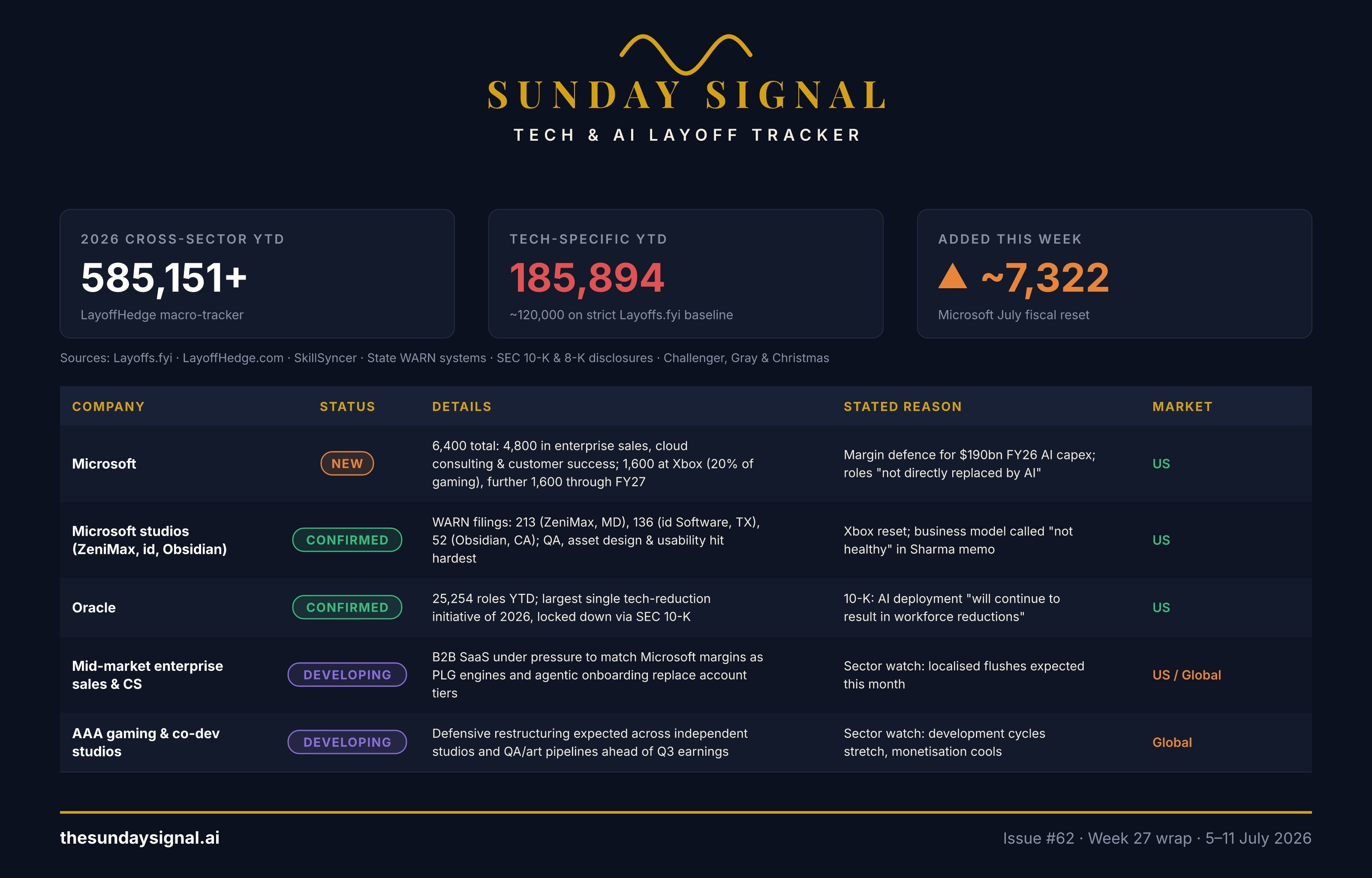
We have crossed the mid-year threshold, and the consolidated picture is sobering. Integrating live metrics from Layoffs.fyi, LayoffHedge, SkillSyncer, state WARN registries and the newly updated mid-year reports from Challenger, Gray & Christmas, the core thesis of 2026 is clear: the tech economy is detaching from the broader market to prioritise AI computing infrastructure over human overhead.
The core numbers. LayoffHedge’s cross-sector macro-tracker puts 2026 year-to-date losses at more than 585,151. The tech-specific figure stands at 185,894 on SkillSyncer’s indexing across 267 events, or roughly 120,000 on the strict Layoffs.fyi baseline. About 7,322 were added this week, driven almost entirely by Microsoft’s July fiscal reset.
The H1 autopsy and the death of AI laundering
The mid-year data delivers an unforgiving reality check. Tech sector layoffs in the first half of 2026 shattered previous pacing expectations, averaging roughly 968 to 1,005 job losses per working day, an 83% explosion compared with H1 2025. The sector now accounts for nearly a third of all job losses globally this year, with the United States the absolute epicentre at 121,072 cuts.
The corporate thesis underneath has shifted too. In late 2024 and early 2025, companies reached for AI-transition buzzwords to mask revenue stagnation, macro headwinds and pandemic-era over-hiring. Entering Q3 2026, the market has seen through the cover-up. According to Challenger, Gray & Christmas outplacement data, AI was the single most-cited reason for technology layoffs in May and June, the third consecutive month it has topped the list. This is the death of AI laundering: the stated reason and the real reason have converged.
And the trade is explicit. Highly profitable conglomerates are posting record revenues while executing a capital transfusion: liquidating payroll lines to fund infrastructure capex, custom silicon orders and hyper-scale cluster deployments. The impact is no longer confined to support and operational roles. Senior engineering teams, middle management and entire product divisions are being systematically dismantled.
Microsoft and Xbox: the cloud capex squeeze (6,400 total cuts). The single most disruptive signal entering the new fiscal quarter. Timed precisely to the July fiscal year-end, Microsoft eliminated 4,800 roles across commercial enterprise sales, cloud consulting and customer success. Simultaneously, an internal memo from newly appointed Xbox chief Asha Sharma forced an immediate 1,600-person reduction, 20% of the gaming workforce, to correct a business model the memo described as “not healthy”, with a further 1,600 roles scheduled to bleed out over the remainder of FY27. The WARN receipts cleared late this week and prove the product developers bore the brunt: 213 at ZeniMax Online Studios in Maryland, 136 at id Software in Texas, 52 at Obsidian Entertainment in California, falling heavily on QA, asset design and usability engineering. Chief people officer Amy Coleman insisted the roles are not being directly replaced by AI; the liquidation nonetheless serves as margin defence for Microsoft’s $190 billion fiscal 2026 AI infrastructure and data centre capex projection.
Oracle: the H1 restructuring leader (25,254 cuts YTD). Analytical reviews published this week, together with public SEC 10-K disclosures, lock down Oracle’s silent rolling purge as the largest single tech-reduction initiative of the year. The regulatory filings say the quiet part in print: the adoption and deployment of AI across internal operations has resulted, and will continue to result, in workforce reductions. The human liquidation ran concurrently with an expanding AI data centre footprint, boosting net quarterly margins while the firm reports massive cloud backlogs.
High-probability targets through mid-July
Watch mid-market enterprise sales and customer success. Microsoft’s hollowing out of their commercial divisions puts institutional pressure on peer B2B software and cloud-layer SaaS firms to match those operating margins, and as platforms shift to product-led growth engines and agentic onboarding bots, large human account-management tiers face sudden, localised flushes this month. And watch AAA gaming infrastructure and co-development studios: the multi-state cuts across Microsoft’s premium IP expose the operational strain in the sector, and parent holding companies will move to defensive restructurings across independent studios and supporting QA and art pipelines ahead of Q3 earnings calls.
Data sources: Layoffs.fyi, LayoffHedge.com, SkillSyncer, state WARN systems, SEC 10-K and 8-K disclosures. For informational purposes only.
Final Thought 🚀
Hold this week’s two stories side by side. In one, the labs shipped four major models in three days and pushed the price of machine cognition sharply lower. In the other, the most profitable companies in history cut thousands of jobs and called it transformation. Nobody can prove a one-to-one causal chain between a benchmark score and a redundancy notice, and I won’t pretend to. But the direction of the capital is not in dispute.
Every gain on SWE-Bench Pro strengthens the business case for moving work from payroll to capex. The companies executing these cuts are not in distress; they are in a hurry. And the workers being shown the door are not being replaced by nothing. They are being replaced, in part, by the very models whose scores opened this issue.
The agentic turn is real, the efficiency gains are real, and, as my afternoon in Boston shows, the technology in your pocket is a marvel. But let’s not launder the accounting. Record revenues, record capex, record layoffs, all in the same quarter, from the same companies. That is not a correction. That is a choice.
Until next Sunday,
David