

The $60 billion company that broke the rulebook
A 300-person company just sold for $60B. The three numbers we used to judge every business no longer hold.

THE SUNDAY SIGNAL · Issue #60 · Week 26 · Sunday 28 June 2026
This issue is also available as a podcast. Listen on Spotify, Apple Podcasts or YouTube and tell me what you think.
Bottom Line Upfront
For half a century we judged a company by three things, in order. How many people it employed. How much revenue it earned. Whether it would ever turn a profit. Cursor has torn the first two pages out of that book, and SpaceX paid sixty billion dollars to hold what was left. This week California started counting the human cost of exactly this shift. And in Friday’s Yorkshire Post I argued that the boardrooms now panicking about the price of artificial intelligence have misread the bill entirely. Three signals. One direction of travel.
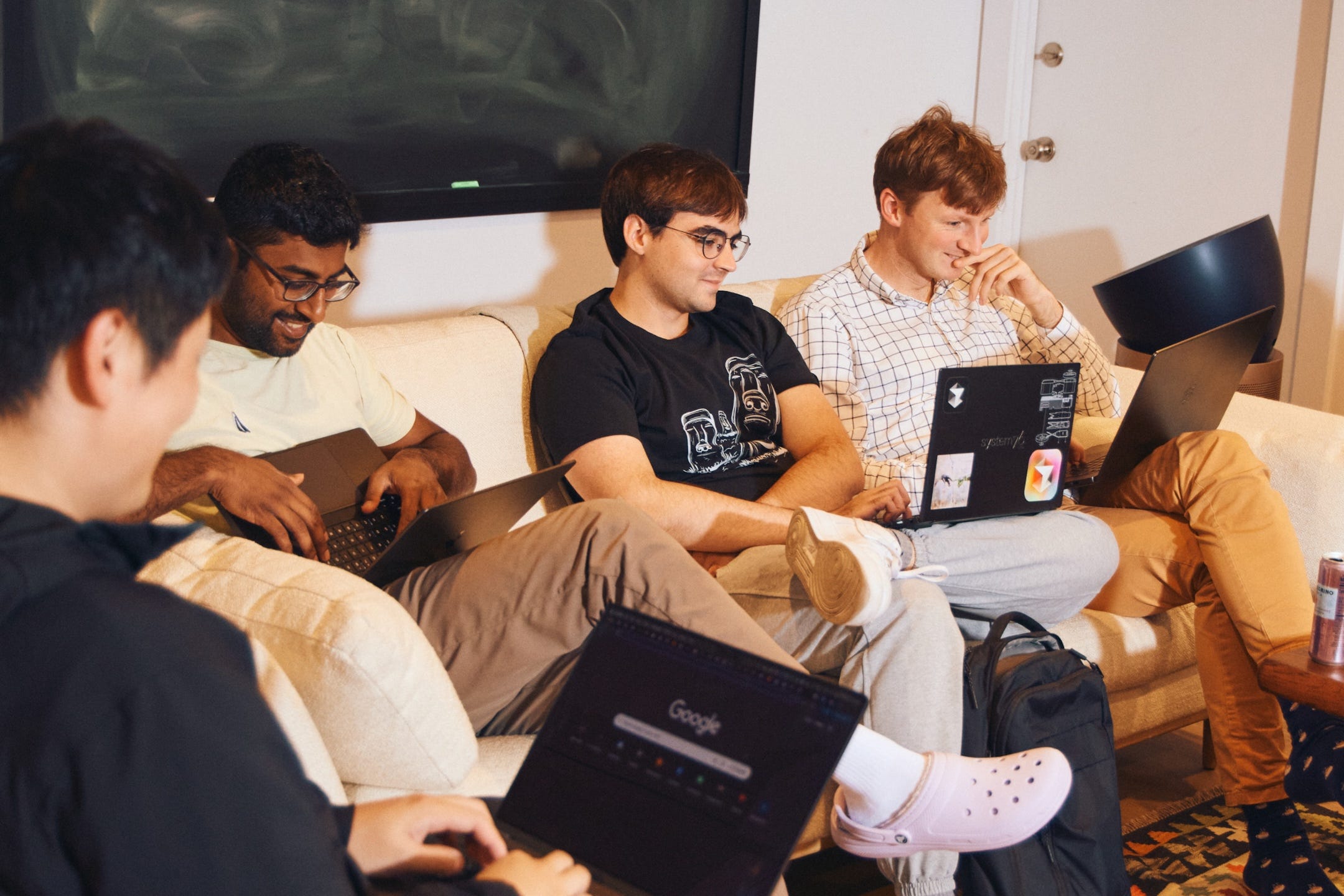
We Used to Count People. Now People Are a Rounding Error.
SpaceX has agreed to buy Anysphere, the company behind the coding tool Cursor, in an all-stock deal worth sixty billion dollars. The announcement landed on 16 June, four days after SpaceX completed the largest stock market debut in history and floated at more than two trillion dollars. Elon Musk used the fresh currency at once. He merged his artificial intelligence venture, xAI, into SpaceX back in February. Cursor is the bolt-on that gives it a real business.
Sixty billion is a serious number. It is not the interesting one.
Anysphere does not publish its headcount. It guards the figure on purpose. The credible estimates cluster around three hundred people, with one respected data provider putting it nearer four hundred. Take the lower number, the one the company’s own admirers tend to use, and the maths stops making sense in the old language. Sixty billion dollars divided by three hundred staff is two hundred million dollars of value for every single employee. Not revenue. Value. The price one of the most aggressive acquirers on earth agreed to pay, per head.
Now set that beside the rulebook we have used since Marc Andreessen told us software was eating the world.
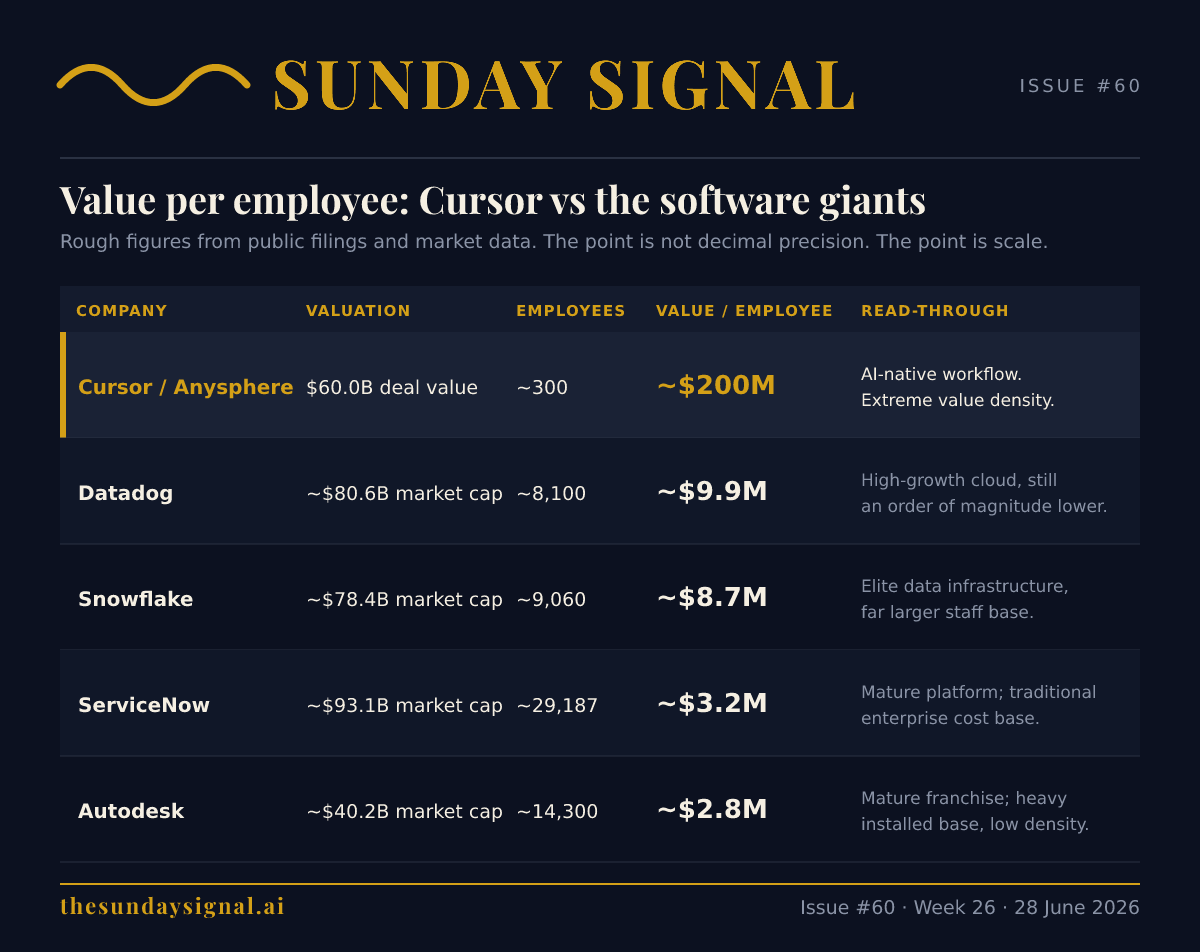
Read across the bottom row. A mature cloud company carries between two and five million dollars of value for each person on its payroll. That used to look like the high-water mark of software leverage. Cursor sits at roughly forty to a hundred times that figure. Read up the column. The company reached a billion dollars of annual recurring revenue in about three years. Salesforce took more than a decade. And the revenue density is the part that should keep incumbents awake. Cursor’s annualised revenue had climbed to around four billion dollars by early June, with roughly 2.6 billion of that coming from enterprise customers. Divide even the conservative enterprise figure by the staff and you land near nine million dollars of sales a head. The average software company manages two hundred thousand.
So the old test fails. We counted people, because people were the engine and the cost. Here the people are neither. They are the rounding error.
They Did Not Cut Costs. They Relocated Them.
The lazy reading is that Cursor proves software companies no longer need employees. That is wrong, and the error matters, because it leads boards to the wrong conclusion about their own businesses.
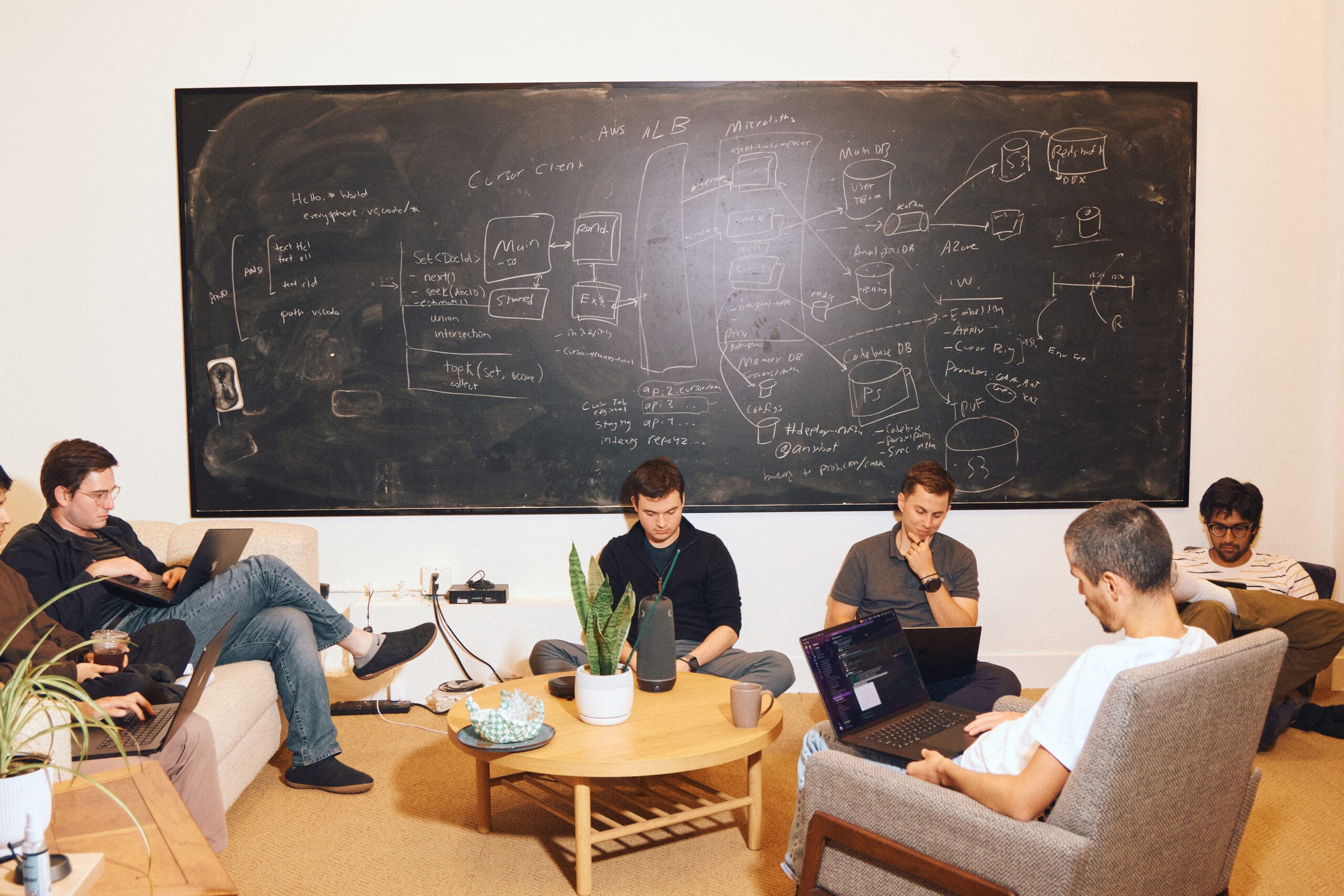
Cursor did four things, and only one of them was about being small.
First, it refused to build what already existed. Rather than write a code editor from scratch, the founders forked Microsoft’s open-source VS Code. They inherited a mature product that millions of developers already knew, then poured every engineering hour into the one layer that mattered: the artificial intelligence sitting inside it. No learning curve for the user. No wasted years on plumbing.
Second, it let the product do the selling. For roughly two years Cursor ran almost no enterprise sales operation. Individual developers downloaded it, found they could work several times faster, and pushed their own employers to buy licences. The company reportedly passed two hundred million dollars of revenue before it hired its first enterprise sales representative. That is the inversion of the classic playbook, where you build a large sales machine first and hope revenue follows.
Third, it paid for density rather than scale. Engineers at Cursor reportedly earn total packages between eight hundred thousand and 1.1 million dollars. The team stayed deliberately tiny and ferociously selective, and it used its own tool to build the tool. A small group of elite people, each amplified by the very product they were shipping.
And fourth, here is the part the celebration leaves out. Cursor did not escape the cost base. It moved it. The bills that a normal company pays as salaries, Cursor pays as compute. Its product runs on frontier models, and for a long stretch a great deal of its revenue flowed straight back out to model providers, Anthropic chief among them. Reporting through 2025 suggested the AI coding companies were running negative gross margins at points, which is why Cursor began training its own models to claw that money back. The payroll was small. The total cost of intelligence was enormous, and it sat in graphics chips and inference, not in offices and headcount.
That single fact is the spine of the whole story. Cursor looked weightless. It was not. It had simply swapped one bottleneck for another.
SpaceX Did Not Buy a Code Editor. It Bought the Map.

Which explains the buyer.
Cursor’s weakness was the mirror image of its strength. It had built the best application in the category on top of models and compute it did not control. Anthropic, OpenAI and Google were all at once its suppliers, its partners and its rivals. As coding assistants became strategic, that dependence became a noose.
SpaceX could cut it. The deal hands Cursor access to serious compute, the constraint that had capped its economics. In return Musk’s empire gets three things money alone cannot buy. It gets distribution to the most valuable users in technology, the engineers who build everything else. It gets a real, fast-growing artificial intelligence business at a moment when Grok has struggled to compete. And it gets the live telemetry of how the world’s best developers actually write software, the highest-grade training data imaginable for the next generation of models. SpaceX did not pay sixty billion dollars for a text editor. It paid for a map of how software gets made, and a captive channel to ship its own intelligence down.
The all-stock structure made it almost painless. A company freshly valued above two trillion dollars can buy a sixty-billion-dollar asset with paper, not cash, and barely feel the dilution. The IPO was the loaded gun. Cursor was the first thing it fired at.
Capital Will Not Retreat. It Will Multiply.
So here is the question every founder and every investor in this region should be asking. If a company can reach billions in revenue with three hundred people, does it still need the mountains of venture capital we used to shovel into start-ups?

The honest answer is no. And that should frighten the venture industry far more than it currently does.
Venture capital is not built to fund lean companies. It is built to deploy. A fund raises a billion dollars, and it is structurally obliged to put that billion to work, whether the companies in front of it need it or not. The entire model assumes capital is the scarce ingredient and the thing you sell founders. When the cost of building collapses, that assumption inverts. The scarce ingredient is no longer money. It is the rare team that can wield the new tools.
At Yorkshire AI Labs our working view is blunt. The companies we back now need somewhere between 10% and 20% of the capital they would have needed before artificial intelligence. A team that once required five million dollars to reach product can get there on a few hundred thousand. That does not mean capital stops flowing. It means it spreads. We expect to do five to ten times as many deals, not fewer, because the barrier to starting something real has fallen through the floor. Fewer dollars per company. Far more companies. A wider, flatter, more crowded field of founders, each able to go further on less.
There is a counter-argument, and it deserves airing. Some will say the capital does not vanish, it simply migrates to the one place that is now more expensive than ever, which is compute. Owning the models and the chips is brutally capital-intensive, as the SpaceX deal itself demonstrates. Both things can be true. Building an application has never been cheaper. Building the intelligence underneath it has never been dearer. The money does not leave. It bifurcates. A flood of small bets on lean builders at the top, and a handful of colossal bets on infrastructure at the bottom. The comfortable middle, the ten-million-dollar round for a forty-person company that needs eighteen months to ship, is the thing that dies.
California Always Sees It First.
Venture capital will recalibrate for this leaner reality. The human cost of that efficiency lands on people, not balance sheets, and this week California started counting it.
In March, in Issue #45, I launched a permanent section of this newsletter: the Tech and AI Layoff Tracker. I had been logging the data since February. I started it for a simple reason. I could see what was coming, and I would rather tell the truth about it than join the chorus pretending artificial intelligence merely “augments” people. My honest expectation remains that more than 40% of white-collar work, as we currently define it, is exposed to elimination over the coming years. That is a forecast, not a fact, and I have always flagged it as such. But I would rather count the change as it happens than be surprised by it.
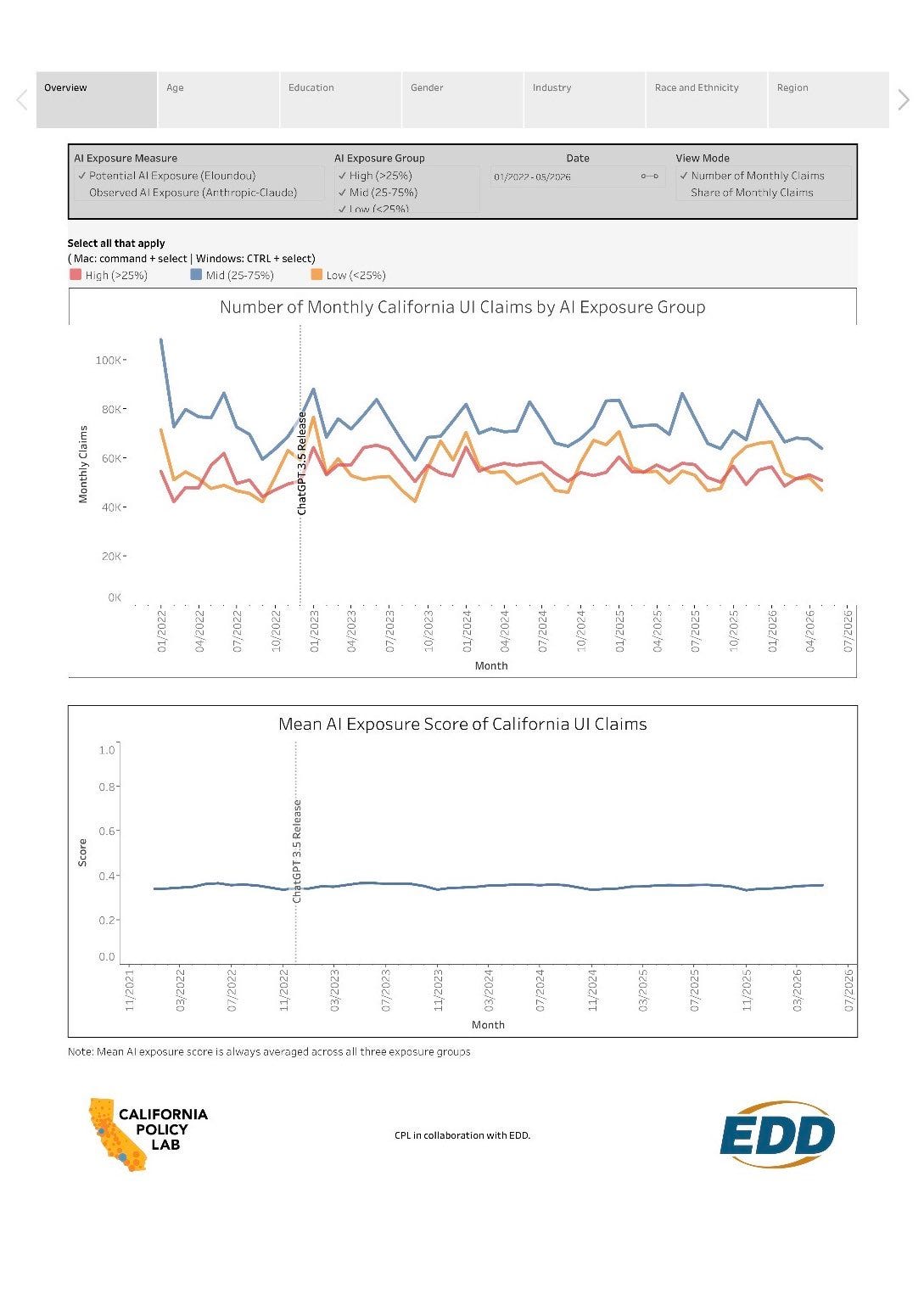
This week the state of California started counting too.
On 25 June, Governor Gavin Newsom launched the California AI-Unemployment Tracker, the first official dashboard of its kind in the United States. Built with the California Policy Lab at UCLA and the state’s Employment Development Department, it does not wait for companies to confess. It cross-references unemployment claims against an “AI exposure” score for each worker’s previous job, asking in effect whether a machine can now do half of what that role required. It updates monthly. The raw data is public.
Read the findings carefully, because the honest version is more useful than the panicked one. The tracker found no statewide surge in artificial-intelligence-driven layoffs through May. There is no mass unemployment event in the numbers yet. But the localised signal is real and it is unmistakable. Claims from college-educated workers in highly exposed occupations have climbed and stayed elevated since ChatGPT arrived in late 2022. The San Francisco Bay Area and the technology sector show it most sharply. One of the lab’s senior researchers put it plainly: they are not yet seeing evidence of large-scale layoffs. Not yet. The dashboard exists precisely so that “not yet” does not become “too late”.
This is why California matters beyond California. The state is the world’s regulatory canary. What it does first, the rest of the democratic world tends to do next, usually within a few years.
The pattern is long. California set vehicle emissions standards in the 1960s that Washington and then the wider world were eventually forced to follow. It banned smoking in bars and workplaces while the rest of America still lit up indoors. Its 2018 privacy law, the CCPA, imported a GDPR-style privacy logic into the United States and forced companies that had never thought of themselves as Californian to rebuild how they handled data. And in 2023 it became the first American state to issue a serious executive order on generative artificial intelligence, then the first to legislate on transparency. Each time, the same shape. California moves. The friction looks local. Then it goes global.
A government dashboard counting the displaced is not a footnote. It is the empirical foundation on which the next decade of policy gets built. Once a state can prove, with its own numbers, that a specific deployment of software put specific people out of work, the political distance to an automation tax, to mandatory disclosure of algorithmic layoffs, to retraining levies, shrinks dramatically. The European Union is already watching the methodology. California has just handed every regulator on earth the instrument they were missing.
Rip It Up and Start Again.
This was the argument of my column in Friday’s Yorkshire Post, and it belongs here too, because it answers the question the Cursor story raises for every leader reading this.
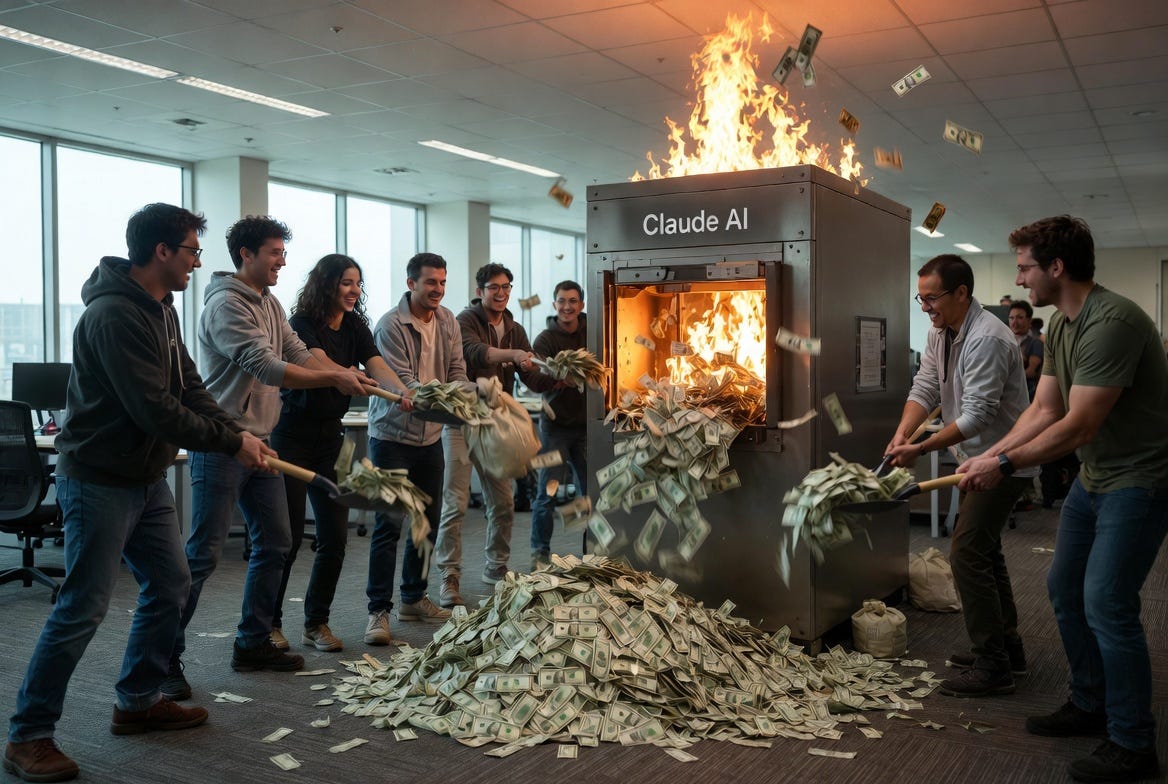
An artificial intelligence consultant told Axios last month that one of their clients had run up half a billion dollars on Anthropic’s Claude in a single month. Five hundred million. The figure has rattled boardrooms. Microsoft has been cancelling most of its Claude Code licences. Uber said it had burned through its 2026 AI budget by April. Amazon scrapped an internal leaderboard that ranked staff by how many tokens they had burned, a game that rewarded activity over output. The worry doing the rounds is simple. Nobody seems sure what this stuff actually costs.
Here is what the panic misses. Bills like that rarely come from clever work. They come from pointing a powerful tool at a hopeless job. And the most hopeless job in software is renovating the old.
A few years ago we rebuilt a house in California, and we did it in two halves. For the first, we tried to work with what was already there. We traced the wiring, worked out where the plumbing ran, knocked down some walls and moved others, and found a fresh surprise behind every one. It ran badly over budget and far over time. For the second half, we stopped being sentimental and knocked it down in a day. Lightly built comes down fast and goes up fast. The second half cost a fraction of the first, in a fraction of the time.
Software is no different. Legacy code is a house nobody kept the plans for. Twenty years of decisions, fixes and shortcuts, mostly undocumented, all load-bearing in ways you discover only when something collapses. Ask the machine to refactor it and it must first read the whole tangle, hold it in its head, and tiptoe through dependencies it cannot fully see. It is slow. It is dear. And it still breaks the thing on the far side of the building that nobody remembered was wired in. That is how your half a billion disappears.
Ask the same machine to build afresh and everything changes. It lays out a clean structure it understands, because it wrote it. Work that would have meant weeks of archaeology takes an afternoon. I have watched it close up. Not long ago someone on our team sat down with a would-be founder for a single conversation. We recorded the meeting, fed the transcript into Claude, and got back a business plan. We passed the plan to Claude Code, which produced a working prototype and a website. From the end of the meeting to something a customer could click on took about an hour. A year of my early Silicon Valley life, compressed into a lunch break.
This is not a rule for every case. Some old systems carry knowledge no one ever wrote down. Some must not be touched at all. But the instinct to preserve, to patch and prop up the thing you already own, is more often than not the costly mistake. Orange Juice had it right in 1983. The only top-ten hit the Glasgow band ever managed told you exactly what to do with the thing that no longer works. Rip it up and start again.
So before you approve another budget to nurse a system built for a vanished age, ask the harder question. Are you renovating, or are you simply afraid to let go?
The Sunday Signal Tech and AI Layoff Tracker
Week 26. The quarter closed hard.
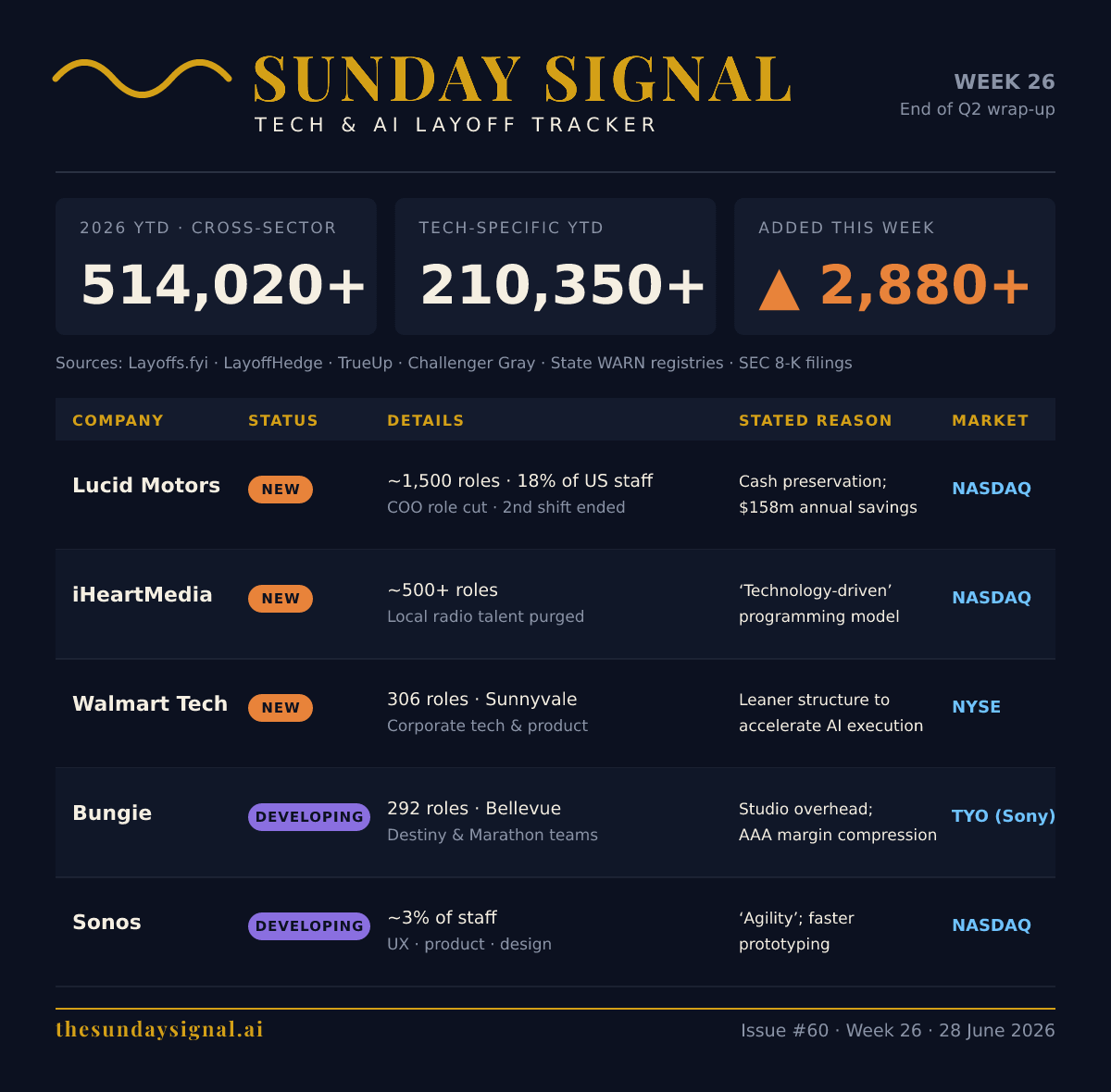
As the Q2 reporting window slammed shut, the language shifted from “AI modernisation” to raw capital preservation. The week’s near-3,000 cuts ran well beyond software, into electric vehicles, legacy media, retail tech and gaming. The dominant excuse was what leadership teams are now selling to Wall Street as the “agility pivot”: strip out middle management and legacy roles, call it the removal of friction, defend the margin.
Lucid Motors. ~1,500 cuts. NEW. The luxury electric carmaker filed an 8-K on 22 June confirming an 18% reduction of its US workforce, across full-time, contractor and hourly production layers. New chief executive Silvio Napoli, three weeks into the job, is dismantling overhead to secure roughly 158 million dollars in annualised savings ahead of the Cosmos SUV. The restructuring abolished the chief operating officer role entirely and ended the second production shift at the Casa Grande, Arizona plant. A pure cash-burn intervention from a company that lost 2.7 billion dollars last year. Market: NASDAQ.
iHeartMedia. ~500+ cuts. NEW. The audio giant ran a nationwide purge of regional programming directors and local on-air talent to unlock about 150 million dollars in savings, crediting a pivot to a “technology-driven” programming model. Automated curation replacing human-curated local radio. Software flattening reaching into the creative trades. Market: NASDAQ.
Walmart Tech. 306 cuts. NEW. The retailer filed California WARN notices eliminating 306 corporate technology and product roles in Sunnyvale, citing overlapping responsibilities and a leaner structure to “accelerate AI product execution”. Market: NYSE.
Bungie. 292 cuts. Developing. Sony-owned Bungie registered deep cuts at its Bellevue headquarters, hitting engineering, design and QA across the Destiny and Marathon teams. Margin compression in high-budget gaming, with the parent stripping studio overhead. Market: TYO (Sony).
Sonos. ~3% cut. Developing. The audio manufacturer trimmed roughly 3% of staff across UX, product and design. Chief executive Tom Conrad framed it squarely in the agility playbook: remove layers, prototype faster, move past the long tail of the 2024 app debacle. Market: NASDAQ.
Q3 horizon. Lucid sets a grim precedent for the EV supply chain; peers facing the same cooling demand will be pressed to match the cut early in the next quarter. Consumer-facing media and tech are running out of administrative fat, which means the next reductions land on core product, editorial and UX, the builder layers themselves.
Sunday Signal Merch is Here

A small word before I let you go. The Sunday Signal now has a shop, live at shop.thesundaysignal.ai. Shirts and a few other things, in black or white, carrying the gold wave.
Use discount code SundaySignal5 for 5% off at the checkout.
Final Thought
🚀 The rules did not erode this quarter. They broke, in public, all at once. A company of three hundred people changed hands for sixty billion dollars. A state government began counting the unemployed by how exposed their old job was to a machine. And a half-billion-dollar bill landed on a boardroom for the crime of trying to save the past. Three signals, one bearing. The leaders who build for the world that is arriving will own it. The ones still defending the world that is leaving will keep paying for the privilege, by the token, until there is nothing left to defend.
Until next Sunday,
David Richards MBE
This issue is also available as a podcast. Listen on Spotify, Apple Podcasts or YouTube and tell me what you think.