

The 15-Minute Lawyer
An email from a City banker shows a £250K legal clock running on a £2m capital raise. A startup is doing the same class of work in 15 mins. And Centrica showed what happens to everyone in between.


BOTTOM LINE UPFRONT: High-priced hourly professional work is over, and this week produced the evidence at both market ends. At the top, a City investment banker showed me an email where a law firm ran up nearly £250,000 of billable time, 12.5% of the growth capital, on a stock market listing raising £2,000,000, one of the reasons for the decline in London listings. At the bottom, a Sheffield legal tech firm reduced the time for a remortgage from weeks to 15 minutes per file. Professional fees are leakage, capital that investors subscribe to and companies never receive. With a fixed cost of a London stock market admission of nearly £900,000, they have driven the UK AIM stock market from almost 1,700 to barely 600. This week, Centrica announced 1,300 jobs would go alongside a £600m digital and AI customer service overhaul, the clearest sign yet of automation arriving on UK shores. The billable hour always survived because there were no alternatives. The alternative now exists, and what stands between it and the market is the professions’ defence of their own clock.
This issue is also available as a podcast. Listen on Spotify, Apple Podcasts or YouTube and tell me what you think.
Nobody raising £2m can afford £250,000 of lawyers
The email was from an investment banker who specialises in taking small companies public. I have anonymised the names of all companies, law firms, and people, and intentionally kept the details of the transaction vague. The numbers are as follows.
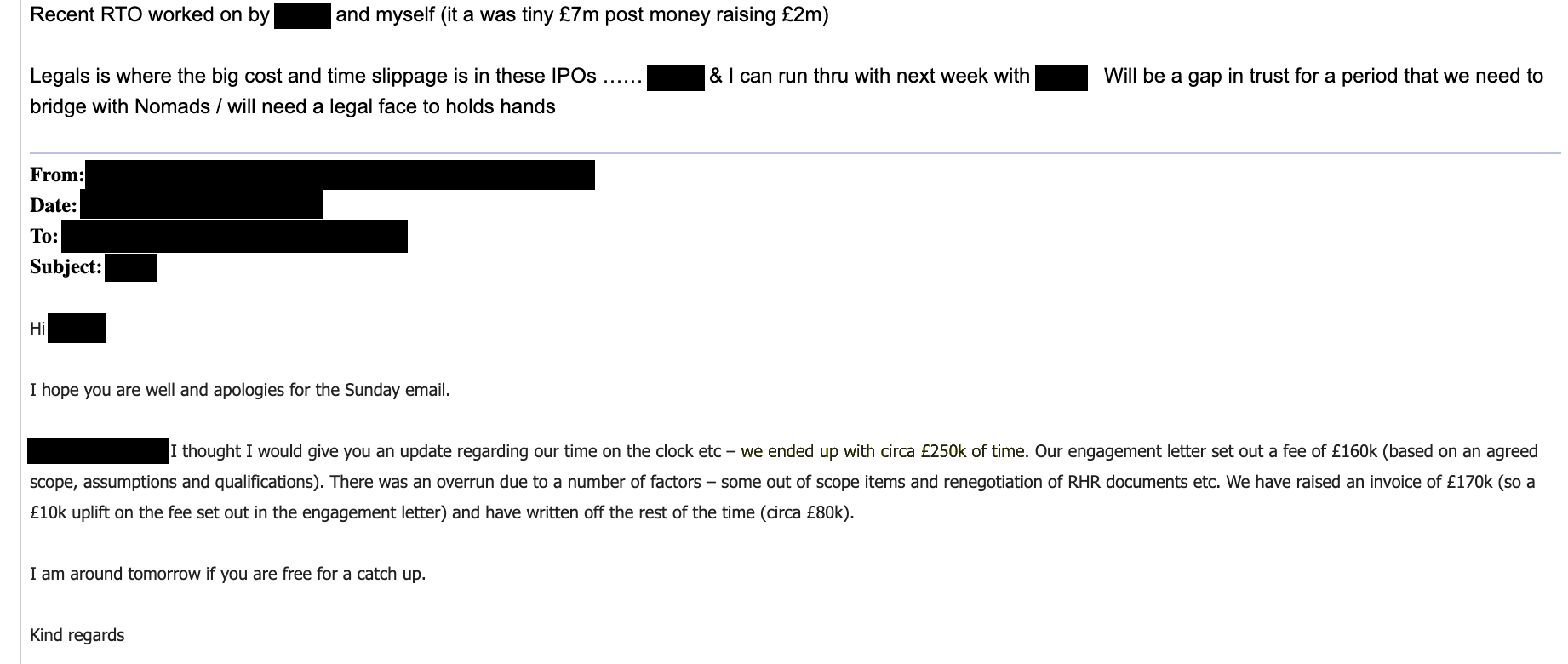
The transaction was a reverse takeover (RTO), the type of transaction the London markets were intended to facilitate, raising around £2m in growth capital. The law firm’s engagement letter set out a fee of £160,000 based on an agreed scope, and then the clock started. In the words of the lawyer, “we ended up with circa £250k of time” by the end of the transaction. The firm billed £170,000 and wrote off the rest, around £80,000.
A quarter of a million pounds worth of legal time to raise £2m equates to 12.5% of the funds being raised. Before the company has hired a single engineer, or shipped a single product, one adviser has consumed an eighth of the funds, and this is before the brokers, accountants and nominated adviser bill the company. No rational founder pays that toll twice. Most of them now refuse to pay it once, which is why they walk into a venture fund’s office, where legal expenses are capped, controlled and relatively small.
It’s worth looking at the explanation for the cost overrun because that’s the system confessing. When justifying the overtime, the renegotiation of relationship agreement documents and out-of-scope items were mentioned. To put that in normal terms, two groups of lawyers were, for weeks, fighting over the wording of standard boilerplate documents. Each hour they spent fighting was billable hours for both groups. The billing model didn’t just tolerate the friction, it rewarded it. And think about what the £80,000 write-off actually tells you. Nobody writes off £80,000 of genuine value. The write-off is the firm conceding the hours were never worth the rate.
AI can easily perform all of those tasks. To renegotiate a relationship agreement, a draft can quickly be reviewed against the current market and deviations flagged. AI can do in seconds what would cost a company thirty hours of billable time. To verify a prospectus means comparing a number of source documents, a task AI can parse quickly and accurately better than several first-year associates. Once the labour collapses, so too does the cost, and the fixed-fee quote will become what it is in the construction industry: a real number the contractor must stand behind.
What is holding it up? The banker’s covering note indicated exactly that. Nominated Advisers carry the regulatory risk of a listing, and they are terrified. In his words, there “will be a gap in trust” that needs to be filled, and “a legal face to hold hands” will be needed. A Nomad does not buy legal work. A Nomad buys someone to blame, backed by a large firm’s professional indemnity policy, for the regulator when the time comes. Until the FCA creates a safe harbour for AI-verification and fixed-fee legal work, the gatekeepers will continue to demand the expensive human ritual, and the small-cap market will continue to be strangled by it. London does not have a valuation issue. London has a toll booth issue.
Take the IPO bill apart line by line. Almost none of it survives
Take apart a toll booth, and you’ll find that the £250,000 on the clock is divvied up into four categories of labour. Each of these categories must answer the same question: what does a human do that a machine cannot?

Let’s start with verification. It is the largest portion of most small-cap listings and is the most misunderstood. A team of junior lawyers would build a verification matrix that lists hundreds of statements and claims, each of which is cross-referenced to a lease, a contract, a set of accounts, and board meeting minutes, among others. A verification matrix eats up associate time and comes at a massive cost to the client.
An AI data room achieves the same task by ingesting source documents, linking each assertion in a draft document to evidence, and identifying gaps in hours instead of weeks. The purpose of verification, which is to safeguard the directors and the investors from a false statement, remains intact. What is rendered obsolete is the manual matrix. The work of the lawyer shifts from creating a matrix to auditing the exceptions, which is the singular task that requires judgement.
Legal due diligence proceeds similarly. Reviewing due diligence reports at a small target company means scanning through all relevant contracts for change of control provisions, termination rights, and consents. Then comes title, litigation, employment, and IP. Automated contract review and clause extraction is the most advanced application of legal AI. This particular technology has existed in larger M&A data rooms for years. The judgement call on whether a clause, which legal AI flagged, is material to the transaction still remains a human task. The two hundred hours spent reading does not.
Once the tedious task of data review is complete, the actual negotiation can begin. The email from the banker was blaming the negotiation for the time overrun. The renegotiation of a relationship agreement requires the comparison of draft agreements to existing market agreements and the justification of the variance. An AI system that has been trained in redlining agreements against market standards can complete this comparison in a matter of seconds. In contrast, traditional methods require over thirty hours of negotiation. There is no reason that the redundant tasks of document assembly should require billing at a fee earner’s hourly rate.
For humans, the remaining areas are real but small: advice on structuring, negotiation strategies, and regulatory judgement calls, as well as conversations with directors to interpret the meaning of a responsibility statement. Priced to reflect that true value, clients would get a fixed fee, at a fraction of the current price. Clients wouldn’t have to bear the risks that are common in hourly billing, as the risks would be eliminated throughout the process.
Why this decides whether London has a small-cap market at all
The toll booth tolls are not simply an irritation. They are a capital leakage for the market. These are funds subscribed by investors that are never received by the companies, since they are collected at the toll booth before any funds begin to operate. One long-time AIM specialist has calculated that the cost to access the AIM is around 3.43% of the total funds raised, and then a ticket of £897,000 is added. Using our banker’s £2m target, the estimated cost would be around £966,000. This is why the deal was executed via a reverse takeover instead of an initial public offering. The fixed cost, charged to all companies, would have priced our company out of doing a deal.
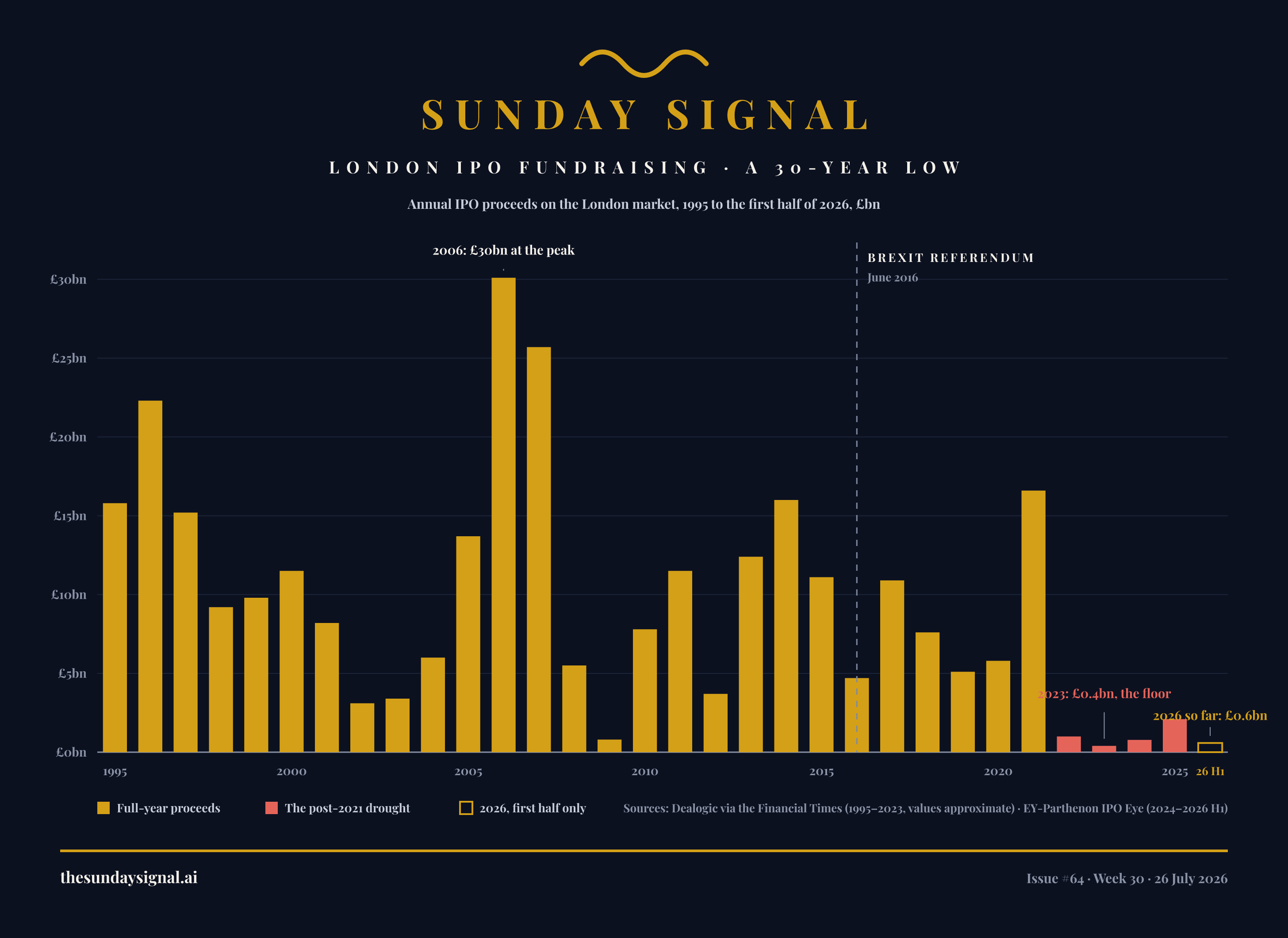
The market data shows what the toll booth has done. AIM held 1,694 companies at the end of 2007. It holds 612 today. The past two decades have brought more than 2,100 delistings, while new admissions ran at just 11 a year in both 2023 and 2024, fewer than in the depths of the financial crisis, raising £119m in 2024 against £6.6bn at the 2006/7 peak. There were two IPOs in London in the first quarter of this year. Colin Wright, chairman of UHY Hacker Young, points to the “excessive red tape” as a reason companies prefer to remain private. Delistings still outpace listings, though the proceeds have improved since spring thanks to listing reforms and stamp duty exemptions. The recovery is only at the top of the market. The small end remains shut.
Perform the calculations in reverse. The exchange’s fees are so small that they are a rounding error, so the reforms that reduce them are welcome and pretty much meaningless. The cost of entry is the advisers. The cost of the advisers is professional hours. The next story will show that cutting the professional hours required to complete the task by 80% to 90%, which is the reduction that has already been achieved in conveyancing, will make the near-£900,000 fixed cost fall to around £200,000. A £2m fund raise would then mean the entry costs would be around 13% of the fund rather than 50%, and a category of company, which has been unable to access the public markets for the past fifteen years, would then have a route to enter the public markets. The leak is not a natural occurrence. It is a model for conducting business. Business models can be changed. The question is whether the FCA and the exchange will allow it to be changed. Nobody in the official conversation is willing to pull the one reform lever that is big enough to matter.
The 15-minute conveyancer has already arrived
If the corporate Bar thinks this is all theoretical, they should look at what is happening two hours up the East Coast Main Line. To be completely up front, LEXcelerate, the company in question, is part of the Yorkshire AI Labs portfolio where I’m the Managing Partner. Judge the numbers on their merits.
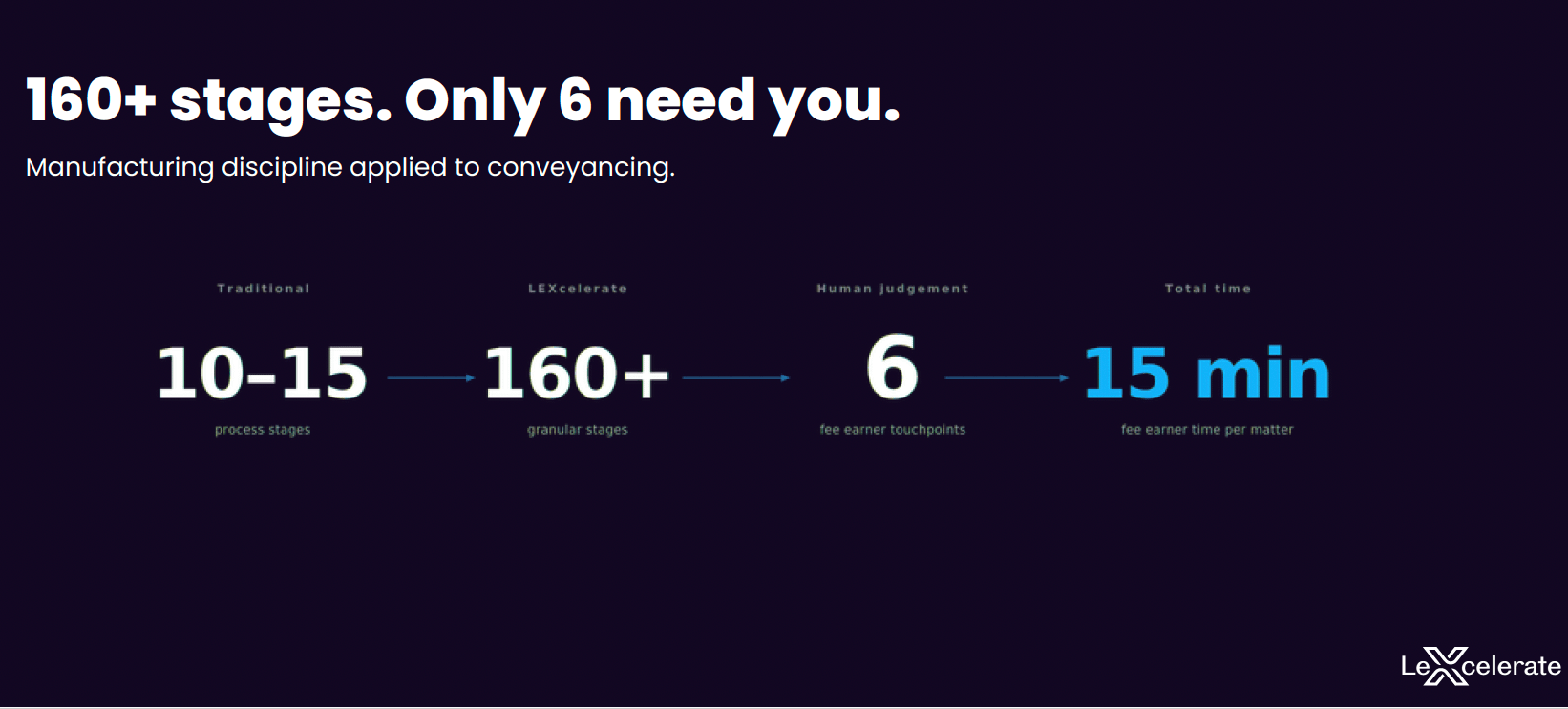
A typical UK remortgage takes six to eight weeks to complete. In client surveys, more than 50% of borrowers said the process takes too long. No one involved in the process knows what takes up all the time. LEXcelerate can complete the process in two weeks. However, that is not the disruptive factor; the disruptive factor is the labour involved. Total human fee-earner time per matter: 15 minutes.
That is possible because the firm views conveyancing as a manufacturing process, not a craft. Where a traditional firm would move a file through a poorly managed dozen stages, LEXcelerate would break the entire process down into more than 160 micro-stages. Most of these micro-stages are automated via API integrations with the Land Registry, lenders, and ID checks. Automated workflows drive the micro-stages. Human judgement is reserved for six mandatory gates. The system enforces the gates: a file cannot progress until the risk checks at each of the gates are completed. The lawyer’s role shifts to that of a verifier.
The founders matter here. This isn’t a pair of outsiders speculating on law’s mechanisms. Paul Firth, the Chief Executive, was DLA Piper’s managing partner for the UK. He also led Irwin Mitchell’s national real estate practice. He spent a career at the summit of the billable-hour model and now sees it as the end of the road. His co-founder, Mark Hewitt, has spent thirty years in the field of automation and built a legal software company that was sold to Verisk. When the people who profited most from the old model start building its replacement, the argument about whether it works is already over, and the only remaining question is how fast it can be done.
Next, let’s follow the economics, because they are harsh. In order to grow, a traditional firm has to hire more associates. This means costs will rise as revenue increases. A platform that caps an employee’s time at 15 minutes per case file builds like a software company, which is why LEXcelerate predicts that within the next three years, profit margins will be more than 70%. If a case file only requires small amounts of human oversight, the salaried employee who is doing junior-level case work is no longer a viable option. The lawyers on the platform operate like locums and register for a shift when they wish to perform a task to help clear the verification gates. The conveyancing market is worth about £2.6bn per year. By cutting the amount of human time to do the work by 90%, the market will need 90% fewer junior-level conveyancers. No lobbying from a professional work body is going to change this.
A defence for the profession has already been employed: remortgages are commoditised, corporate work is tailored, an IPO cannot run on rails. Solicitors made the same sort of defence in 1985, when licensed conveyancers breached the monopoly on property work, and conveyancing fees never recovered. Once the market understands that risk can be systemically managed instead of manually, and that a fixed price is a standard instead of a concession, the £250,000 clock cited in the first story has no excuse remaining to run.
AI has landed on our shores, and the call centre goes first
The wave rolling through the law does not stop at the law. For over a year, this newsletter has followed it in American earnings calls and restructuring memos from Silicon Valley. This week, for the first time, the wave reached the UK, and it did so via the most ordinary company possible.
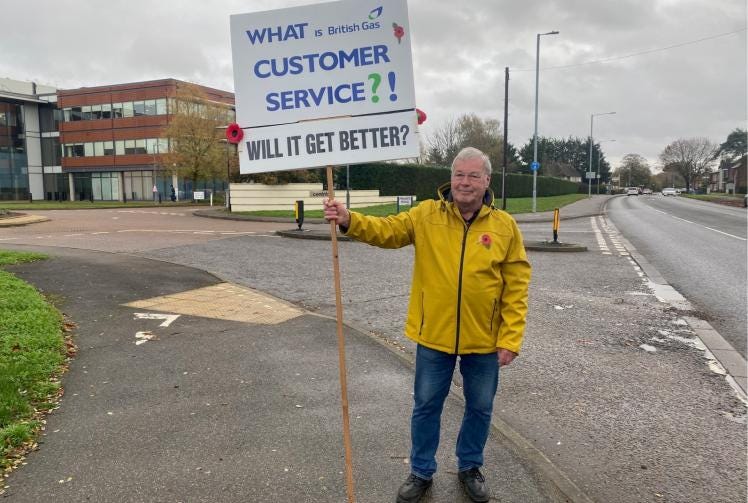
Centrica, owner of British Gas and a FTSE 100 firm, announced alongside its half-year results that it will cut 1,300 jobs over two years. 500 of the jobs are contact centre positions in Glasgow, Edinburgh, Cardiff, Leicester, Stockport and Leeds, and the remaining 800 are offshore, outsourced, and back-office operational support. In total, Centrica will cut 14% of its customer operations workforce and 3% of its operating costs. Some of these roles will be cut through attrition, while the remaining will be eliminated through redundancy.
Centrica is trying to convince the public that it’s not the machines. CEO of Centrica, Chris O’Shea, told the press that “AI isn’t driving these particular job reductions,” and instead described the change in customer behaviour: more than 90% of customers now use digital channels first, calls have reduced by 20% year on year, and inbound contact has fallen by a third since 2023. The GMB union doesn’t agree. GMB’s national secretary, Charlotte Brumpton-Childs, said staff are “being replaced by artificial intelligence”.
Both things can be true, and the results illustrate how. Centrica’s adjusted EBITDA dropped from £900m to £737m, a decline of 18%, because of asset divestments, outages, and milder weather, yet the interim dividend increased by 9%, retail profits even increased to £346m from £338m, and even with British Gas’s customer base falling to 7.45 million, the company is investing £600m to digitise and incorporate AI into the customer operations. Read the numbers this way. Earnings under pressure, dividends protected, technology funded, and payroll paying for it all. Whether the chatbot took the job or the job became unnecessary is a distinction that is important for the press office and unimportant for everyone in Stockport.
Centrica’s case won’t be unique, but rather a template, and it’s coming at the worst possible time. The S&P Global UK Services PMI reported 48.8 in June, indicating a second month of contraction and the largest decline since January 2023. Services account for around 80% of the UK economy. Banks, insurers, telecoms and retailers provide customer service and back-office functions at large scale, and all of those firms watched Centrica cut 14% of them this week while increasing its dividend. During the same week, Uber announced that it would cut 10% of its global customer service function and, for the first time, named AI as the reason. These are not City jobs, but they are essential to the economy of the towns and regions in the UK that were promised service jobs would replace the roles lost in manufacturing.
Centrica points, fairly, to the other side of its ledger: it keeps hiring engineers and plans 500 apprentices this year. But a 45-year-old call handler in Leicester does not retrain as a heat-pump engineer between redundancy notice and final pay cheque. The jobs being created and the jobs being destroyed belong to different people in different places with different lives. If the rest of the UK service economy runs the Centrica play, and the incentives say it will, the bill lands on the state, one Universal Credit claim at a time. The Institute for Public Policy Research has warned that millions of UK jobs sit exposed to this exact automation. This week, that ceased being a projection, and instead has become the announcement of results.
The Signal Tech & AI Layoff Tracker
Week 29 wrap, 18 to 24 July, built directly on last week’s verified baseline and synthesised from Layoffs.fyi, LayoffHedge, SkillSyncer, state WARN registries and SEC disclosures. For informational purposes only. Here is where the data stands:
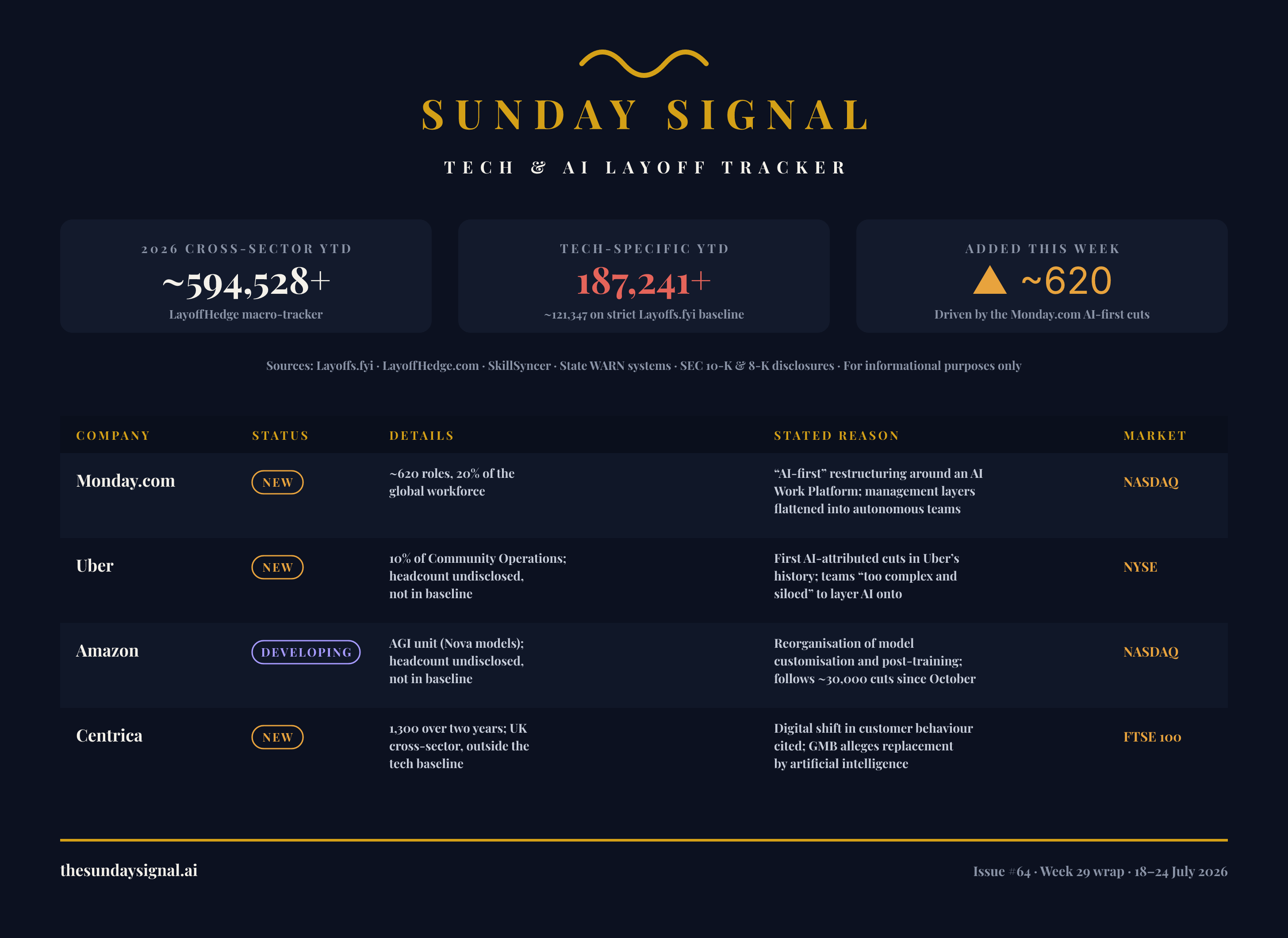
This week was all about explicitness. For the past two years, companies have obfuscated the AI-induced restructuring behind euphemistic references to efficiency improvements and customer behavioural shifts. This week, three of them chose to say the quiet part out loud in regulatory filings and internal memos.
Monday.com, ~620. The work management platform announced workforce reductions impacting 20% of their global employees, approximately 620, in a Form 6-K filed with the SEC on 22 July. Staff were told by co-founders Roy Mann and Eran Zinman that the company was reorganising, centring around an “AI Work Platform,” which entailed a shift from helping customers manage work towards doing the work via AI agents. They also announced plans to flatten management tiers by organising staff into smaller, fully autonomous teams. They argue that the changes should not be seen as cost-cutting or direct AI replacement of work, and the numbers half support them: while restructuring costs the company between $45m and $55m, they maintain that the company is on track for 19% to 20% revenue growth. However, the signal sent by the move was far from ambiguous. A SaaS company that was built in the platform era has determined that its own organisational structure is the obstacle to competing in the AI era, and the company has made the difficult decision to reduce staff by 620.
Uber, headcount undisclosed. Uber laid off 10% of its global Community Operations team. For the first time, the company said artificial intelligence contributed to the layoffs. The team is responsible for supporting Uber’s riders, drivers, and couriers. Vice President Megha Yethadka, who leads Community Operations, told her team it had become “too complex and siloed” for Uber to optimally implement AI. This is Uber’s second round of layoffs in two months, and since the company has not disclosed the total headcount, the layoffs are reported but have not been fully incorporated into the baseline.
Amazon, headcount undisclosed. Reported layoffs in Amazon’s Artificial General Intelligence unit, the team developing the Nova models, continue to affect roles in model customisation and post-training. Since no numbers have been disclosed, the layoffs will not be included in the baseline. However, the context is important. These layoffs add to the approximately 30,000 layoffs affecting Amazon’s corporate positions that were announced since October of last year. These layoffs also illustrate that even the teams building the technology are not sheltered from the corporate restructuring.
And on this side of the Atlantic, the largest UK cross-sector event of the week is Centrica, reported in full above, with 1,300 layoffs, logged by LayoffHedge. For UK readers, this is the domestic counterpart to the international reports this tracker has been compiling. Read it as the arrival on our shores of everything in the numbers above.
Week 30 Watch List: Customer Operations. This week, Centrica and Uber eliminated the same function on different continents. Now, every business with a contact centre is analysing the impact of these events as they prepare their Q3 earnings. Also, expect the same type of middle-management reduction you see with Monday.com, as SaaS firms under valuation pressure realise that AI is eliminating organisational layers, not just headcount.
Final Thought 🚀
In these three stories, a single machine begins to form. At the top of the professions, a law firm runs a £250,000 clock on a £2m fundraise and writes off £80,000 as if it’s a giveaway. In Sheffield, a man who used to run one of the largest law firms in the world shows that the same type of work can be done in 15 minutes at a fixed price. And, at Centrica, the machine meets the workforce, giving us 1,300 letters, a protected dividend, and £600m for the tech.
The professions have been saying to themselves for the last two years that the wave would break on someone else. Lawyers said it would be the call centres. The call centres have been taken, and this week the wave reached the timesheet, which is the profession. The billable hour was a way to measure scarcity, and the scarcity is finished.
There will be no obituary when it finally dies. There will be a client who asks for a fixed price, a Nomad who finally accepts an algorithm’s verification, a founder who lists in London because the toll booth is gone. Until that day, every hour on the clock is a choice, and the ones who choose it no longer get to say it’s a cost of doing business. It is the business, and that is precisely the problem.
📩 Read the full issue free at thesundaysignal.ai. New issue every Sunday. AI disruption, UK innovation, and the future of work, with no hype and no hedging.
Until next Sunday,
David
This issue is also available as a podcast. Listen on Spotify, Apple Podcasts or YouTube and tell me what you think.