

The £10 Billion Goldmine Britain Keeps Giving Away
We sold DeepMind to America for four hundred million pounds. Now a politician is selling our NHS data. We have done this before, and we never seem to learn.

THE SUNDAY SIGNAL · Issue #57 · Week 23 · Sunday 7 June 2026
By David Richards MBE
This issue is also available as a podcast. Listen on Spotify, Apple Podcasts or YouTube and tell me what you think.

Bottom Line Up Front
Britain has a habit it cannot break. We invent the future, and then we sell it to people who understand its value better than we do. This week a select committee told ministers to remove Palantir from the NHS, and the company’s British boss spent the days that followed on the airwaves and in the papers explaining why that would be reckless. He is a fluent advocate. He is also, by training and temperament, a politician rather than a technologist, and that tells you exactly what this fight is really about. It is not about software. It is about who owns the most valuable dataset in the world, and whether we are about to repeat with our health records the mistake we made with DeepMind.
A lobbyist, not an engineer
Listen to Louis Mosley defend Palantir on the radio, as I did this week, and one thing becomes obvious. He does not sound like a tech chief executive. He sounds like a minister. The cadence, the appeal to fairness, the careful reframing of every awkward question into a question about patients: this is the grammar of Westminster, not Silicon Valley.
There is a reason for that, and it is not an accident of personality. Mosley read history at Oxford. He cut his teeth in Conservative politics, working as an aide to Rory Stewart and serving as a councillor in Kensington and Chelsea. In 2017 he came close to standing for Parliament, until the party grew nervous about his surname. He is the grandson of Sir Oswald Mosley, the man who led the British Union of Fascists in the 1930s, a piece of family history that has shadowed his public life and which he did not choose. He worked in finance, then joined Palantir in 2016, and now runs a UK and European division that accounts for roughly a quarter of the company’s entire global workforce.

What he was not, at any point, was an engineer. And the question worth asking is why an American software company would put a Tory networker rather than a coder in charge of its British operation.
The answer is that Palantir’s product is not really software. Its product is government. When a company sells data infrastructure to the state, its biggest obstacle is never a competitor. It is the state itself: procurement rules, select committees, ministers, the slow machinery of public trust. So you do not hire the best architect. You hire the person with the best contacts book. Mosley pitched directly to Michael Gove in 2019 and won a Brexit planning contract. When the pandemic hit, Palantir offered its services for a pound, then turned that pound into a sprawling presence across the NHS. The seven-year, three hundred and thirty million pound Federated Data Platform was the prize at the end of that road.
We have seen this casting before
If a politician fronting an aggressive American tech firm feels familiar, that is because we watched it happen once already.
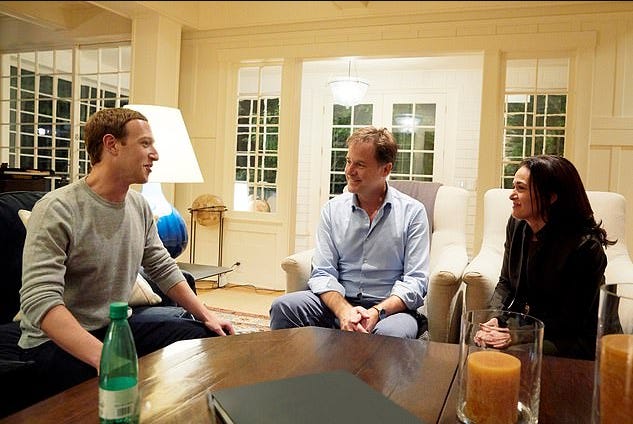
In 2018, with Facebook reeling from Cambridge Analytica and Brussels sharpening its regulatory knives, Mark Zuckerberg hired Nick Clegg. Not for his grasp of machine learning. For his Rolodex. The former Deputy Prime Minister became the respectable, centrist, European face of a company that badly needed one, and he spent years building the buffers, the oversight board, the careful language, that kept governments at arm’s length.
Then the politics changed, and so did the casting. In January 2025, three weeks before Donald Trump returned to the White House, Meta replaced Clegg with Joel Kaplan, a Bush-era Republican operative with deep ties to the incoming administration. The lesson was unmistakable. These appointments are not about conviction. They are instruments, swapped out the moment the political weather turns. Clegg was hired to keep regulators out of Meta’s business. Mosley’s job is the opposite: to get Palantir deeper into ours. One played defence. The other plays offence. The casting logic is identical.
Mosley’s Telegraph defence is full of holes
This week Mosley took to the pages of the Telegraph to argue that the MPs attacking Palantir were putting politics above patients. It is a polished piece. It is also, on inspection, an exercise in answering questions nobody is asking while ducking the ones that matter.
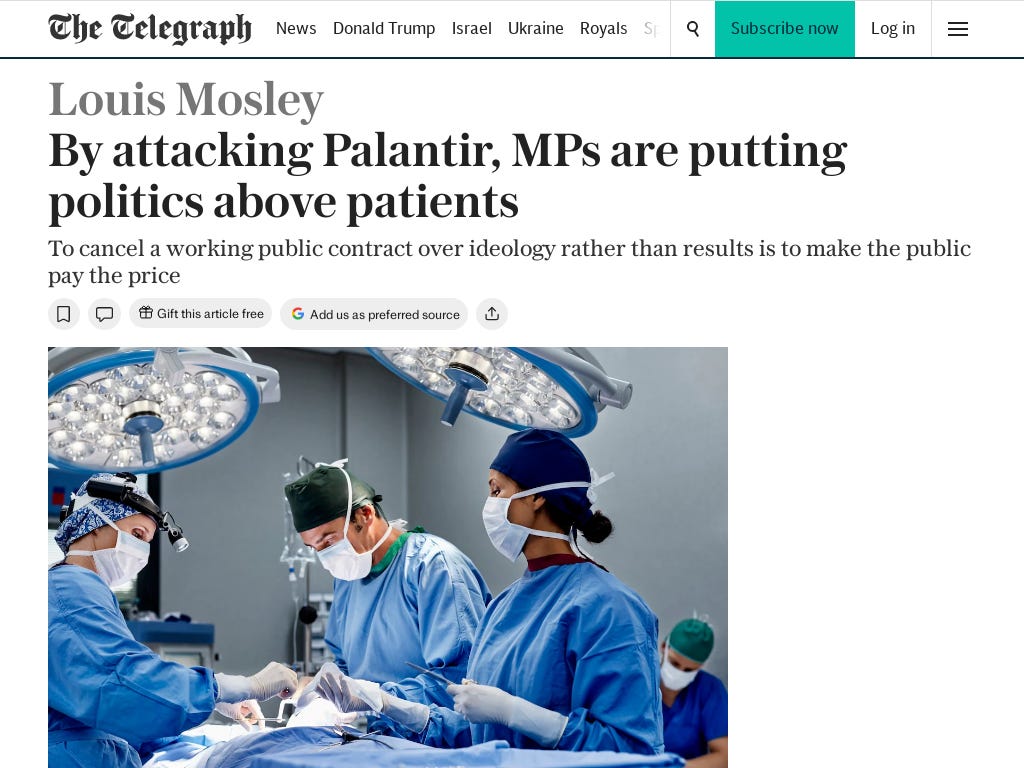
Take the operational case. Mosley leans on Palantir’s own figures: more than a hundred and ten thousand extra operations, almost three hundred thousand patients discharged sooner. Those numbers come from the NHS’s own count, and they may well be real. But they have not faced serious external scrutiny, and critics inside the health service have noted that some “waiting list reductions” amount to little more than removing patients who stopped replying to text messages. A claim that cannot be independently audited is a marketing line, not a finding.
Then there is the committee itself. Mosley says the MPs urged cancellation with no idea what should replace Palantir. That is not what the report says. The Science, Innovation and Technology Committee, chaired by Dame Chi Onwurah, explicitly told ministers to either build a domestic replacement or find a UK provider. Its worry was sovereignty, the danger of leaning on a small number of vast American firms, and it warned in plain terms that the current arrangement leaves Britain exposed “at the mercy of foreign actors.” You can argue with that conclusion. You cannot pretend it was not made.
And on data, Mosley is at his most reassuring and his most slippery. There is no central vault to seize, he says; Palantir cannot use, sell or move the data. On the narrow point, he is right. Palantir is a processor, not a broker, and the data stays with each trust. But the committee’s fear was never theft. It was entanglement. Palantir’s platform burrows into the plumbing of individual trusts through custom connectors and proprietary code, and the deeper that integration runs, the harder and costlier it becomes to ever pull the company out. That is what lock-in means. Reassuring me that you will not steal the house does not address my worry that I can no longer change the locks.
He saves the loftiest line for last, insisting Palantir has never worked in states adversarial to Western values and only serves governments with a democratic mandate. Yet the protests outside his offices are not about abstract values. They are about a company with deep roots in US defence and immigration enforcement, and ties to military programmes abroad, now sitting at the centre of a service built on the idea of care for all. Amnesty International, medical groups and NHS staff are not confused about this. Mosley would prefer to call their objection ideology. It is not. It is a values question, and he knows it.
The plumbing problem: ask the National Grid
Here is the part the patient-centred framing leaves out. We already know what happens when Britain lets a foreign, state-adjacent company into critical national infrastructure, because we have spent the last few years frantically undoing exactly that.

In 2023 the National Grid began ripping out components made by a unit of the China-backed firm Nari Technology, acting on direct advice from GCHQ’s cyber arm. The parts in question helped balance the grid and prevent blackouts. We had wired a potential adversary into the machinery that keeps the lights on, and then quietly tore it out again.
It did not stop there. The “golden era” welcome once extended to China General Nuclear curdled into a costly buy-out of its stake in our nuclear programme. And only this March, ministers blocked a one and a half billion pound plan by the Chinese firm Ming Yang to build what would have been the world’s largest wind turbine factory in Scotland, walking away from fifteen hundred jobs on national security grounds, with the Ministry of Defence warning the turbines could double as surveillance platforms.
Notice the pattern. Court the foreign money, embed the foreign technology, then discover, too late and at enormous expense, that you have created a dependency you cannot afford. The committee looking at Palantir has simply learned the lesson the energy world learned the hard way. Data is infrastructure too. It is the most strategic infrastructure we have.
What this is really about: the goldmine
Strip away the politics and the reassurances, and the fight comes down to a single resource. Data is the oil of this century, and the NHS sits on one of the richest, cleanest reserves on the planet.
Because we built a single-payer system, we hold consistent, trusted records on roughly fifty-five million people, tracked from cradle to grave across decades. No fragmented American insurer can match it. Ernst and Young put a number on what that asset could unlock: as much as nine point six billion pounds a year, split between operational savings for the NHS and benefits to patients, once the data is properly curated and put to work. Call it the ten billion pound goldmine.
That is what the platform war is about. Whoever structures and operationalises this data gets to train the next generation of diagnostic models, risk tools and medical AI on it. The intellectual property, the patents and the profits then flow to private shareholders, while the public that funded the raw material for decades is downgraded from owner to mere data provider. We supply the gold. Someone else walks off with the finished jewellery, and then sells it back to us as a service.
We invented the thing they fear. Then we sold it.
And this is where it becomes unbearable, because we have rehearsed this exact failure before, at the very frontier of AI.
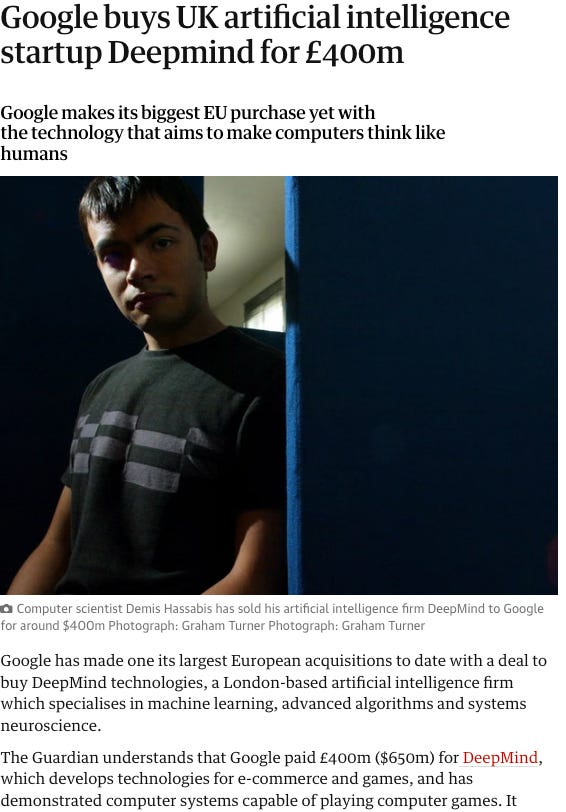
The most advanced AI lab on earth was not born in California. DeepMind was founded in London in 2010. In 2014 we sold it to Google for around four hundred million pounds, outbidding a desperate Mark Zuckerberg in the process. It looked like a tidy exit at the time. It now looks like one of the great strategic giveaways in our history. DeepMind became the crown jewel of Google’s AI empire. Its founder, Demis Hassabis, won a Nobel Prize and now runs all of Google’s AI. His drug-discovery spin-out, Isomorphic Labs, is reportedly raising over two billion dollars. The four hundred million pound price tag has not aged well, and the real cost, the capability we handed to a foreign giant, cannot be counted at all.
We should have known what we were losing, because the people racing against DeepMind knew exactly what it was. When Elon Musk and Sam Altman were casting around for a name for the venture that became OpenAI, the court exhibits from this spring’s trial show Musk pushing one option above the rest. He wanted to call it Freemind, he wrote, because it would convey intelligence freely available to all, “the opposite of Deepmind’s one-ring-to-rule-them-all approach.” He told his co-founders that unless they hired the best people on earth they would “get whipped by Deepmind.” By his own account, Google at that point had snapped up something close to three-quarters of all the AI talent in the world. The most powerful men in technology built a company out of fear of what Britain had created.
Read that back slowly. Silicon Valley feared our lab so much it founded a rival to contain it. We feared nothing, so we sold it. Now the same instinct that gave away DeepMind is being asked to hand over the data that could have trained the next one. The idea that we need a Silicon Valley giant to make sense of British health records is not pragmatism. It is a failure of nerve dressed up as common sense. We lost our best technology. We must not lose our best data as well.
The 17-Year Itch: Why Brilliant Technology Goes to Die in the NHS
If Palantir is the story of who owns the data, this is the story of why even the best technology so often rots before it reaches a single patient.
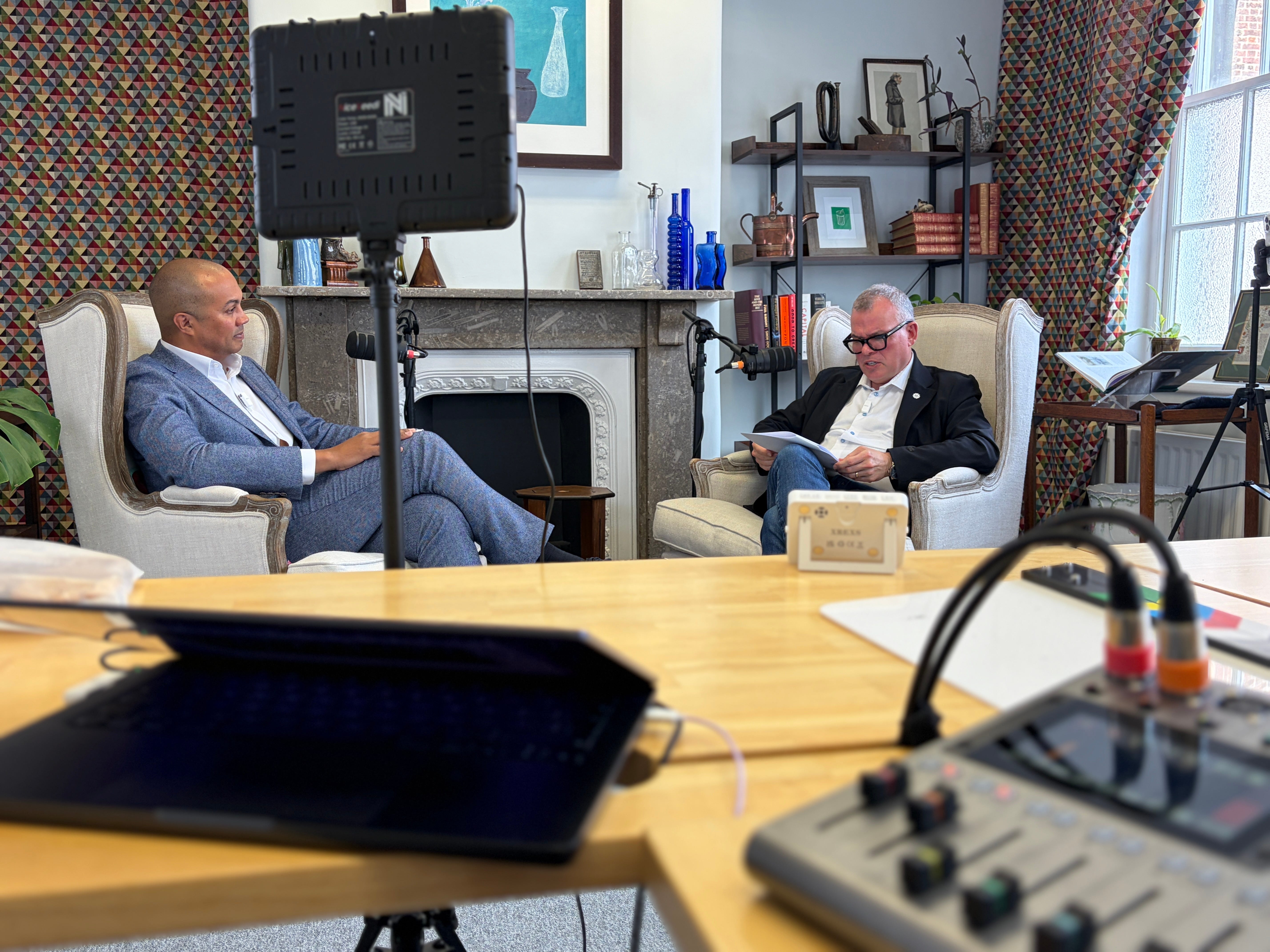
On this week’s episode of The Digital Forge Podcast I sat down with Richard Stubbs, chief executive of Health Innovation Yorkshire and Humber and a member of the MHRA’s national commission on regulating AI in healthcare. Stubbs has spent more than two decades inside the system, and he punctured a fantasy that every founder entering healthcare carries around: the dream of one meeting with a minister, one handshake, and a rollout to the whole country.
It does not work like that, and the reason is structural. American firms walk in, win the minister over, and walk out certain they have a deal for sixty million patients. Then someone has to break the news. As Stubbs put it, “There is really no such thing as the NHS.” There are five or six hundred separately governed, largely autonomous organisations, and every one of them has to say yes for itself. There is no big lever in a big room. What thrives in Bradford can be ignored entirely in Barnsley, and the result is a technological postcode lottery.
That fragmentation breeds a particular disease, the conviction that nothing proven elsewhere can be trusted here until it has been piloted all over again. “We have more pilots in the NHS than British Airways,” Stubbs told me, and the line lands because it is true. Proven technology emerges, a local pilot is approved, the metrics check out, the funding lapses, and the whole circus starts again somewhere new. Meanwhile the underlying reality stays medieval. In parts of the country, patient notes are still bundled into the back of a taxi and driven down the A1 because electronic records are not yet universal.
The number that should stop you cold is this. By one Royal College estimate, it takes an average of seventeen years for a proven innovation to reach mainstream NHS use. Seventeen years ago the App Store had only just launched. If we take the better part of two decades to adopt the present, we have no hope of keeping pace with AI.
Stubbs’s prescription is not to crush local decision-making but to be honest about the trade-off it carries. He wants a “comply or explain” regime: the centre sets a gold standard for a transformational pathway, and a region either adopts it or proves, in numbers, that its own way delivers better outcomes for the same money or less. No more reinventing the wheel as a reflex.
The sharpest moment came when we turned to safety, the word always reached for to slow AI down. Stubbs flipped it. “Nobody ever asks the question of: how safe are we right now?” Nothing in the NHS is a hundred per cent safe, he pointed out, yet we treat the exhausted, paper-bound status quo as if it were, and demand flawless perfection from the software meant to improve on it. By holding AI to a standard we never apply to ourselves, we keep patients waiting longer in settings that are already, measurably, less safe.
There are bright spots, and they show what is possible when the system gets out of its own way. Pinpoint, a machine learning tool developed over years in Yorkshire, reads previously taken blood tests and helps safely lift lower-risk patients off the two-week cancer pathway, giving them peace of mind and freeing capacity for those who genuinely need it. Ambient voice technology now lets clinicians hold a real conversation while the record writes itself. These are not science fiction. They are working today. The barrier was never the technology. It was us.
Would AI Have Locked Us Down? (This Week’s Yorkshire Post Column)
The third strand runs through my Yorkshire Post column this week, and it asks a question I have turned over for six years. Would the models we have today have told ministers to shut the country?
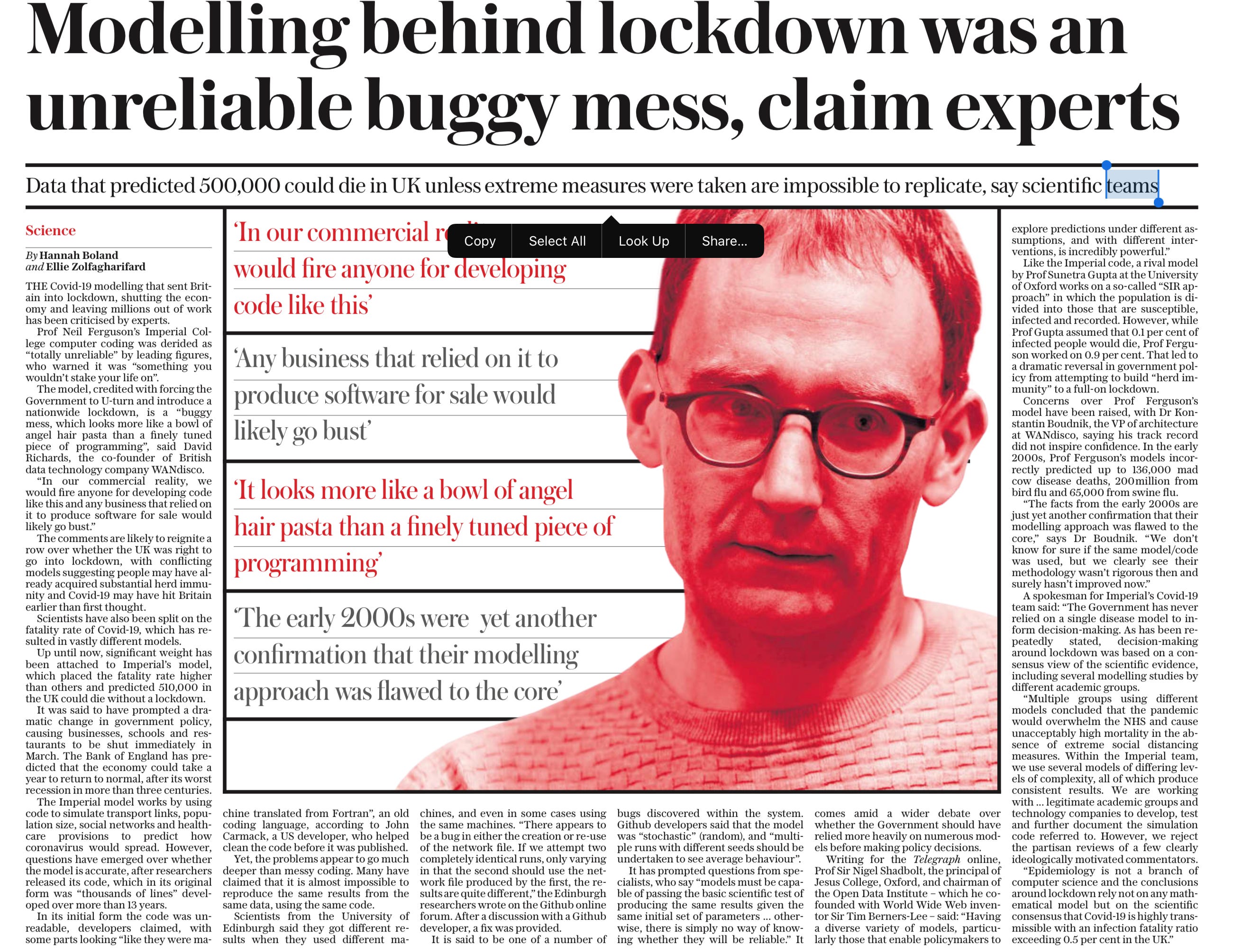
Cast your mind back to March 2020. The plan was mitigation: shield the vulnerable, slow the spread, keep the schools and shops open. Then came Report 9 from Imperial College, which modelled five hundred and ten thousand deaths in an unmitigated epidemic and suggested that even mitigation could overwhelm hospitals. Within days the plan was dead and the country was indoors. It was not the only model. But it broke the deadlock, and it did so before anyone outside the team could read a single line of its code.
Some readers will remember that I was one of the people who did read it, at the time, and said so loudly in the national press. The code was a decade old, sprawling, with functions that looked, as the programmer John Carmack later put it, “machine translated from Fortran.” My objection was never that academic code looks like academic code. Carmack himself judged it held up better than its fiercest critics claimed, and on reflection I think that is fair. The scandal was narrower and worse. A tool built for experts to interrogate became an instrument of government before the public could interrogate it at all.
The danger of dressing a guess as a certainty did not end in 2020. This February, Britain’s own statistics watchdog had to write to the Covid Inquiry to correct it. The Inquiry’s summary had claimed modelling “established” that an earlier lockdown would have saved twenty-three thousand lives in the first wave. One word did the damage. Established. Not estimated, not suggested, not modelled. A what-if had been exhumed and presented as a fact, and the same overreach that drove the original decision was being written into its official autopsy.
So run 2020 again with the tools we have now. AI-assisted models would not have handed a minister the answer, and that is precisely the point. They would have watched first, reading wastewater, admissions, genomics and mobility together, faster than 2020 managed. They would have aimed at the network rather than the nation, closing the settings doing most of the spreading and leaving the rest running where the evidence allowed. They would have priced every path, lives against lost school years, risk against ruin, and put those trade-offs in front of the person who had to choose.
Would they have recommended a lockdown? Faced with a pathogen that spread fast and silently and killed at scale, yes, they might. Sometimes the only way to break an epidemic is to break a contact network. But which one, and for how long? Schools, pubs, care homes, cities, or the whole country? That is the question 2020 never properly asked, and it is the question that cost a generation of students two years of their lives.
The Sunday Signal Tech and AI Layoff Tracker
Week 23 · 31 May to 6 June 2026
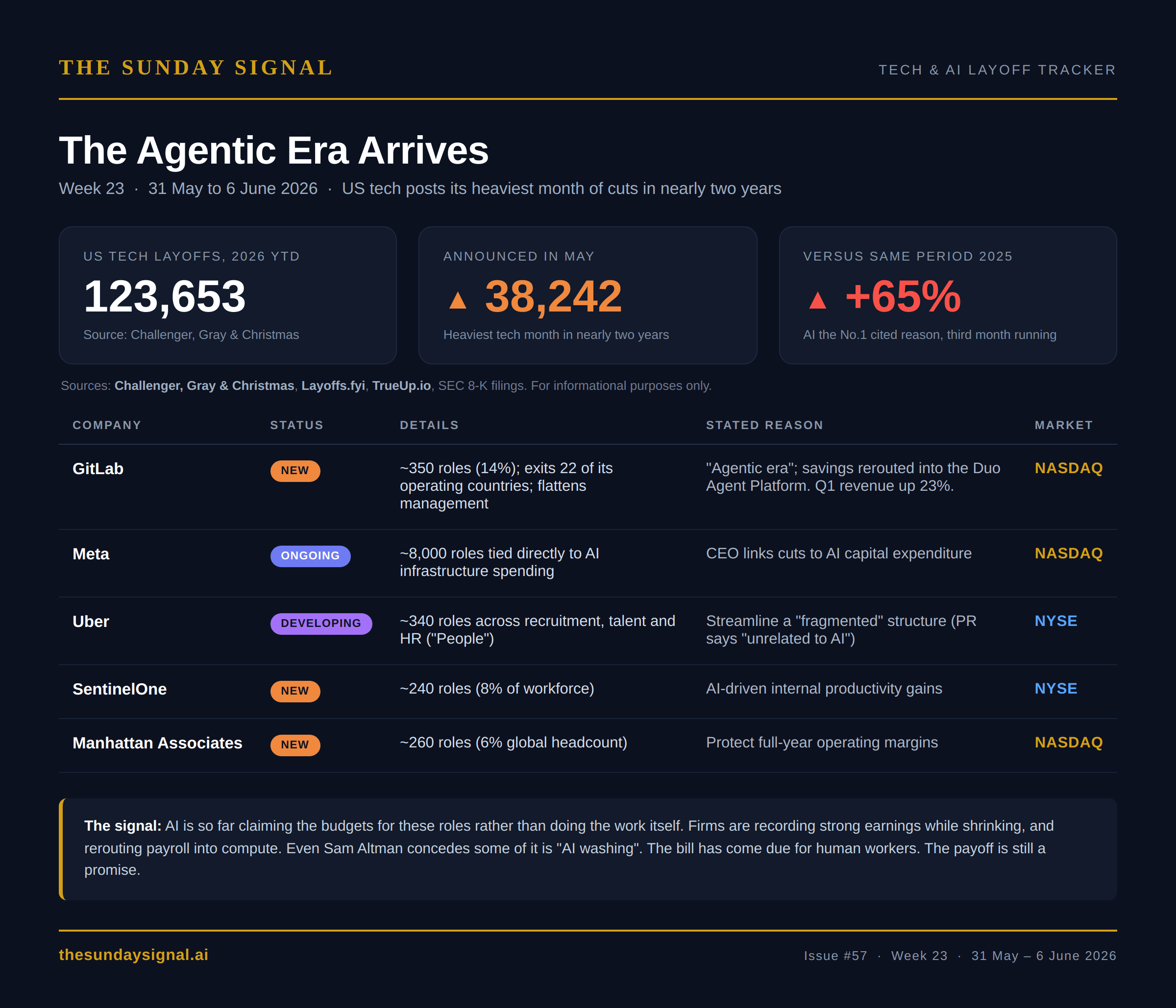
The macro picture hardened this week, and the official numbers are now starker than any single company’s announcement. According to Challenger, Gray and Christmas, US technology employers cut 38,242 jobs in May, the sector’s heaviest month in nearly two years, lifting its 2026 running total to 123,653, up more than sixty-five per cent on the same stretch last year. For the third month in a row, AI was the most-cited reason for layoffs across every sector. Andy Challenger’s verdict was blunt: AI is now the leading reason companies give for cutting jobs.
The emblem of the week was GitLab. The all-remote pioneer filed to cut about fourteen per cent of its workforce, roughly three hundred and fifty roles, while exiting twenty-two of the countries it operates in and flattening layers of management. Chief executive Bill Staples pinned it explicitly on the “agentic era” and the company’s Duo Agent Platform. What makes it the perfect case study is the accompanying earnings: first-quarter revenue up twenty-three per cent. This was not a distress cut. It was a deliberate redirection of payroll into compute.
Which is exactly why the “AI laundering” story is now mainstream. The pattern is no longer disputed even by the optimists. Sam Altman has conceded that some firms practise “AI washing,” blaming the technology for cuts they would have made anyway. And the most telling line comes from Challenger’s own data: AI is so far claiming the budgets for these roles rather than doing the work itself. The money once spent on people is being rerouted to GPUs in the hope the machines deliver. When Meta ties roughly eight thousand cuts directly to its AI infrastructure spending, and the big four hyperscalers plan some seven hundred and twenty-five billion dollars of capital expenditure this year, you are watching a wager, not a productivity gain. The bill has come due for human workers. The payoff is still a promise.
Final Thought 🚀
Britain is not a country that lacks invention. We built the lab the rest of the world feared, and we sit on the richest health dataset on earth. The thing we lack is the nerve to keep what we make.
We sold DeepMind for the price of a footballer. We are being talked into renting out our data to the people who already own our best AI. And when something brilliant does survive contact with the system, it waits seventeen years for permission to help anyone.
The machines will not save us from this. The flaw was never in the technology. It is in us, and no model has ever been written that can fix that.
Until next Sunday, David Richards MBE
Your argument that the Deepmind sale was for too little or shouldn't have happened at all assumes that Deepmind could have been a success on its own (remember that it had no products and no revenues when it was sold) and neglects the billions Alphabet has poured into Deepmind and the UK AI ecosystem since the acquisition. Deepmind is a jewel *because* Alphabet had supported it so fullsomely, not despite that.